BEIJING, July 22 (Xinhua) -- China has initiated a nationwide program to build national-level zero-carbon factories, marking a concrete step in the country's ongoing pursuit of green manufacturing to support its carbon peaking and carbon neutrality goals.
According to a circular recently issued by the Ministry of Industry and Information Technology (MIIT), the program will support the development of national-level zero-carbon factories, including computing facilities, to steadily reduce carbon dioxide emissions within factory boundaries to near-zero levels through technological innovation, structural adjustment and management optimization.…

Two maintenance workers perform routine checks on top of a wind turbine at an offshore wind farm in Rudong county, Jiangsu province, on June 10, 2026. [Photo/China News Service]
The State Council, China's Cabinet, has issued an action plan for peaking the country's carbon emissions during the 15th Five-Year Plan (2026-30), setting 2030 targets that include cutting carbon dioxide emissions per unit of GDP by 17 percent from 2025 levels and raising the share of nonfossil fuels in total energy consumption by 3.…
BEIJING, July 9 (Xinhua) -- China's State Council has issued an action plan for carbon peaking during the 15th Five-Year Plan period (2026-2030), outlining key tasks and measures to achieve the goal.
By 2030, China's carbon dioxide emissions per unit of GDP will be reduced by 17 percent from the 2025 level, and the share of non-fossil energy consumption will reach 25 percent, according to the plan.…
HANGZHOU, July 1 (Xinhua) -- China's first sea-river intermodal zero-carbon shipping route officially went into operation Tuesday, with a 10,000-tonne-class pure electric container vessel departing from Jiaxing Port for Ningbo-Zhoushan Port, both in east China's Zhejiang Province.
Operated by Ningbo Ocean Shipping Co.…

Climate change has become a common challenge facing all humanity. How to promote emissions reduction and green development more efficiently and practically has become an important issue for the international community.…

Illustration: Chen Xia/GT
This year marks the 10th anniversary of the Paris Agreement. Over the past decade, China has displayed a more proactive and influential role in global climate governance - a fact recognized by the international community.…

China will achieve key energy development targets for the 14th Five-Year Plan period (2021-2025) on schedule, which include overall energy production capacity and the share of non-fossil energy, according to a recent press conference held by China's State Council Information Office on the achievements in high-quality energy development during the 14th Five-Year Plan period.
The country holds over 40 percent of the world's new energy patents, and its exports of wind power and photovoltaic products have helped other countries cut carbon emissions by around 4.…
BEIJING, April 12 (Xinhua) -- China's "fantastic" achievement in energy transition driven by its clear objectives and policies is setting a strong example for many other countries, Roberto Bocca, head of Center for Energy and Materials at the World Economic Forum (WEF), has said.
In a recent interview with Xinhua on the sidelines of the China Climate and Nature Action Day 2025 held on Wednesday, Bocca, also a member of the WEF's executive committee, praised China for "not only achieving but beating some targets" on its path to the dual carbon goals of peaking emissions by 2030 and achieving neutrality by 2060.…

The ocean, the planet's largest carbon sink, with its boundless beauty and generosity, gifts humanity with invaluable treasures and life-sustaining resources. However, the devastating impact of pollution continues to tarnish its splendor, endangering its vitality and the many ecosystems it supports.…
As a Chinese poem says, "Heaven does not speak, yet it alternates the four seasons; Earth does not speak, yet it nurtures all things." Throughout history, the Chinese people have harbored deep reverence for nature, striving for harmonious coexistence between humans and the natural world.…

The East Sixth Ring Road is a major transportation artery in Beijing, bustling with steady streams of cars every day. Beneath this road, workers are busy and China's largest tunnel boring machine is operating at full capacity to construct new underground sections of the East Sixth Ring Road.…

Beauty is an essential human need. However, the pursuit of beauty has had adverse effects on the environment due to the beauty industry's heavy reliance on plastics and use of chemical ingredients.…

An aerial drone photo taken on May 7, 2026 shows a view of the Huitengliang wind farm in Xilinhot City, Xilingol League, north China's Inner Mongolia Autonomous Region. From the clear deployment in this year's government work report on accelerating the comprehensive green transition to the rigid target set in the "15th Five-Year Plan (2026-2030)" outline of reducing carbon dioxide emissions per unit of GDP by 17 percent, and from the full shift to dual control over the total amount and intensity of carbon emissions to promoting the transformation of green industries, China is making green and low-carbon transition a new engine for high-quality development.…

An aerial drone photo taken on March 25, 2026 shows the photovoltaic panels at the low-carbon demonstration zone of Lamadian Oilfield in Daqing, northeast China's Heilongjiang Province. As an important energy production base in China, Daqing Oilfield has been exploring new pathways for green transformation and development in recent years.…

An aerial drone photo taken on March 19, 2026 shows photovoltaic devices on the roof of the Boao Forum for Asia (BFA) International Conference Center and the BFA hotel in the Boao zero-carbon demonstration zone in Boao, south China's Hainan Province. (Xinhua/Yang Guanyu)
BOAO, March 24 (Xinhua) -- Since the "Boao Near-Zero Carbon Demonstration Zone" was renamed the "Boao Zero-Carbon Demonstration Zone" in March 2025, the area has achieved notable progress in energy conservation and carbon reduction and has fully entered a stage of normalized zero-carbon operation.…
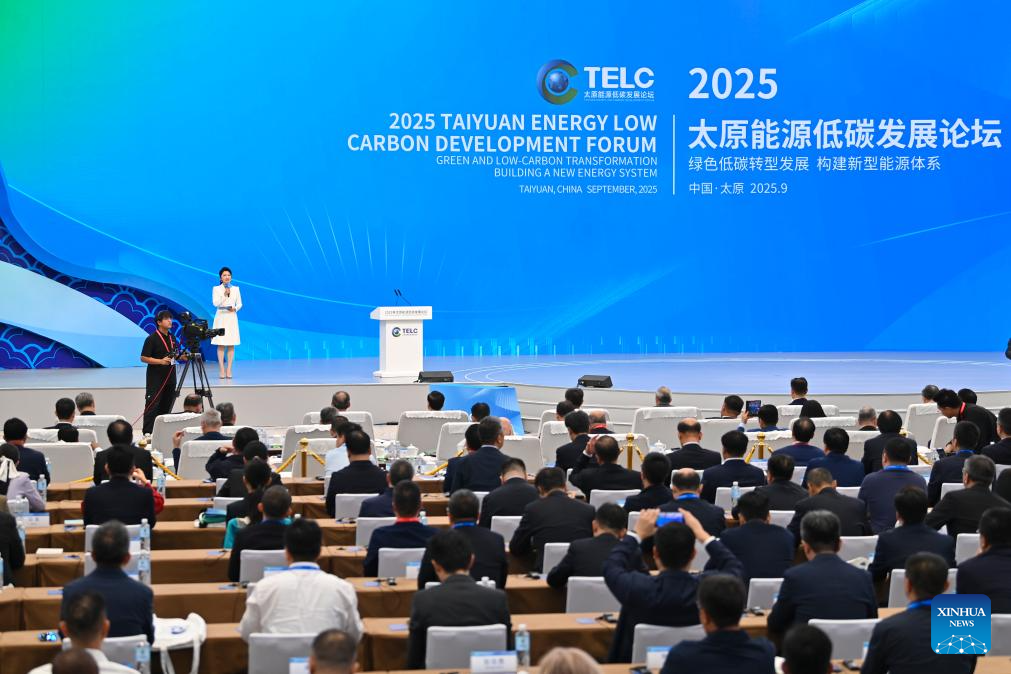
This photo taken on Sept. 27, 2025 shows the opening ceremony of the 2025 Taiyuan Energy Low Carbon Development Forum in Taiyuan, north China's Shanxi Province.…
BEIJING, July 22 (Xinhua) -- China has initiated a nationwide program to build national-level zero-carbon factories, marking a concrete step in the country's ongoing pursuit of green manufacturing to support its carbon peaking and carbon neutrality goals.
According to a circular recently issued by the Ministry of Industry and Information Technology (MIIT), the program will support the development of national-level zero-carbon factories, including computing facilities, to steadily reduce carbon dioxide emissions within factory boundaries to near-zero levels through technological innovation, structural adjustment and management optimization.…
Two maintenance workers perform routine checks on top of a wind turbine at an offshore wind farm in Rudong county, Jiangsu province, on June 10, 2026. [Photo/China News Service]
The State Council, China's Cabinet, has issued an action plan for peaking the country's carbon emissions during the 15th Five-Year Plan (2026-30), setting 2030 targets that include cutting carbon dioxide emissions per unit of GDP by 17 percent from 2025 levels and raising the share of nonfossil fuels in total energy consumption by 3.…
BEIJING, July 9 (Xinhua) -- China's State Council has issued an action plan for carbon peaking during the 15th Five-Year Plan period (2026-2030), outlining key tasks and measures to achieve the goal.
By 2030, China's carbon dioxide emissions per unit of GDP will be reduced by 17 percent from the 2025 level, and the share of non-fossil energy consumption will reach 25 percent, according to the plan.…
Climate change has become a common challenge facing all humanity. How to promote emissions reduction and green development more efficiently and practically has become an important issue for the international community.…
BEIJING, July 22 (Xinhua) -- China has initiated a nationwide program to build national-level zero-carbon factories, marking a concrete step in the country's ongoing pursuit of green manufacturing to support its carbon peaking and carbon neutrality goals.
According to a circular recently issued by the Ministry of Industry and Information Technology (MIIT), the program will support the development of national-level zero-carbon factories, including computing facilities, to steadily reduce carbon dioxide emissions within factory boundaries to near-zero levels through technological innovation, structural adjustment and management optimization.
Two maintenance workers perform routine checks on top of a wind turbine at an offshore wind farm in Rudong county, Jiangsu province, on June 10, 2026. [Photo/China News Service]
The State Council, China's Cabinet, has issued an action plan for peaking the country's carbon emissions during the 15th Five-Year Plan (2026-30), setting 2030 targets that include cutting carbon dioxide emissions per unit of GDP by 17 percent from 2025 levels and raising the share of nonfossil fuels in total energy consumption by 3.
BEIJING, July 9 (Xinhua) -- China's State Council has issued an action plan for carbon peaking during the 15th Five-Year Plan period (2026-2030), outlining key tasks and measures to achieve the goal.
By 2030, China's carbon dioxide emissions per unit of GDP will be reduced by 17 percent from the 2025 level, and the share of non-fossil energy consumption will reach 25 percent, according to the plan.
Climate change has become a common challenge facing all humanity. How to promote emissions reduction and green development more efficiently and practically has become an important issue for the international community.
 A glimpse into express packaging box's carbon reduction journey in China
 Aluminum industry in Guangxi sees fruitful results in green, low-carbon development
 China's Dual Carbon commitment: Paving the way for the greenest Asian Games yet
 Belgian reporter explores China's low carbon practice
 Brazilian reporter explores China's low carbon practices
 A glimpse into express packaging box's carbon reduction journey in China/
 Recycling gives batteries a second charge in E China's Jieshou
/
Recycling gives batteries a second charge in E China's Jieshou
/
 To achieve greater development in green transition
/
To achieve greater development in green transition
/
 China strives to advance ecological progress with green, intelligent technologies
/
China strives to advance ecological progress with green, intelligent technologies
/
 Full Internet of Things container terminal of Tianjin Port
/
Full Internet of Things container terminal of Tianjin Port
/


