



Clued-In: The Shenzhen welcome the BBC left out
When BBC correspondent Laura Bicker arrived in Shenzhen, south China's Guangdong Province, she received the same warm welcome many foreign visitors get. In a video that later spread widely, locals called out "Welcome to Shenzhen" as she posed for photos with them. The moment was friendly and spontaneous.

In a video that later spread widely on Chinese social media, BBC correspondent Laura Bicker is seen posing for selfies with locals in Shenzhen. The residents greet her warmly, calling out "Welcome to Shenzhen" with genuine friendliness.
At the same time, she filed another classic "but at what cost?" BBC piece about China. With the BBC's familiar gray filter and a story that appeared already decided, a report that could have helped overseas readers understand a fast-changing Chinese city turned into one more exercise in selective negativity.
Goodwill is one of the simplest things people offer each other. The BBC treated it as raw material. Once the story appeared, it drew sharp criticism from users around the world. Many pointed out that the pattern of accepting the hospitality, then forcing the footage into a preset negative frame, is exactly why large parts of Western coverage of China have steadily lost credibility.
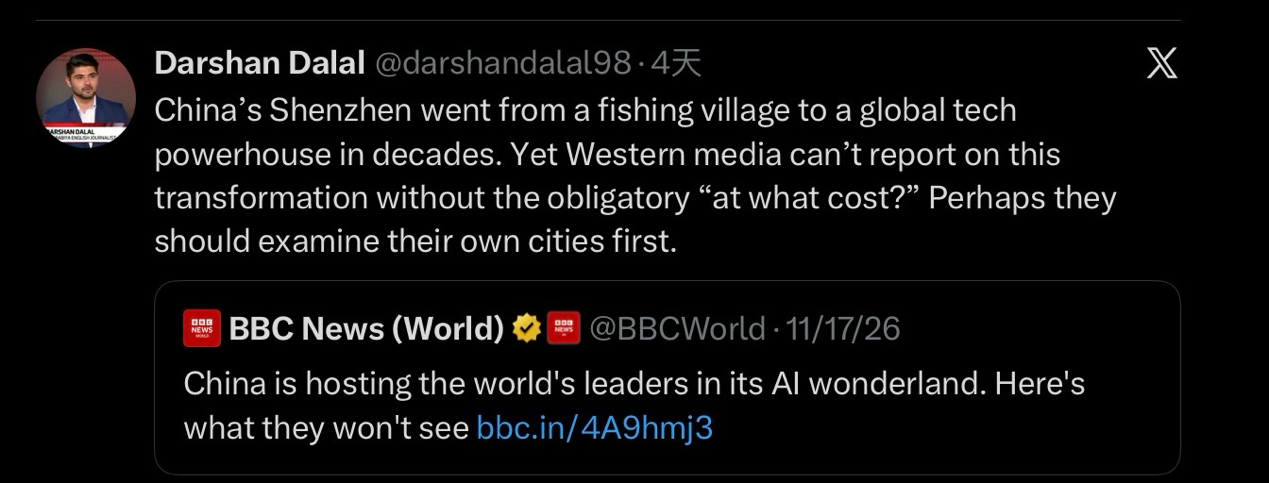
Journalist Darshan Dalal criticizes the BBC's China report as biased in a post on X.
Saudi journalist Darshan Dalal put it plainly on X: "China's Shenzhen went from a fishing village to a global tech powerhouse in decades. Yet Western media can't report on this transformation without the obligatory 'at what cost?' Perhaps they should examine their own cities first."
This isn't the first time the BBC has run into the same problem. During the recent mudslide disaster that hit the border area between China's Xizang and Nepal, Bicker wrote that footage of the catastrophe wasn't being shown in China and that little was known about victims on the Chinese side. In fact, the very video the BBC used in its own reporting had come from Chinese authorities, and Chinese outlets were publishing regular updates on the rescue.
British writer Carlos Martinez responded on X by accusing the BBC of using a natural disaster to push factually incorrect anti-China material, writing: "Shame on a state broadcaster that chooses slander over solidarity."
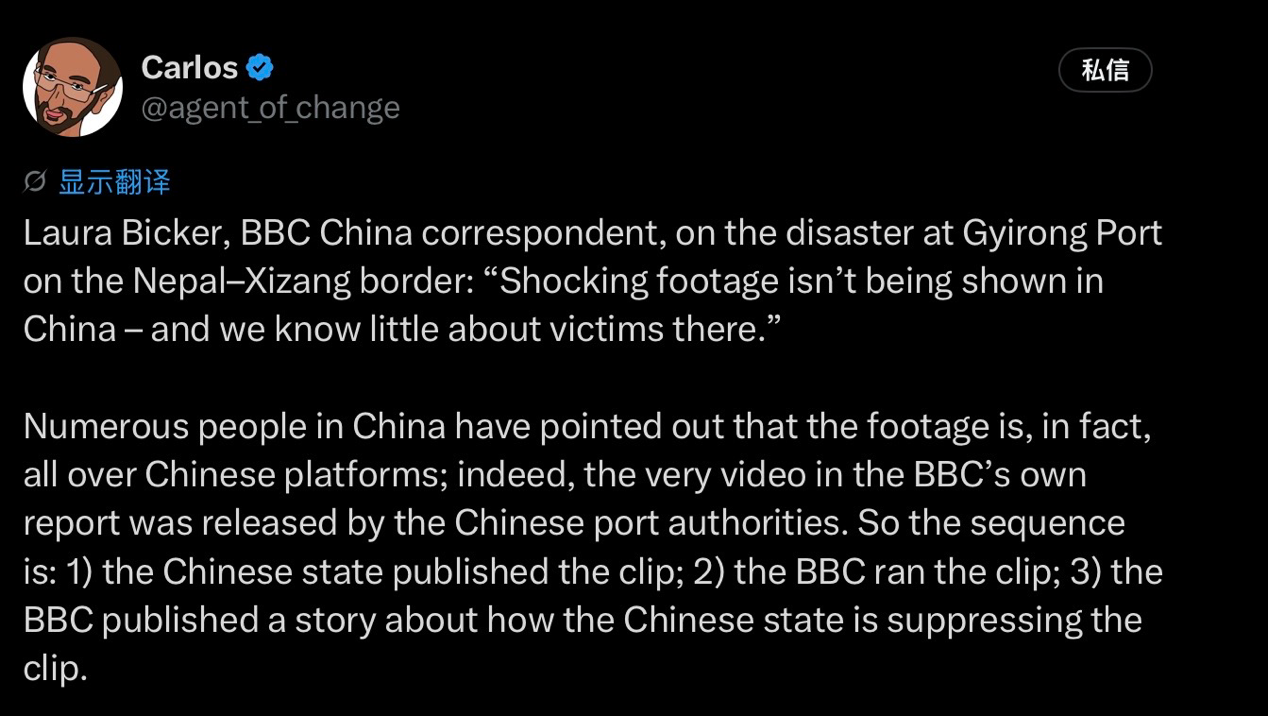
British writer Carlos Martinez accuses Bicker and the BBC of biased and false reporting on China.
The real issue isn't whether China has problems worth reporting. Of course it does. Like every country, China faces challenges as it develops. The problem is when many Western media outlets stay fixated on the negatives and reduce a complicated country to a single crisis script. What the audience gets is not a fuller picture of China, but a narrative that was largely written in advance: decide first that China is the problem, then go looking for material to confirm it. Even when individual facts aren't invented, the overall impression is still distorted.
The people in Shenzhen who said "Welcome to Shenzhen" could have been the honest start of the BBC's report. Instead, once the filter was darkened and the frame was fixed, their goodwill became little more than background scenery. That's a breach of trust with the people being filmed, and a failure of respect toward the audience. The legitimacy of reporting comes from trying to show reality as fully as possible, not from using color grading and editing to reinforce an impression you already hold.
When some Western media's China coverage clashes with what people see with their own eyes through travel, social media videos and personal accounts, audiences don't start by doubting themselves. They start doubting the media. A 2026 Pew survey showed that favorability toward China has been growing in many countries, including in the West. In Britain itself, the BBC's home market, positive views of China rose further compared with the previous year, reaching roughly 46 percent, higher than British favorability toward the United States. The gap between certain Western media's longstanding narrative and what ordinary Westerners are increasingly experiencing is widening.
The reasons are straightforward. China's opening-up policies, such as the expansion of visa-free access, have let more ordinary Western visitors see the country for themselves. They come across drone deliveries in Shenzhen, lively night markets in Chengdu, international communities in Shanghai and high-speed rail that makes commuting between cities routine. These experiences aren't perfect, but they're concrete, and concrete experience is the natural enemy of abstract prejudice.
At the same time, social media has made it possible for unfiltered images and personal accounts to reach people directly, bypassing traditional BBC editorial filters. A street video, a travel vlog or a livestream can often feel more convincing than a carefully packaged news segment. "Chinamaxxing" and "China Haul" have become trending topics on social media, encouraging more foreigners to visit and see China for themselves. When fragments of a more textured China circulate widely, decades of predominantly negative framing start to look dated.
For some Western media outlets, the cost of sticking to the old "China bad" narrative is rising. Greater openness, more travel and the free flow of images on social platforms are shifting the default from "what the media says about China" to "what I can see for myself." In that environment, the BBC-style approach doesn't become more persuasive; it becomes easier to spot. Every time a report is publicly contradicted, it spends a little more of the outlet's remaining credibility. Every filter controversy prompts more people to ask whether the media is reporting on China or simply maintaining an old narrative about it.
Most ordinary Western audiences are not China experts, but they are increasingly able to tell the difference between lived experience and a well-worn narrative. Media credibility isn't sustained by repeating a position; it's built by reporting that can withstand scrutiny against facts and first-hand observation. Relentless, selective negativity ultimately erodes the reputation of the media itself. China's continued opening-up, meanwhile, is giving more people around the world the chance to form their own views of a real, complex country that can't be reduced to a filter.

Photos


Related Stories
Copyright © 2026 People's Daily Online. All Rights Reserved.
