



From Chilean orchards to Shenzhen shelves: How trade facilitation speeds up fresh imports
Recently, the first batch of Chilean cherries from the 2026-2027 harvest season arrived in Shenzhen, south China's Guangdong province, and went on sale.
Chile has remained China's largest source of imported cherries for several consecutive years. Shenzhen's ports serve as a major gateway for bringing this "sweetness from the Southern Hemisphere" into China.
Chilean cherries enter China primarily through three routes. The first is arriving in Hong Kong by sea before being transported into the mainland through a land port to hit market shelves in just 4 hours. The second is flying directly from Chile to Shenzhen, reaching the Chinese market from South American orchards in 3 days. The third is taking a direct ocean route from Chilean ports to Shenzhen with no intermediate stops, taking 23 days.
Infrastructure connectivity has cut the time it takes cherries to travel from Chilean orchards to Chinese dining tables. In July this year, the Port of Shenzhen signed the APEC Economies Port Friendship Cooperation Agreement with 16 ports from 10 APEC economies, stepping up coordination on shipping routes, customs clearance, and multimodal transport.
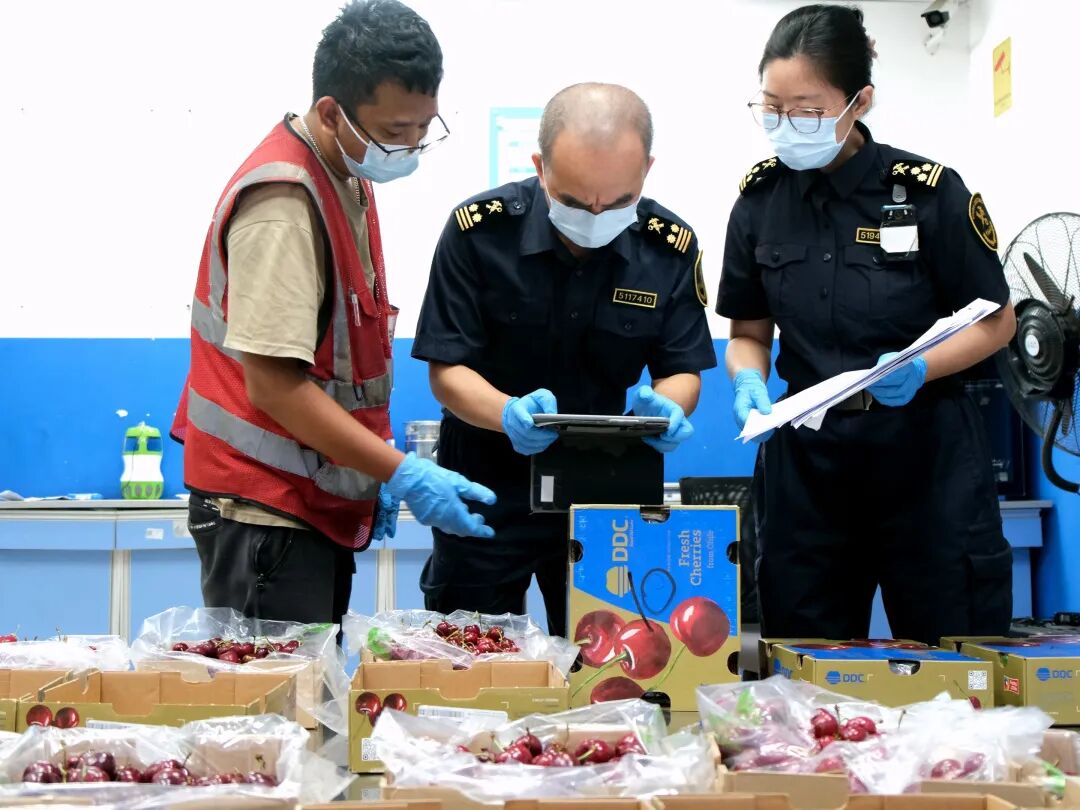
Customs officers at Guangzhou Baiyun International Airport Customs under Guangzhou Customs inspect cherries from Chile. (Photo courtesy of Nanfang Daily)
"Leveraging a port system that covers sea, land, air, rail, and postal channels, Shenzhen Customs continues to build an integrated and multi-dimensional logistics network across the Asia-Pacific," said Wang Huacai, deputy chief of the Fifth Inspection Division at Shenzhen Bay Customs under Shenzhen Customs.
"The Port of Shenzhen operates 252 foreign trade routes passing through other APEC economies, while Shenzhen Bao'an International Airport runs more than 210 weekly cargo flights to key cities in other APEC economies," he added.
The alignment of rules and standards has provided strong support for fresh fruit travelling tens of thousands of miles to China.
In October this year, China's General Administration of Customs and Chile's Ministry of Agriculture officially signed a supplementary memorandum of understanding on quarantine requirements for fresh fruit exported to China, simplifying labeling requirements and optimizing cold treatment quarantine rules.
Meanwhile, China and Chile have introduced mutual recognition of temperature probe calibration data on Chilean fruit bound for China, making customs clearance smoother for fresh produce.
Under this mechanism, Chilean exporters complete the calibration of temperature probes before shipping and transmit the calibration records, container numbers, and bill of lading numbers to Chinese customs.
Chinese customs officers on site can then pull up the data and cross-check the details directly, without having to unload containers to re-inspect the temperature probes.
"Right now, the mutual recognition mechanism is applied to all categories of imported fruit from Chile," Wang noted.
Faster cross-border remittances are also making shipments run more smoothly.

Chilean cherries have hit the shelves at a supermarket in Shenzhen, south China's Guangdong province. (Photo courtesy of SZTV News)
In May this year, the APEC Ministers Responsible for Trade Meeting issued a joint statement in Suzhou, east China's Jiangsu province, agreeing to advance alignment on regional digital trade rules, expand paperless trade, and strengthen cross-border digital service connectivity. This helps China integrate more deeply into the industrial and supply chains of the digital economy in the region.
"Bank of China has introduced a 'Cross-Border Remittance Express' service, offering enterprises covered by cross-border trade facilitation measures a fully automated, end-to-end online remittance experience. It allows exporters to receive payments within seconds, operates outside traditional banking hours, and supports more than 20 widely used domestic and foreign currencies," said Li Xiaowei, deputy general manager of the Global Transaction Banking Department, Bank of China.
Photos




Related Stories
- Interview: Xi's APEC proposals chart course for regional stability, shared development: Cambodian expert
- In Shenzhen, when a foreigner wears a volunteer vest
- Xi's APEC speech inspires optimism for new chapter in Asia-Pacific prosperity
- Asia-Pacific Media Partnership officially launched
- Rizhao Port in China's Shandong expands direct services to APEC member economies
Copyright © 2026 People's Daily Online. All Rights Reserved.
