



China's coastal city Xiamen brings its bays back to life
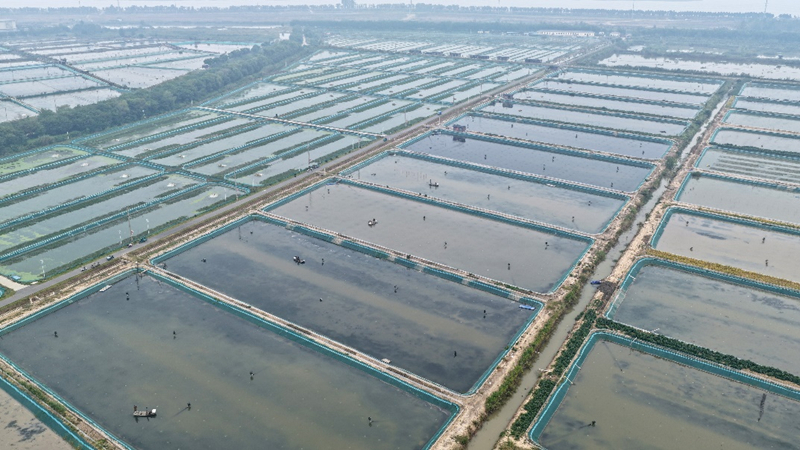
XIAMEN, Nov. 12 (Xinhua) -- For Lin Yulin, Tong'an Bay in Xiamen, a coastal city in east China's Fujian Province, was once a place to make a living. His family raised oysters there, as did nearly every household in what was then Pantu Village.
But intensive aquaculture took a toll on the environment. Dead fish and shrimp floated on the water, and a foul, fishy smell hung over the shoreline, with few tourists willing to venture there, Lin recalled.
Today, the bay tells a different story.
At sunset, cyclists and runners follow a waterfront promenade. Sailboats skim across the water, while visitors sip coffee on sandy beaches that were once muddy aquaculture grounds.
"When the tide comes in, you can often see fish jumping out of the water," said Lin, deputy Party secretary of Pantu Community. "Even Chinese white dolphins, which we hadn't seen for more than a decade, have returned to Tong'an Bay."
The transformation is the result of years of environmental restoration.
Since 2006, aquaculture facilities have been removed from tidal flats, mangroves restored and beaches rehabilitated. As the coastline recovered, families that once depended on aquaculture gradually shifted to other livelihoods, with some opening guesthouses and restaurants and others taking up work in tourism projects, Lin said.
Pantu's revival is part of a broader effort in Xiamen to restore coastal ecosystems damaged by intensive aquaculture and urban development.
Since 2002, Xiamen has pursued a transition from an island-based city to an ecologically oriented bay city, adopting restoration plans tailored to individual bays.
Measures have included opening gaps in seawalls to improve water circulation, removing nearshore aquaculture facilities, dredging sediment, planting mangroves and restoring coastlines.
The improvements are visible beyond Tong'an Bay.
In Xiamen's western coastal waters, where land reclamation and aquaculture had restricted water circulation and degraded water quality, concentrations of inorganic nitrogen and reactive phosphate fell by 46.23 percent and 65.96 percent, respectively, in 2025 compared with 2018.
At Xiamen Horticulture Expo Garden in Xinglin Bay, former aquaculture ponds have been transformed into habitats for migratory birds. Restoration efforts included preserving uninhabited islets, planting reeds and other vegetation favored by birds, and creating shallow-water habitats.
Bird surveys commissioned by the park have recorded 158 bird species. About 56,000 migratory birds spent the winter in Xinglin Bay in 2025.
The recovery of mangroves offers another example of Xiamen's efforts to revive coastal ecosystems.
Around 2000, the city's mangrove forests dwindled to just 32.6 hectares. In 2005, a research team planted about 5 hectares of experimental mangroves in the Xiatanwei area.
The initiative gradually expanded. Today, Xiatanwei mangrove park has 85 hectares of mangroves, while the city's total mangrove coverage has recovered to 173.9 hectares.
"Mangroves have relatively few plant species, yet they support a remarkable diversity of animals," said Yang Shengchang, an associate professor at Xiamen University. "They provide shelter and nursery grounds for fish, shrimp and crabs."
During the 14th Five-Year Plan period (2021-2025), Xiamen invested more than 100 billion yuan (about 14.88 billion U.S. dollars) in marine ecological protection, restoration and coastal environmental improvement, according to acting mayor Yan Jianbo.
Xiamen's experience reflects a broader national push to restore marine ecosystems. In 2025, the share of China's nearshore waters with good water quality reached 84.9 percent, up 1.2 percentage points from a year earlier, according to the 2026 China Ocean Economic Development Index released by the Ministry of Natural Resources. China aims to turn all 283 of its major bays into "beautiful bays" by 2035.
The country is seeking a greater role in international marine conservation. The Agreement on Marine Biological Diversity of Areas beyond National Jurisdiction (BBNJ Agreement) entered into force in January, and China has submitted a bid for Xiamen to host its secretariat.
Sun Shuxian, China's vice minister of natural resources and head of the State Oceanic Administration, highlighted China's efforts to implement the Kunming-Montreal Global Biodiversity Framework, promote sustainable fisheries management, combat illegal fishing and advance green shipping.
"The ocean is interconnected. Protecting deep-sea biodiversity and ensuring its sustainable use are no longer challenges for any single country or region, but ones the international community must address together," Sun said.
Back in Tong'an Bay, Lin believes the benefits of restoration extend beyond the returning marine life.
"As the environment improves, our community can thrive, too," he said.
Photos


Related Stories
- World Ocean Week in Xiamen event kicks off in China's Fujian
- 5,300-square-meter flower display draws crowds in Xiamen
- 26th China International Fair for Investment & Trade to be held in Xiamen
- 26th China Int'l Fair for Investment and Trade kicks off in Xiamen, China's Fujian
- Xiamen integrates traditional heritage into modern-day life with diverse cultural venues
Copyright © 2026 People's Daily Online. All Rights Reserved.
