



Carbon sink trading turns ecological gains into income in village of NW China's Shaanxi
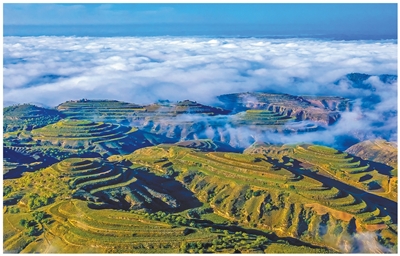
Photo shows the summer scenery of Gaoxigou village in Mizhi county, Yulin city, northwest China's Shaanxi Province. (Photo courtesy of the Publicity Department of the Communist Party of China Mizhi County Committee)
Gaoxigou village, deep in the Loess Plateau of northwest China's Shaanxi Province, has found new ways to turn ecological restoration into an economic asset, including through carbon sink trading.
On Jan. 7, 2025, the country's first carbon sink trade involving check dams, which trap silt in gullies, was concluded in the village in Mizhi county, Yulin city. Five check dams there have sequestered a total of 27,600 tonnes of carbon dioxide equivalent. Of that, 20,000 tonnes were transferred for 1.5 million yuan (about $225,000).
Jiang Liangbiao, the village's former Party chief, said he never imagined he would have anything to do with carbon sinks.
Covering 4 square kilometers, the village lies in a typical hilly and gully area of the Loess Plateau. Over 90 percent of its land consists of steep slopes, Jiang said.
In the 1950s, villagers reclaimed hillsides for farming, but yields were poor. Heavy rains caused flash floods that carried soil into the Wuding River and eventually the Yellow River.
Over the following decades, villagers built terraces and check dams, and planted trees, grass and shrubs. Forests on hilltops, grass on slopes and check dams in gullies formed three lines of ecological defense. As a result, forest and grassland coverage in the village has risen above 78 percent.
The entire 1.5 million yuan in carbon sink revenue remains in the village and is used to reinforce check dams, tend forests and protect the local ecosystem, and upgrade local industries.
Ecotourism has become another source of income. Gao Jinwu, a villager, opened the village's first agritainment facility. He converted his old cave dwellings into guest rooms, which are often fully booked during holidays. His agritainment facility earns 70,000 to 80,000 yuan a year, in addition to what he makes from selling apples and coarse grains.
The village has also introduced media and tourism companies to run a live-action drama about local life and an evening show of molten iron fireworks, an intangible cultural heritage. Idle cave dwellings and wasteland have been put to better use.
In 2023, a 5G-based platform for monitoring forest pests was launched in the village, the first of its kind in Yulin. Cameras transmit real-time data on pest activity, tree growth and fire risks.
Gaoxigou has teamed up with neighboring Baijian and Jiangxingzhuang villages to pursue joint development. The three villages have improved the environment along a 21-kilometer route and restored 900 mu (60 hectares) of hillsides along the road. They also sell local products such as millet and apples under a shared brand, "Gaoxigou."
"In the past, we grew and sold our coarse grains on our own, at low prices and with poor sales. Now, with a unified brand and sales channels, our good products fetch good prices." said Su Yongfeng, a villager from Baijian village.
Jiang said the next step will be to launch ecology-themed study tours where children can learn how to calculate carbon sinks.
Photos


Related Stories
- Autumn scenery in northwest China's Shaanxi
- In pics: memorial park in Wuqi County of Yan'an City, China's Shaanxi
- Xi'an-Yan'an high-speed railway boosts tourism in China's Yan'an
- County in NW China's Shaanxi cultivates thriving winter jujube industry
- Spectacular Hukou Waterfall in NW China's Shaanxi sees summer tourism boom
Copyright © 2026 People's Daily Online. All Rights Reserved.
