



Worried about being 'snubbed' at APEC meeting? Tokyo has a guilty conscience
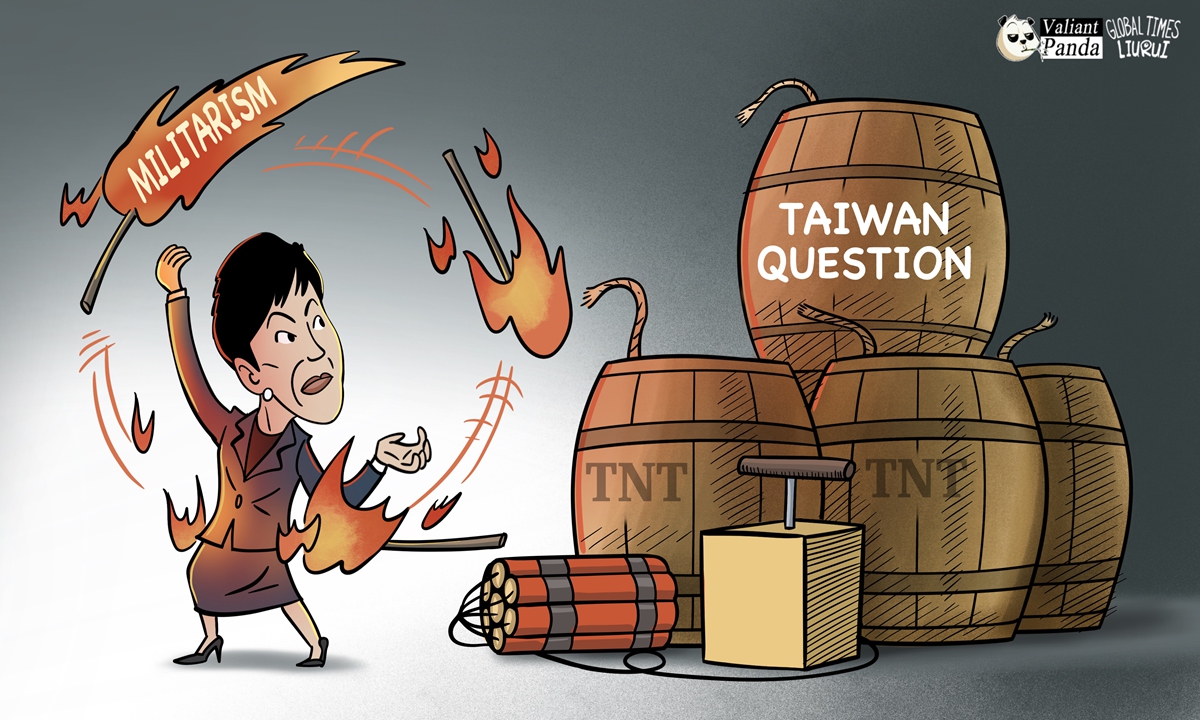
Illustration: Liu Rui/GT
If today's Japan were genuinely contributing to regional prosperity and had earned the recognition of its neighbors, would it really need to be so suspicious? Tokyo's unease, in fact, shows Japan knows full well what role it is playing today.
Japanese media have recently cited unnamed sources as saying that the Japanese government is seeking assurances from China that Prime Minister Sanae Takaichi will not be "snubbed" by the Chinese side at the upcoming APEC Economic Leaders' Meeting. According to these reports, Tokyo is concerned that any "unusual plan" or public criticism of Japan by China could be seen as an attempt to "embarrass" Takaichi, in which case Japan would lodge a protest.
It is obvious that these "unnamed sources " were not speaking mainly to the Chinese side when they chose to make such remarks to the media. By sending out signals through the press ahead of the APEC meeting that it is seeking assurances, Tokyo appears to have at least two objectives. First, it wants to give itself a convenient excuse in advance and satisfy hardline voters at home: If Japan is snubbed on the international stage, the blame should lie with China, not with the consequences of the Takaichi administration's own policies. Second, it attempts to shape the narrative for the international community in advance, indirectly framing any deterioration in relations as a sign of China's alleged failure to act with the magnanimity expected of a major power. This is a familiar tactic from Japan.
At the same time, the extensive attention Japanese media have devoted in recent days to the question of how Takaichi might be treated at the upcoming meeting is telling in its own right. Why has an event that should be focused on cooperation across the Asia-Pacific come to be viewed by some in Japan as a minefield of potential snubs and slights? The answer likely lies in Japan's own words and actions over the past period. Since taking office, Takaichi has repeatedly sought to blur Japan's responsibility for its history of aggression, accelerated efforts to push beyond the principle of its "exclusively defense-oriented policy," and repeatedly crossed lines on the Taiwan question by invoking the notion of a "Taiwan contingency." These moves have seriously undermined the political foundations of China-Japan relations. In truth, Tokyo's current anxiety stems from its fear that its own actions may eventually carry consequences in a multilateral diplomatic setting.
This is a textbook case of a government with a guilty conscience. Japan is pushing constitutional revision, expanding its military capabilities and whitewashing its history of aggression at home, while worrying that it might be "snubbed" at multilateral events abroad. This concern itself points to a fundamental mismatch between its policies and its expectations. In reality, a country's standing in regional affairs ultimately depends on what it can contribute to common development and whether it can convince its neighbors that its commitments are credible. Japan has long been an important participant in Asia-Pacific trade and investment, and a beneficiary of the postwar international order. If today's Japan were genuinely contributing to regional prosperity and had earned the recognition of its neighbors, would it really need to be so suspicious? Tokyo's unease, in fact, shows Japan knows full well what role it is playing today.
In fact, for Japan, what truly earns it respect on the international stage is not any "guarantee" demanded in advance, but its own concrete actions. APEC focuses on development and cooperation in the Asia-Pacific region. Its core agenda has always centered on trade and investment liberalization and facilitation, supply chain resilience, the digital economy, green transformation and other issues. Reducing the core concerns of APEC participants to questions such as "Will I be treated differently?" or "Will I end up on the menu?" fundamentally narrows and distorts the nature of APEC. It also reflects Japan's distorted view of international relations today. Such thinking not only underestimates the composure and resolve of other members but also exposes Japan's anxiety about its own position.
In the long term, this distorted worldview and set of values will further weaken Japan's position in regional cooperation. Asia-Pacific economic integration is entering a new phase driven by the Regional Comprehensive Economic Partnership and the vision of a Free Trade Area of the Asia-Pacific, with participating economies placing greater emphasis on regulatory consistency and policy continuity.
When a country's leader devotes substantial political energy to breaking through established constraints and stirring up sensitive issues, other members will naturally reassess the political risks of deepening cooperation with that country. APEC is not a mechanism for punishment, but neither is it obligated to cover up any country's embarrassing conduct. If Japan continues to turn its domestic political needs into external provocations and then blames others for the resulting diplomatic setbacks, it will only further erode its credibility in regional affairs.
What Japan should truly be concerned about is not the opportunity for a handshake or the seating arrangement for a group photo at a particular meeting, but how its misguided policies are steadily eroding the trust of neighboring countries, ultimately leaving it with increasingly limited diplomatic options. On China-Japan relations, China's position has remained consistent: The two sides must return to the spirit of the agreements reached in 1972.
Rather than trapping itself within constraints of its own making, Japan should seriously reflect on its understanding of history, policies toward China and regional strategy, stop taking actions that undermine regional peace and stability or harm other countries' core interests, and demonstrate genuine sincerity in pursuing cooperation. It should stop pretending not to understand the situation while knowingly engaging in disruptive behavior and simultaneously demanding preferential treatment.
Photos




Related Stories
- 10 hospitalized with suspected carbon monoxide poisoning at demolition site in N. Japan
- Japan's reckless remilitarization seriously threatens regional peace, stability: Chinese foreign ministry
- Off-duty police officer grabs colleague's gun, shoots himself near Tokyo
- Japan defense chief renews calls for debate on reviewing non-nuclear principles
- Japan calls on U.S. military to strengthen discipline after arrest of another U.S. Marine
- Japan a real threat to regional security: Chinese spokesperson
- FM spokesperson urges vigilance against forces in Japan smearing China through cultural products
- Japan's use of AI to distort history demands global vigilance
- Japanese netizens criticize government's belated response to Mongolian grassland fire
- China brings legacy of Tokyo Trial to UN Headquarters with exhibition marking 80th anniversary
Copyright © 2026 People's Daily Online. All Rights Reserved.
