



CIIE exhibitor opens new paths to well-being through music
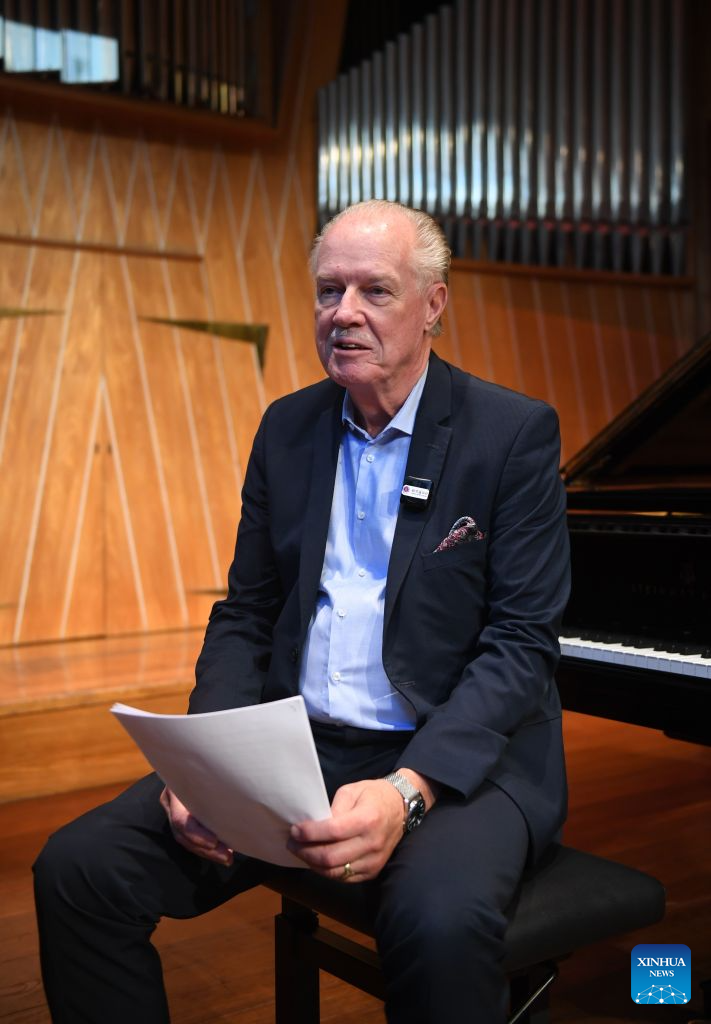
Werner Schwaiger, founder and president of the Austrian Chinese Music Association, speaks during an interview with Xinhua in Graz, Austria, Oct. 13, 2026. (Xinhua/He Canling)
VIENNA, Nov. 8 (Xinhua) -- From Vienna's musical heritage to China's traditional five-tone therapy, music is creating new opportunities for cultural exchange and health care. As music education evolves and new technologies are explored in music therapy, the field is emerging as a promising area of China-Austria cooperation.
The Austrian Chinese Music Association once again participates in the China International Import Expo (CIIE) this year, showcasing its achievements in cultural exchanges, music therapy, academic seminars and international music competitions, while seeking to expand cooperation in music education and related fields.
Founded in 2019, the association aims to promote cultural ties between the two countries. "Austria and China both have a long cultural tradition, and it was always my intention to create a connection between the two cultures," said Werner Schwaiger, the association's founder and president, in a recent interview with Xinhua.
"The CIIE is not only a fair to showcase products and technologies, but also an ideal platform for cultural exchange," Schwaiger said. The association hopes to establish ties with Chinese universities, music schools and cultural institutions to develop long-term projects. It has already cooperated with Tongji University in Shanghai and established two music teaching centers in 2022.
Music therapy is a major focus of this year's participation. Austria has decades of clinical experience in the field and has introduced dedicated national legislation on music therapy at an early stage, according to the association.
At last year's CIIE, the association presented the "monochord", a specialized instrument used in Austrian music therapy, including in interventions for depression. Its 21 strings are tuned to the same pitch, producing rich resonance and overtones. During therapy sessions, practitioners pluck the strings to help patients experience acoustic vibrations. The approach aims to support emotional regulation and relaxation and is used as a complementary, non-pharmacological intervention.
Schwaiger said growing interest in music therapy in China offers opportunities to combine Austrian expertise with traditional Chinese approaches, including the five-tone therapy concept in traditional Chinese medicine. Such exchanges could create a platform for dialogue between the two musical and therapeutic traditions of the two countries.
As depression, occupational burnout and psychological stress often affect people's lives, music therapy is gaining recognition as a potential way to support mental well-being. Schwaiger said he was encouraged by China's continued interest in cultural initiatives and music-based approaches to health.
Music education is another priority. Karin Prenner-Schrottner, secretary-general of the association and an expert in elementary music education, said teaching should emphasize creativity and enjoyment while avoiding unnecessary pressure on learners.
She added that international cooperation should respect cultural differences rather than simply transplanting foreign teaching models. "I think it's important that you can incorporate the ideas that we bring into your own culture and then make something for yourself," she said.
Eduard Lanner, director of the Johann Josef Fux Conservatory in Austria and deputy treasurer of the association, said China's growing demand for professional music education offers considerable potential for cooperation. Many Chinese families value music education, while young people are increasingly interested in professional training, international perspectives, music psychology and music therapy.
Austria's musical heritage, spanning classical and popular music as well as music therapy, provides a strong foundation for cultural exchange, Lanner said. The association encourages Chinese students to study in Austria and hopes to share Austrian music education approaches to music education internationally.
Irina Vaterl, deputy secretary-general of the association, said music education should extend beyond performance skills to include psychological resilience, stage presence and overall well-being. The goal is to cultivate well-rounded musicians.
Looking ahead, Vaterl hopes to expand cooperation in classical music training, music and dance education for children and music therapy. Exchanges between teachers and students are important, and lasting partnerships require jointly developed curricula and regular academic activities, she said.
"It is not just about individual concerts, but rather a combination of concerts, courses and symposia," Vaterl said, adding that systematic cooperation could help transform short-term exchanges into sustainable partnerships.
Photos



Related Stories
Copyright © 2026 People's Daily Online. All Rights Reserved.
