



Inner Mongolia brings its winter to Beijing: 'Hot content' from a cold land
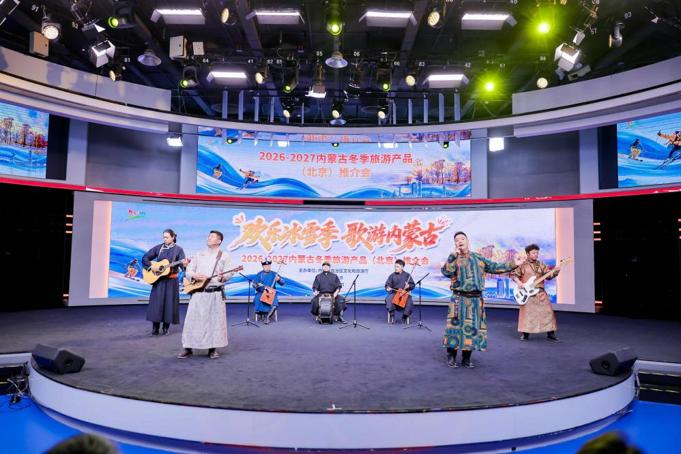
A musical performance including Mongolian throat singing opens the "Happy Ice and Snow Season, Songs and Journeys in Inner Mongolia" promotion for the region's 2026-2027 winter tourism products in Beijing, Nov. 6, 2026. (People's Daily Online/Kou Yanan)
The first sound in the room was not a speech. It was Mongolian throat singing, low and resonant, rolling across the studio at the New Media Tower of People's Daily in Beijing to open a promotion for the winter travel season in north China's Inner Mongolia Autonomous Region on Nov. 6.
For many people, the name Inner Mongolia still calls up one picture: endless green grassland under a summer sky. Over the course of the event, presenters from seven cities and leagues worked to replace it with another, of snowbound forests, steaming hot springs, frozen rivers and ski slopes lit for night runs.
"Happy Ice and Snow Season, Songs and Journeys in Inner Mongolia" is the theme of the region's 2026-2027 winter campaign. It was hosted by the region's Department of Culture and Tourism to deepen regional tourism cooperation. Wang Ning, deputy director of the department, attended along with Li Hui of the Beijing Municipal Bureau of Culture and Tourism and Pan Jian, vice president of People's Daily Online. Central and regional media, heads of leading travel agencies, and executives from Ctrip, Qunar and Xiaohongshu filled the hall.
Cold resource, hot content
Pan said People's Daily Online has followed Inner Mongolia for years. Its coverage of last winter's ice and snow season drew more than 230 million views across platforms. "Inner Mongolia's ice and snow are not just a 'cold resource,'" he said. "They are 'hot content' that brings its own traffic and goes straight to the heart."

Wang Ning, deputy director of the Inner Mongolia Department of Culture and Tourism, unveils the region's 2026-2027 winter tourism products at the "Happy Ice and Snow Season, Songs and Journeys in Inner Mongolia" promotion in Beijing, Nov. 6, 2026. (People's Daily Online/Kou Yanan)
Wang then unveiled the season's offerings, built around ice-and-snow sightseeing, sports, culture, folk customs and wellness. The season opens on Nov.7 in Genhe, Hulunbuir, known as "China's cold pole." The 22nd Ice and Snow Nadam Fair, a festival of traditional horsemanship and winter sport, follows on Dec. 7 in Yakeshi. Ski resorts in Hulunbuir, Hohhot, Xing'an League and Chifeng begin opening this month.
Visitors will find incentives as well. From Nov. 7, the region will release 5 million yuan ($740,000) in ice-and-snow vouchers covering attraction tickets, skiing, skating and equipment rental. A 299-yuan all-season pass offers free or discounted entry at more than 120 attractions, with no holiday surcharge.
More than snow
Winter in Inner Mongolia, Wang said, is meant to be lived rather than just viewed, and the offerings reached well beyond the ski slope. Sports fans can try cross-country skiing, ice-and-snow car racing and snowmobiles, or watch winter Mongolian horse races in Xilingol. Sightseers can see the ice floes of the Yellow River in Baotou or Xing'an League's rivers that never freeze, steaming beside hot springs. Culture seekers can browse Hohhot's Lantern Festival temple fair, or travel to Genhe, home to Ewenki reindeer herders, to throw boiling water into the frozen air and watch it turn to ice. At Dali Lake in Chifeng, visitors can watch winter fishing on the ice and taste the catch.
And then there is the table. Wang invited guests to warm up with lamb and fresh dairy treats by the stove, then to enjoy hot springs and hot pot, the kind of cozy warmth that means ice cream in short sleeves while snow falls outside.
Seven winters, seven pitches
Each presenter used photos and video to pull the audience into a hometown. The screens filled with steaming lamb, milk tea and snow-covered forests, and the pride was easy to see.
Nuoerman, a young musician from Hulunbuir who studied film music production, described driving through snowfields into birch forests "as if stepping into a film of your own life." She closed with an invitation: "Save one winter of your life for Hulunbuir."
For Xing'an League, Wu Huipeng presented "Ice and Snow Greater Xing'an, Fairytale Arxan," a season of 10 themed experiences running from November into March. He pointed to hot springs steaming in the cold, a ski resort with floodlit night runs and a new gondola, and the fact that it is all only a short flight from the capital.

Bai Yajie presents Ordos, "the city that warms the world," at the "Happy Ice and Snow Season, Songs and Journeys in Inner Mongolia" promotion in Beijing, Nov. 6, 2026. (People's Daily Online/Kou Yanan)
Bai Yajie of Ordos gave the most moving pitch. She shared the story of Yin Yuzhen, a desert-reclamation pioneer who posted an online appeal this May to find the American teacher who had backed her work 26 years earlier. Ronald Sakolsky's $5,000 donation in 1999, Bai said, became 50,000 trees. The two reunited at the Ordos airport on Aug. 23.
Bayannur's Li Fuli offered "Du Yinshan," or "Crossing the Yinshan Mountains," a 1,600-kilometer self-drive route. Di Juan presented Hohhot's winter, from its snow to a lamb burger that won a national burger festival, and told the audience to put their diets on hold. Chifeng and Ulanqab staged short skits, "Meet in Chifeng" and "One Step West of Beijing: Winter in Ulanqab."
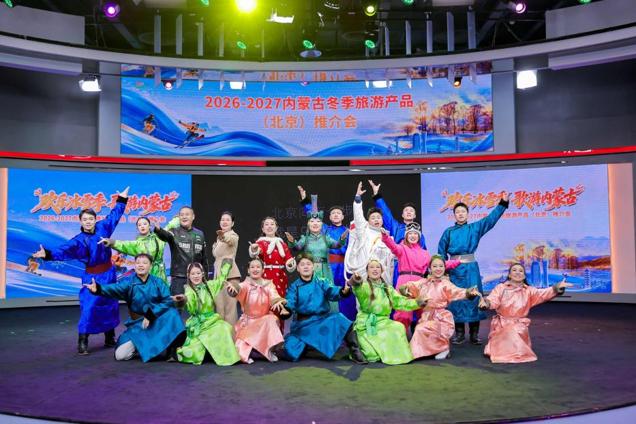
Performers stage the skit "One Step West of Beijing: Winter in Ulanqab" at the "Happy Ice and Snow Season, Songs and Journeys in Inner Mongolia" promotion in Beijing, Nov. 6, 2026. (People's Daily Online/Kou Yanan)
Two companies pushed the idea further. Yili Group showed its Health Valley in Hohhot, a factory turned tourist stop where a "milk tap" has become a favorite photo spot. The Xiangshawan Resort pitched "Lotus in the Desert, Snow Dancing on the Singing Sands," a landscape of white snow on yellow sand.
Music between the pitches
Music was more than an interlude. The campaign's name pairs songs with journeys, and the afternoon took that literally. After the throat singing that opened the event, four voices sang a song about the Hulunbuir grassland with no instruments at all, a warm, open sound in a room that had just been talking about snow. Singer Agudamu took the stage with a group of young student singers, passing the song along from one generation to the next. A song-and-dance number closed the program.
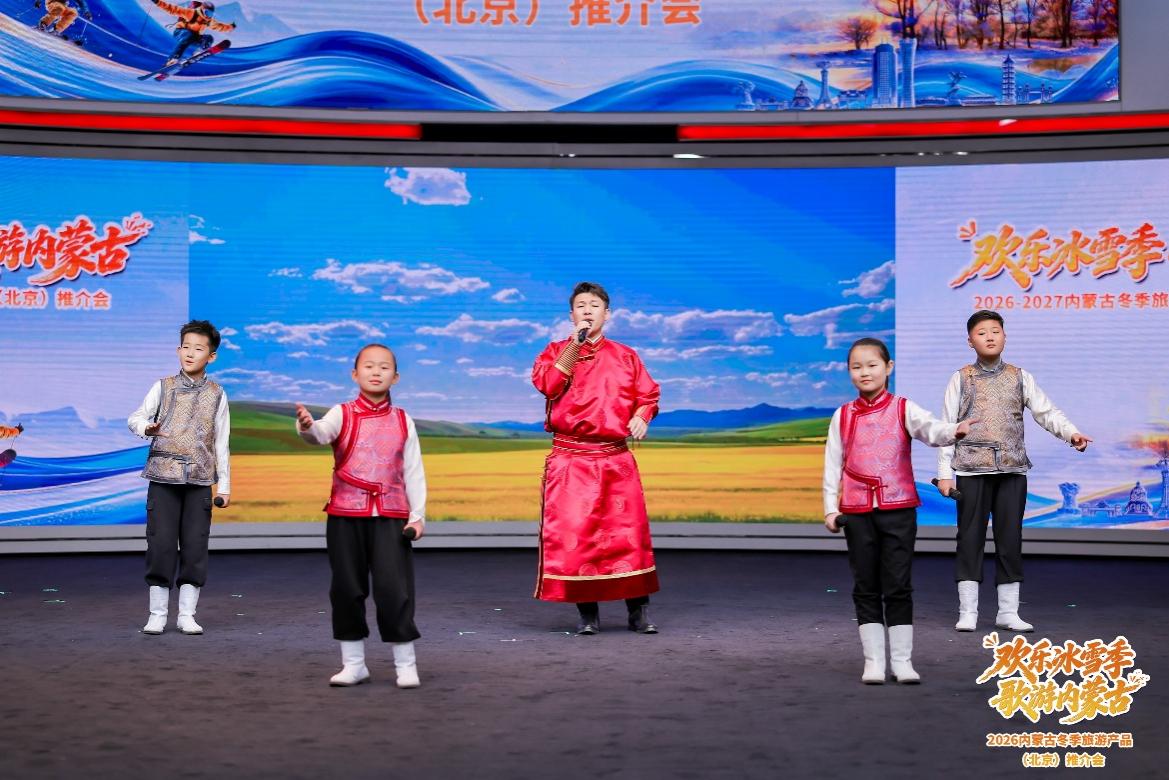
Singer Agudamu and four young student singers perform during the "Happy Ice and Snow Season, Songs and Journeys in Inner Mongolia" promotion in Beijing, Nov. 6, 2026. (Photo provided by organizers)
From the audience, the strongest impression was not the discounts or the itineraries but the pride. Each presenter spoke about home as if inviting guests through the front door, and the effect was infectious. For visitors who know Inner Mongolia only as a summer sea of grass, the afternoon made a persuasive case that the region's second act may be its best. In Inner Mongolia's telling, the colder it gets, the warmer the welcome.
Photos

Related Stories
Copyright © 2026 People's Daily Online. All Rights Reserved.
