



Ecological restoration revives ecologically fragile areas across China
Ecologically fragile areas in China are showing new vitality after years of restoration efforts.
Red-crowned cranes have returned to the Daling River estuary in Jinzhou city, northeast China's Liaoning Province, after years of coastal restoration.
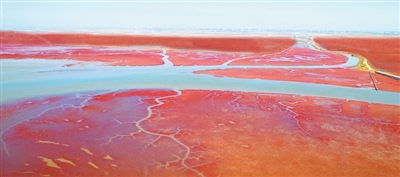
Photo shows the red beach after restoration on Jiuzhi Road in Linghai, a county-level city under Jinzhou city, northeast China's Liaoning Province. (Photo courtesy of the ocean and fisheries bureau of Jinzhou)
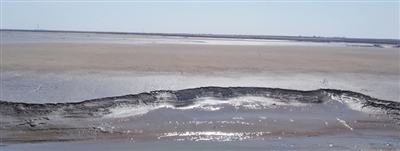
Photo shows the red beach before restoration on Jiuzhi Road in Linghai, a county-level city under Jinzhou city, northeast China's Liaoning Province. (Photo courtesy of the ocean and fisheries bureau of Jinzhou)
The tidal flat of the estuary was once crisscrossed by aquaculture embankments that blocked tidal creeks, causing Suaeda salsa, a salt-tolerant plant, to wither. Since 2018, Jinzhou has carried out a campaign to improve the marine environment in the Bohai Sea region. It later launched an ecological restoration project for the estuary, removing the embankments, dredging the creeks and replanting native species such as reeds and Suaeda salsa. In 2022, the city launched a marine environment restoration project.
That spring, four pairs of red-crowned cranes were found nesting there, marking the first natural breeding in the area in more than a decade. "The cranes are demanding about their habitat. That they stay shows the ecosystem has truly recovered," said Yu Lian, vice president of a local wildlife and wetland protection association.
The coastal wetland's hydrodynamic conditions have improved by 30 percent, and bird diversity and numbers have risen markedly. Some former fish farmers now work as bird wardens.
In Minqin county, northwest China's Gansu Province, Qingtu Lake has reappeared between the Tengger and Badain Jaran deserts.
The lake, at the lower end of the Shiyang River, dried up in 1959 as upstream inflows dwindled and water was overused. Its exposed bed created a 13-kilometer sandstorm belt, the largest gap in the windbreak system in northern Minqin.
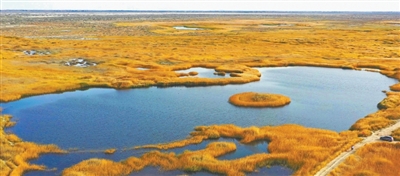
Photo shows the autumn scenery of Qingtu Lake in Minqin county, northwest China's Gansu Province. (Photo/Ma Aibin)
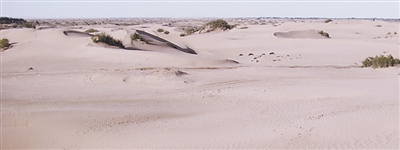
File photo shows Qingtu Lake before restoration in Minqin county, northwest China's Gansu Province.
Inter-basin water diversion became the key to restoring the lake. Since 2001, water from the Yellow River has been transported through a canal more than 260 kilometers long and pumped nearly 500 meters uphill by 13 pumping stations. It is then mixed with local water in a reservoir before being released into the lake.
In 2010, the reservoir released 12.9 million cubic meters of water into the long-dry lake, forming a 3-square-kilometer water body. Water transfers have continued for more than 10 years, and regional groundwater levels have been rising steadily. The lake now covers 27.65 square kilometers.
In addition, a 380-kilometer shelterbelt now forms a closed loop around the county's oases, reversing the trend of "sand forcing humans to retreat." Residents earn stable incomes by growing cistanche, a medicinal herb, and raising seedlings of desert trees.
In Xichou county, southwest China's Yunnan Province, a campaign against rocky desertification, a process in which soil erosion exposes bare bedrock, has turned barren hills into productive farmland.
The county has built terraces that retain water, soil and nutrients. In 2015, it brought in a company to grow kiwifruit through a model involving cooperatives, planting bases and farmers.

Photo shows the Sanguang area after rocky desertification control in Xichou county, southwest China's Yunnan Province. (Photo/Xiong Pingxiang)
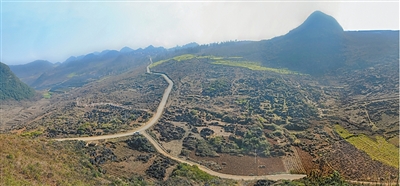
Photo shows the Sanguang area before rocky desertification control in Xichou county, southwest China's Yunnan Province. (Photo/Lyu Deren)
Sanguang village in Xingjie town, once plagued by severe rocky desertification, has been transformed into a tourism complex offering kiwifruit picking, ecotourism and displays of ethnic culture. It has forged a development path that combines ecological restoration, industry-led income growth and comprehensive rural revitalization.
Photos



Related Stories
- NE China's Liaoning makes significant progress in protecting migratory bird sanctuaries
- Changshan Archipelago's World Heritage listing highlights China's efforts to advance ecological progress
- China advances ecological governance under the rule of law
- China marks National Ecology Day with solid gains in green push
- EcoChina | Ecological restoration achievements in SW China's Zoige Wetland
- EcoChina | Improved ecology draws more migratory birds to Heilongjiang
- Scenery of Fujin National Wetland Park in China's Heilongjiang
- China issues plan to build Beautiful China from 2026 to 2030
- Spotted seals return as marine ecosystems recover in Panjin, NE China
- Tidal-flat seaweed in East China becomes ecological asset
Copyright © 2026 People's Daily Online. All Rights Reserved.
