



China's agricultural service centers help small rural households embrace modern farming
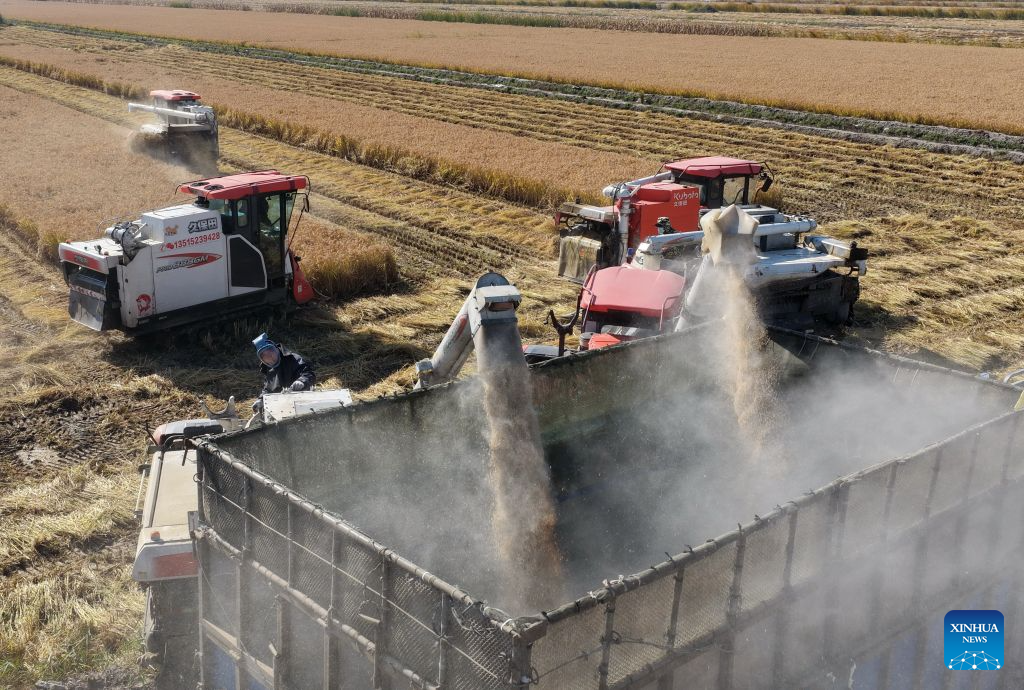
Farmers operate agricultural machines to harvest rice in paddy fields at a farm in Lutai economic development zone of Tangshan, north China's Hebei Province, Oct. 28, 2026. (Xinhua/Yang Shiyao)
Agricultural service centers across China are bringing technology, data and professional services to farmers' fields, helping them adapt to modern agricultural practices.
The outline of the 15th Five-Year Plan (2026-2030) calls for improving the system of accessible and efficient agricultural services and promoting closer integration between smallholder farmers and modern agriculture.
Six central government departments, including the Ministry of Agriculture and Rural Affairs, issued guidelines calling for the establishment of modern integrated agricultural service centers with well-planned locations, standardized operations and high-quality services, emphasizing their role in supporting smallholder farmers.
By the end of the 14th Five-Year Plan period (2021-2025), China's supply and marketing cooperative system had built 16,000 agricultural service centers. Another 1,000 will be built or upgraded over the next five years.
In Zhangqiu district, Jinan, east China's Shandong Province, Han Xiangchao, a major grain grower, used to dread prolonged rain. His farmland lies alongside the Yellow River floodplain, where heavy downpours could rot corn roots, flatten stalks and even wipe out harvests.
In 2022, Han entrusted the management of his 400 mu (about 26.67 hectares) of farmland to a local agricultural service center. The center handles every step, from land preparation, drainage and plant protection to harvesting and drying, using smart farming technologies to manage operations precisely.
The center assigns staff to each plot and has installed sensors that continuously transmit data on soil moisture, seedling growth and pests to an online platform. Drones and large sprayers apply pesticides precisely, cutting pesticide use by 20 percent and keeping the pest control rate above 96 percent.
During the prolonged heavy rains last autumn, the center used monitoring data to anticipate risks, pumped out standing water with machinery during the storms and sent technicians to repair damage afterward. Han's fields escaped serious damage.
"Whether it's drought or flood, my yield stays above 450 kilograms per mu. This year I expect the 400 mu of farmland to generate an income of 380,000 yuan (about $57,005.28)," Han said.
The center's operator has also built grain drying towers and silos, with a combined capacity of 100,000 tonnes for drying, storage, processing and sales. It manages 62,000 mu of farmland across 12 subdistricts in Zhangqiu district, serving 17,000 households and helping 94 village collectives increase their incomes.
To date, the Shandong Provincial Supply and Marketing Cooperative has set up 841 such centers, which provide agricultural services covering a cumulative area of more than 90 million mu annually.
In Shiyan town, Dongtai, a county-level city under Yancheng city, east China's Jiangsu Province, rice farmer Fan Wenming used to worry less about whether his crop was ripe than about when a harvester would show up. Farmers struggled to find machines, while agricultural machinery operators wasted working hours looking for jobs.
Now a WeChat mini program connects the two sides. Farmers enter their plot location, size and preferred date, and nearby agricultural machinery operators can see their requests immediately. "I used to chase operators for a time slot. Now they come to me, and the prices are transparent," Fan said.
"I can get more work done each day, and my income is more stable," said Yan Falin, an agricultural machinery operator. In the first half of this year, Yancheng city coordinated agricultural machinery operations covering a cumulative area of 45,000 mu through the platform.
The platform also offers an AI-powered "crop doctor." When Fan noticed yellowing wheat leaves last year, he uploaded photos to the mini program. Drawing on an agricultural knowledge base and a large language model, the system identified a potential problem with water and fertilizer management and advised him to check soil moisture. Fan then asked a local technician to inspect the field and prevent further losses.
"Farming depends on timing, and digital platforms make services faster and more precise," said Yu Weiguo, head of the Shiyan supply and marketing cooperative.
The "Sunongfu" digital agricultural service platform, developed by the Jiangsu Provincial Supply and Marketing Cooperative, has been rolled out in Yancheng, Suqian and other parts of the province. It has provided agricultural services covering a cumulative area of more than 1 million mu, served more than 800,000 mu of farmland, and brought 12 regional agricultural service centers online.
In Yangmei village, Wenfeng township, Xunwu county, Ganzhou city, east China's Jiangxi Province, citrus grower Ling Zhenghua has spent 20 years growing navel oranges. Years of continuous cropping and traditional fertilizing practices left his soil compacted and depleted, while citrus greening disease spread rapidly.
The Xunwu agricultural service center, operated by Sino-Agri Group, a subsidiary of China CO-OP Group, is bringing the laboratory to the orchard. Technicians take soil samples, send them for testing and develop a data-based plan for each orchard, covering soil improvement, precise fertilizing and tree care.
To tackle citrus greening disease, the center has established a research station dedicated to the disease and developed an integrated approach combining soil improvement, stronger trees and measures to block the spread of infection. This includes improving soil conditions and tree health, as well as using physical barriers and targeted pesticide applications to interrupt transmission.
The service center is also experimenting with intercropping passion fruit and chili peppers at a demonstration base in Daping township, Nankang district, Ganzhou. "In the past, when I grew only passion fruit, I had expenses in the first half of the year but no income. Since introducing intercropping, I have sold 60,000 kilograms of chili peppers this year, earning 230,000 yuan. The proceeds have covered the greenhouse rent and labor costs," said grower Zhu Fangquan.
"I used to fertilize based on experience alone. Now the trees are growing better and better," Ling said. In many orchards, fruit sweetness has risen by about 2 degrees, and the proportion of large fruit has increased significantly.
"The agricultural service center helps farmers improve soil quality, combat plant diseases and adopt scientific farming practices," said Zhang Qi, head of the Xunwu agricultural service center.
By the end of September this year, the agricultural service centers established in Jiangxi Province had provided services covering a cumulative area of 766,500 mu.
Photos



Related Stories
- In pics: agricultural science and technology industrial park in Jinhua City, China's Zhejiang
- Researchers propose new irrigation to balance water conservation, food security in China
- 33rd China Yangling Agricultural Hi-tech Fair opens
- Farming by data: how smart agriculture is reshaping China's fields
- Chinese scientists develop new nanoparticles to make pesticides more efficient
- Four Chinese sites added to World Heritage Irrigation Structures list
- China's revitalized countryside gains attention abroad
- Autumn grain harvest in full swing across China
- Chinese scientists develop rice's full-lifecycle cell atlas
- China expects bumper grain harvest for 2026
Copyright © 2026 People's Daily Online. All Rights Reserved.
