



China's Central Archives opens over 5,000 Long March items to mark 90th anniversary
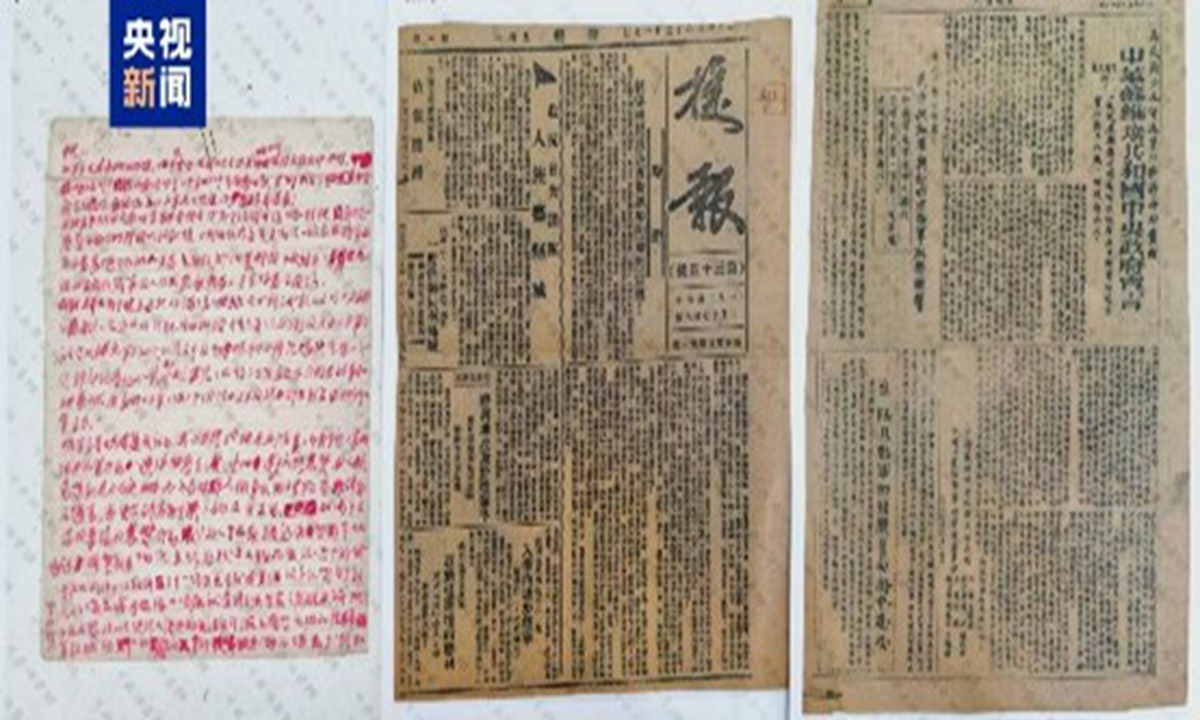
China's Central Archives opens more than 5,000 Long March-related archival items to the public on October 19, 2026 to mark the 90th anniversary of the Red Army's Long March victory. Photo: CCTV News
China's Central Archives opened more than 5,000 Long March-related archival items to the public on Monday to mark the 90th anniversary of the Red Army's Long March victory, offering firsthand accounts of key battles, strategic decisions and solidarity between soldiers and civilians, according to China Central Television (CCTV) News.
The newly accessible materials mainly date from October 1934 to October 1936, including include programs and declarations issued by the Communist Party of China, Red Army telegrams and reports on operational deployments, and revolutionary newspapers and periodicals founded and published by the Party. Together, they showcase the revolutionary spirit of the CPC and the people's armed forces, vividly depicting how the Red Army and ordinary people stood united, braved sacrifice and pressed ahead during the Long March, according to CCTV News.
Among the materials opened to the public for the first time is Jiebao (victory bulletin), a newspaper founded by the CPC's Shanghai central bureau. A total of 40 issues were published between October 1933 and June 1935, exposing the reactionary rule of the Kuomintang, publicizing the Red Army's military achievements and development in the revolutionary base areas.
Liu Kun, a staff member of the Central Archives' archival access department, was cited as saying that "the December 17, 1934, issue of Jiebao carried a report stating, 'The westward-bound Red Army has victoriously captured Liping in Guizhou' … Liping was the site of the first Political Bureau meeting held by the CPC Central Committee after the Long March began. The Liping Meeting affirmed the decision to change course at Tongdao and established the Red Army's strategy of advancing westward, thereby averting the risk of being encircled and annihilated by Kuomintang forces had it continued north."
The words "utmost urgency" on the telegram testify to the critical military situation at the time. Another document, titled "Report on the first division's covering of the entire army's bridge crossing tomorrow," provides a detailed account of the Red Army's exploits in capturing Luding Bridge, said Liu.
"The capture of Luding Bridge was one of the major victories of strategic significance during the Red Army's Long March," Liu said. "As a firsthand battlefield record, this document details when units of the first red army corps arrived at Luding Bridge and launched their attacks. It also records the situation on the ground as they captured the bridge, defeated a regiment of Sichuan troops and seized military supplies. The document states, 'Today, we captured more than 100 prisoners and over 100 firearms, along with enough ammunition and hand grenades to substantially replenish our supplies.'"
The 25th Red Army set out from Hejiachong in Luoshan county, Henan Province, on November 16, 1934, and arrived in Yongping, Shaanxi Province, on September 15, 1935, to become the first Red Army force to reach northern Shaanxi during the Long March.
A special report submitted to the CPC Central Committee on July 17, 1935, by Wu Huanxian, the political commissar of the 25th Red Army, is an important historical source for research into the force's Long March.
"In this report, Wu perceptively raised the question of whether they could join forces with the 26th and 28th armies, concentrate their strength to destroy enemy forces, support the main Red Army's operations in the northwest, and swiftly establish a new, strong and consolidated revolutionary base there," Liu said.
"Operating in isolation, without instructions from the CPC Central Committee or deployments ordered by higher authorities, the CPC Hubei-Henan-Shaanxi Provincial Committee resolutely decided that the main force of the 25th Red Army should advance westward and northward to support the main Red Army. Wu's report also explains the thinking behind that decision," Liu said.
Starting Monday, audiences can consult these materials at the Central Archives' public reading hall by presenting valid identification, such as a national ID card or work ID, per CCTV News.
Photos




Related Stories
- Long March legacy takes root in greener landscapes of revolutionary heartlands
- Brushstrokes bring Red Army martyrs' portraits for families
- Interview: Long March spirit inspires modern governance, global solidarity: Kenyan media executive
- Long March Origin choir carries forward Red Army spirit
- Long March legacy inspires innovation breakthroughs in city of historic turning point
- 90 years on, Long March spirit endures in China, resonates beyond borders
- Feature: Reliving the Long March, 90 years on
- Where the Long March began, China's new journey unfolds
- Over 300 artifacts, documents debut in Beijing as China marks 90th anniversary of Long March victory
- Revolutionary base of China's Long March in Wuqi County sees ecological, industrial development
Copyright © 2026 People's Daily Online. All Rights Reserved.
