



Grassland highway turns ecological gains into economic ones
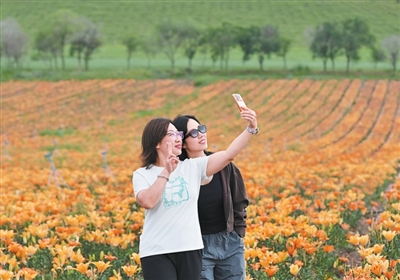
Tourists pose for a picture amid lily flowers along the grassland highway in Zhangbei county, Zhangjiakou, north China's Hebei Province. (Photo/Zhai Yujia)
The grassland highway in Zhangbei county, Zhangjiakou, north China's Hebei Province, announces itself underfoot: colorful asphalt, and a view that shifts the moment you drive onto it.
The scenic corridor stretches more than 320 kilometers, from the Hebei-Inner Mongolia border in the west to Chengde in the east.
As part of the coordinated development of the Beijing-Tianjin-Hebei region, Zhangjiakou plays a key role in conserving water resources for the capital and supporting the region's ecological environment. The grassland highway cuts through the heart of this ecological barrier.
Heading west, you see Chahan Nur Lake come into view. According to the latest monitoring data, its surface area has reached 88 square kilometers — the highest for this time of year in two decades.
Farther north lies Kangba Nur Wetland, where two-thirds of the world's relict gulls breed each summer — some 9,000 birds, gathered in one place.
The lush greenery and vitality are the result of three decades of sustained ecological restoration.
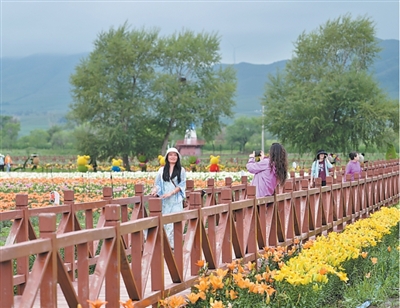
Tourists pose for a picture amid lily flowers along the grassland highway in Zhangbei county, Zhangjiakou, north China's Hebei Province. (Photo/Zhai Yujia)
In the late 1990s, Hebei launched a reforestation drive, aiming to build three new forest farms on the model of Saihanba, the province's flagship tree-planting project. Along the grassland highway in Zhangbei, more than 10,000 mu (about 667 hectares) of barren land was planted with trees and shrubs. Today, heavily desertified land has all but vanished from Zhangjiakou.
Heading back east, the highway's signature view appears: the road curving through rolling hills, rows of wind turbines stretching out on either side.
Zhangjiakou's installed renewable energy capacity now exceeds 45 million kilowatts, more than 88 percent of the city's total. That makes it the most important source of green electricity for the Beijing-Tianjin-Hebei region.
The same wind and solar farms are now powering something else: computing. Zhangjiakou has 48 data centers in operation, and its computing capacity ranks first in Hebei.
Chongli, at the eastern end of the grassland highway, drew more than 10 million tourist visits in 2025. This summer alone it hosted more than 600 cultural and sporting events — competitions almost every day, performances every night.
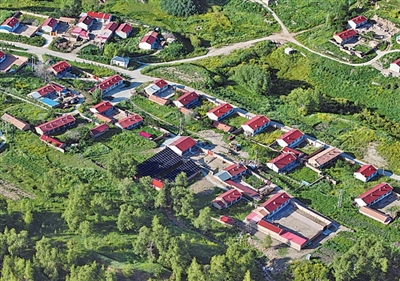
Photo shows red-roofed brick houses scattered across winding grasslands and mountains along the grassland highway in Zhangbei county, Zhangjiakou, north China's Hebei Province. (Photo/Sun Jihu)
Continuing east into Guyuan county, you see the scenery change again. Vast fields of red, green, yellow, purple and white spread across the landscape like a spilled palette. They are quinoa fields.
When quinoa arrived here in 2012, villager Zhang Qingjun planted a single mu to see whether the unfamiliar crop would grow at all. It did. Today he grows a locally bred variety with thick, wind-resistant stalks, yielding 275 kilograms per mu — 30 percent more than traditional varieties, and nearly three times the income of naked oats at about 1,600 yuan (roughly $239) per mu.
Guyuan has partnered with the Chinese Academy of Sciences on a 50-mu joint breeding base, which holds more than 6,000 quinoa germplasm resources and has produced over 150 breeding lines suited to local conditions.
Quinoa now covers more than 100,000 mu in the county, about a fifth of China's total planted area. In 2025, output topped 20,000 tonnes and was worth close to 200 million yuan (roughly $28 million). The county has also developed 36 processed products.
Photos


Related Stories
- 'The Big Picture' Season 7, Episode 1: 'The Doughnut'
- Cultural event in Kuwait highlights traditions, tourism resources of China's Hebei
- Autumn scenery in Zhangbei County of China's Hebei
- Garden, landscaping tools from Pingquan, N China's Hebei, dig their way to global markets
- Morning scenery of Wuling Mountain National Nature Reserve in N China's Hebei
- Salt farms enter harvest season in China's Hebei
- Ecological improvement creates favorable environment for migratory waterbirds in N China's Zunhua
- Morning scenery of ancient Great Wall in China's Hebei
- Summer performances at Hetou Old Street scenic area boost tourism in Tangshan, N China
- Scenery of Bashang grassland in N China's Hebei
Copyright © 2026 People's Daily Online. All Rights Reserved.
