



More than a factory floor: foreign companies expand innovation footprint in China
CHONGQING, Oct. 9 (Xinhua) -- The AUDI Innovation & Technology Center (AITC), jointly established by Audi and Chinese automaker SAIC Motor, opened in Shanghai in early September -- a shift reflecting how multinationals are deepening their R&D roots in China.
With the AITC focusing on intelligent electrification and full vehicle development, the German luxury carmaker is treating China not simply as a place to build cars, but as a place to design them.
Audi and SAIC Motor have agreed to jointly develop four all-new AUDI models based on the ADP (Advanced Digitized Platform) 2.0, with the first model slated to launch in 2028.
The center is Audi's first R&D entity outside Germany to cover the entire value chain. It will not only lead the development of next-generation AUDI products but also channel Chinese innovations into Audi's global operations.
"We are combining German engineering precision with local innovation," said Johannes Roscheck, president of Audi China. "Our expanded R&D footprint will further elevate our competitiveness in China."
"Quite a few multinational companies are upgrading their manufacturing bases in China into innovation hubs, while their China R&D centers are evolving from local adaptation units into global innovation anchors," said He Yadong, spokesperson for the Ministry of Commerce, at a press conference in April.
In 2025, foreign investment in China's scientific research and technical services sector accounted for nearly one-fifth of the country's total inbound foreign investment, a share that had risen steadily for seven consecutive years, 3.8 times its 2018 level.
The sector saw 14,000 new foreign-funded enterprises established last year, up 27.2 percent year on year. Beyond the numbers, a growing list of multinationals, including AstraZeneca, Philips, Porsche and Schneider Electric, have set up R&D centers in China in recent years.
Rapid market adoption and industrial coordination have become key drivers behind multinationals' accelerating R&D expansion in China. Jerome Dorlack, president and CEO of Adient, a global automotive seating supplier, said Chinese cities such as southwest China's Chongqing Municipality offer a world-class industrial ecosystem, where companies can find partners across the entire value chain, from customers to suppliers.
"Chinese consumers adopt new technologies very quickly -- typically within 12 to 14 months from launch to widespread adoption, whereas in some other markets the process can take three to four years," he said.
Adient has developed products such as the ProForce massage system in China, launching them first in the Chinese market before rolling them out globally. The company now operates 39 production bases and three global technology centers in the country. "Expanding our technology centers in China has been a great success," Dorlack added.
Han Jin-Kyu, president of the Asia-Pacific region for Germany's Vibracoustic, said the company, which specializes in automotive NVH (noise, vibration and harshness) solutions, operates plants in Chongqing and in the eastern Chinese cities of Wuxi and Yantai. Rather than simply supplying parts, it works closely with local automakers to jointly develop new products.
Han added that, with well-developed infrastructure, major cities such as Chongqing can foster joint development and innovation across sectors including AI, smart manufacturing, automobiles and semiconductors.
Talent and innovation capacity are another major draw. Michael Mertin, CEO of AT&S, a leading Austrian semiconductor materials company, said China has long made it a priority to train scientists and engineers, and that the new generation of Chinese engineers "not only possesses outstanding mathematical skills but is also increasingly creative."
Data shows that China produces more than 5 million STEM (science, technology, engineering and mathematics) graduates each year, and that more than half of the world's top AI researchers, by undergraduate origin, come from Chinese universities.
Mertin said Chongqing is a key hub in the company's global network. The core technology of its signature product, the substrate, was first commercialized in the municipality and has since been refined and matured there.
"In today's digital age, no company, city or country can innovate in isolation," Mertin said. "High-tech progress depends on trusted global networks, cross-border collaboration, and the exchange of talent, expertise and ideas."
The same logic applies to other industries. This year, HP also opened an AI innovation center in Chongqing. The center has already rolled out its first product, an AI acoustic inspection machine. The device can accurately identify product defects and has been deployed in quality inspection across multiple manufacturing sectors.
"Chongqing's ability to attract and cultivate talent gives the city a strong competitive edge," said Jonathan Jennings, HP's chief procurement officer. "We are working with Chinese universities and local governments to build this hub, because we need to keep growing and stay on top of the latest innovations."
China is also stepping up policy support to bring more foreign innovation and technology into the country. Its 15th Five-Year Plan (2026-2030) calls for more regional headquarters and R&D centers from foreign companies. A revised catalog of industries encouraged to attract foreign investment adds new entries in areas such as innovative drug development and digital creative technology, while foreign-funded R&D centers are eligible for tax breaks on imported research supplies.
He Yadong said the Ministry of Commerce will work with relevant departments to leverage China's "complete industrial system, high-quality talent pool and rich application scenarios" to draw more multinationals to base their R&D operations in China.
Photos
 Tourists enjoy sunrise at Mount Tai in China's Shandong
 Basha Village in China's Guizhou draws tourists with charming scenery and folk customs
 Low-altitude tourism programs become growth point in Hongcun Village, China's Anhui
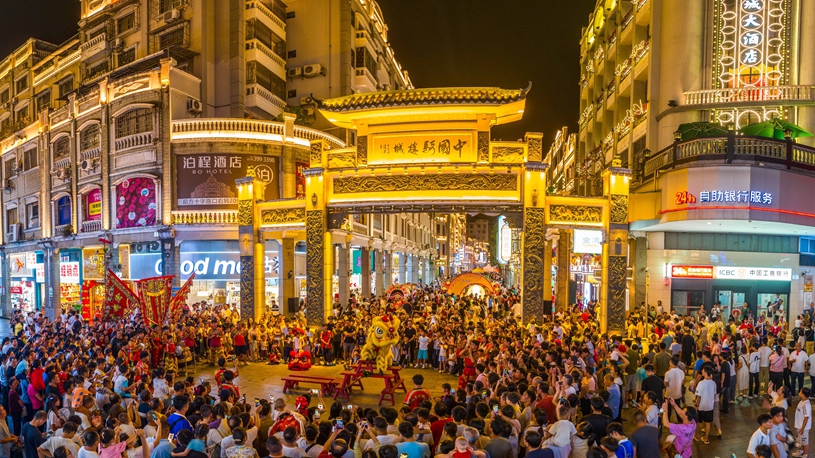 Various cultural, tourism events draw visitors during National Day holiday
Related Stories
- Multinationals double down on R&D in China to serve global markets
- Starbucks expands China footprint with Xinjiang debut
- German enterprises scale up investment in China amid market growth
- Interview: Chinese market is great opportunity for Spanish food products: ICEX executive
- China's central bank pledges high-level financial opening-up at symposium with foreign institutions
Copyright © 2026 People's Daily Online. All Rights Reserved.
