



Building bridges in porcelain: how one artist is welcoming the world to Jingdezhen
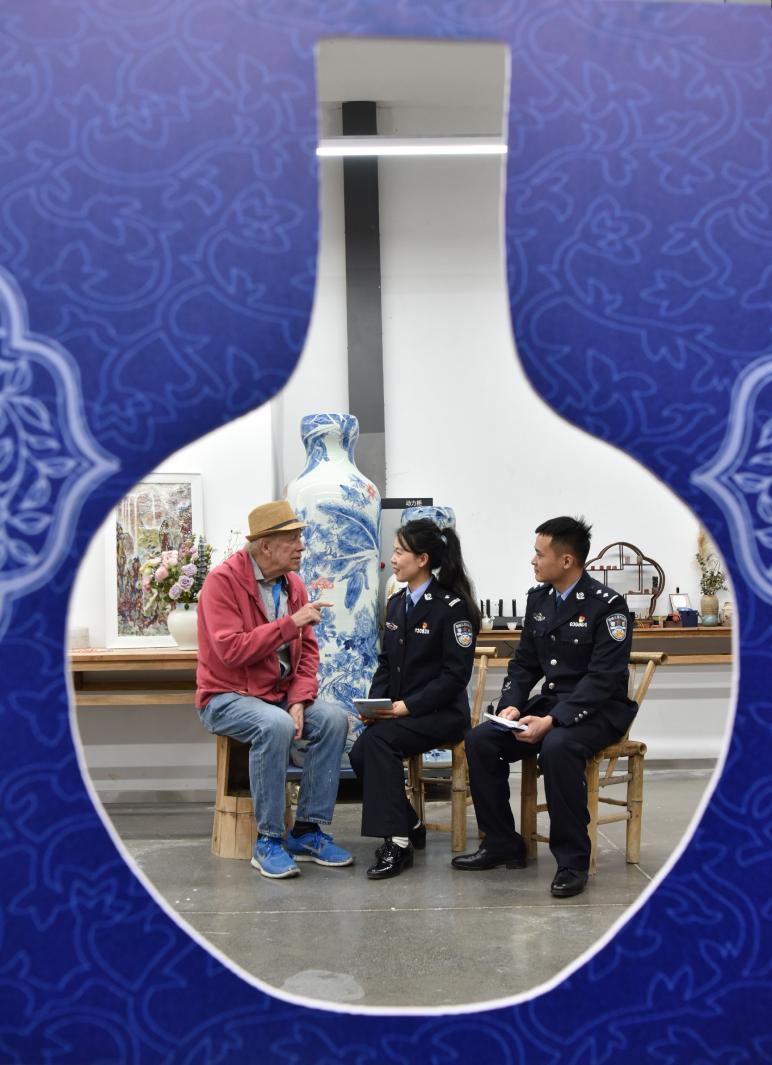
Police officers with the Zhushan branch of the Jingdezhen Public Security Bureau communicate with Philip Read over public services and policies. (Photo/Shi Weiming)
Golden afternoon light spills into the studio of Philip Read, a 76-year-old Canadian artist, nestled in Taoxichuan, a vibrant cultural hub in Jingdezhen, widely celebrated as China's "porcelain capital" in east China's Jiangxi province.
With a paintbrush in hand, Read carefully applies pigment to a porcelain panel. Beside him rests a blue certificate naming him lead coordinator of the "Yang Jingpiao" volunteer service team, a grassroots network dedicated to supporting international artists and expatriates who have made Jingdezhen their home.
After more than 30 years of living and working in Jingdezhen, Read sums up his life there in one sentence: "I find joy in creating art and warmth in helping others. I feel very fulfilled."
Over the past few years, Jingdezhen has grown into a magnet for global talent. By the end of 2025, more than 5,000 foreign artists and international residents had settled in the city. Yet many face hurdles -- from navigating unfamiliar local regulations to overcoming language and cultural gaps that can hinder daily life and professional collaboration.
"Many newcomers face similar challenges, notes Yu Huiyao, suggested Yu Huiyao, director of the Zhushan branch of the Jingdezhen Public Security Bureau. "What if we gathered experienced foreign residents who already know the city well and formed a volunteer network to guide them?"
Read was among the first to volunteer. He still recalls his initial visit 37 years ago, when he was instantly mesmerized by Jingdezhen's masterful ceramics. That early fascination eventually led to an invitation as a visiting scholar at Jingdezhen Ceramic University.
"Early mentors and friends helped me understand the nuances of porcelain-panel painting and adjust to life here," he says. "The kindness I received planted a lasting commitment: to pay forward the support I once needed."
To launch the initiative, Read reached out to American ceramic artist Michael May, whose own exhibition nearly collapsed due to language barriers until local officials intervened. "He knows exactly how vital timely, cross-cultural support can be," Read explains. He also recruited colleagues and alumni from Jingdezhen Ceramic University who shared his vision.
On July 16, 2025, the "Yang Jingpiao" volunteer team officially launched, with Read unanimously chosen as its coordinator. Starting with nine members from seven countries, it marked Jiangxi province's first dedicated support network for foreign residents.
Partnering with the Zhushan public security branch, Read helped design a three-tier service model. First, they integrated the team into a digital police-citizen platform, enabling foreigners to submit requests for real-time assistance. Second, dedicated service desks were opened in high-traffic expat neighborhoods like Taoyuan Valley. Finally, volunteers began offering outreach directly in universities, residential communities, and creative markets.
"We're not just solving paperwork problems," Read says. "We're building bridges -- helping people understand each other and truly belong.""Formal presentations rarely resonate with artists," he notes. "They learn best through conversation, in informal settings where ideas can flow freely."
Each weekend, at the bustling creative markets, Read sets up a modest booth he affectionately calls his "policy counter." There, he and fellow volunteers break down residency, visa, and business regulations into plain, accessible advice.
Over time, Read realized translation alone wasn't enough. Regulations often felt abstract or intimidating. The solution? Frame legal requirements through lived experience -- turning bureaucratic language into actionable, story-driven guidance.
More recently, he's taken things a step further: staging short plays to demystify local policies.
At the Taoxichuan Art Center, Read, May, and several other team members performed a short play titled "Yang Jingpiao" Adventures in the Millennium Porcelain Capital. Blending humor with practical tips on housing, permits, and daily logistics, the sketch drew laughs -- and nods of recognition -- from more than 30 attending foreign artists.
"Everything clicked," says Malaysian ceramist Goh Zhenxi. "Visa steps, rental advice, mentorship contacts -- it all made sense in a way a government brochure never could."
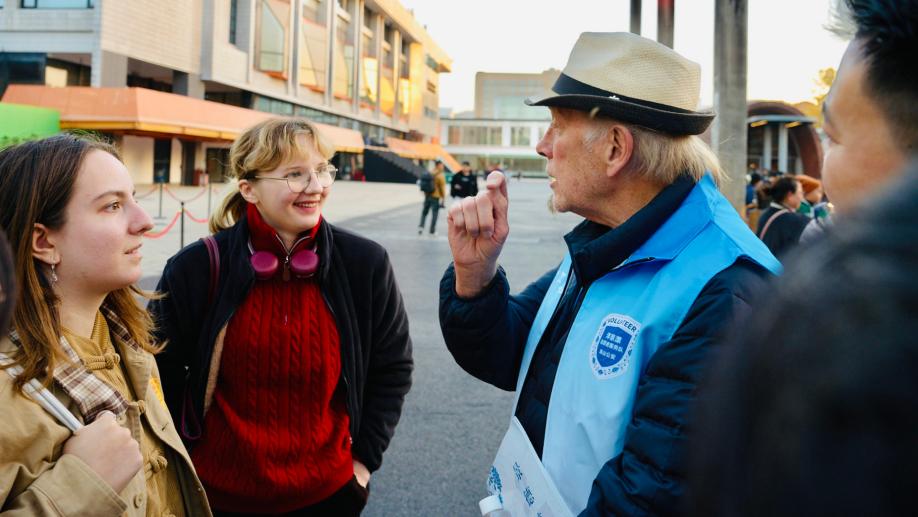
Philip Read (first from right) interprets policies for other foreign Jingdezhen drifters in Taoxichuan, Jingdezhen, east China's Jiangxi province. (Photo/Zhai Yu)
Beyond administrative support, the team has stepped into community mediation.
Read frequently serves as a cultural liaison during minor disputes, helping parties navigate differing expectations with patience and clarity.
In August 2025, for example, a minor traffic collision between two foreign residents sparked confusion over liability. Police and Read arrived promptly.
"Read explained China's traffic regulations in English, while gently highlighting how cultural norms shape our understanding of responsibility. In less than half an hour, they'd shaken hands and moved on," said police officer Li Yuchen.
"Most friction stems not from malice, but from miscommunication," Read observes. "That's why I train our volunteers to listen actively, translate contextually, and bridge cultural assumptions," Read said.
Appointed a cultural tourism ambassador for Jingdezhen, Read now leads regular "ceramic salons" that connect newcomers with masters of Jingdezhen's intangible cultural heritage. Volunteers also organize guided tours through historic kiln ruins, repurposed industrial zones, and active studios, giving international artists hands-on exposure to centuries-old craftsmanship.
In just over a year, the team has hosted nine major outreach events, delivered more than 150 consultations and translation sessions, and assisted over 500 individuals.
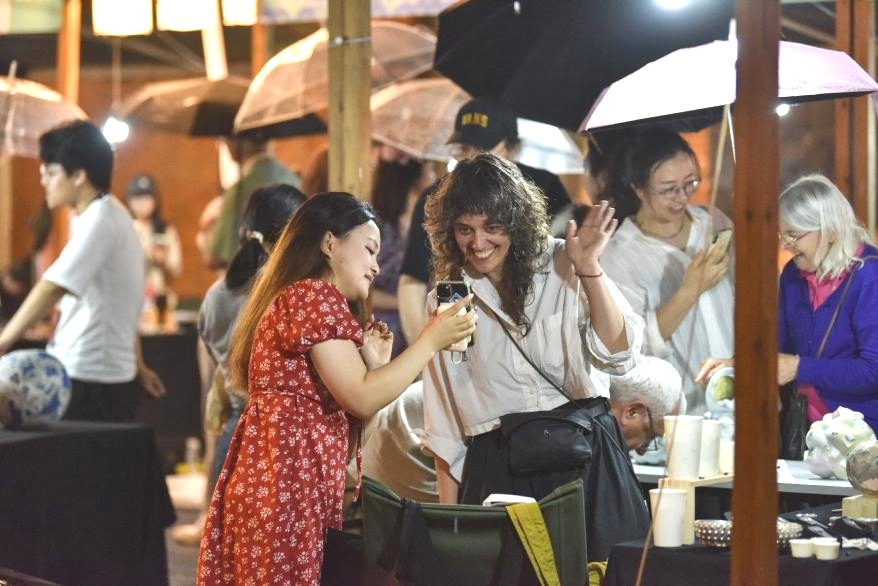
Chinese and foreign artists, visitors communicate with each other at a cultural and creative fair held in Taoxichuan, Jingdezhen, east China's Jiangxi province. (Photo/Shi Weiming)
Ultimately, Read envisions a community where foreign creatives and local residents don't just coexist -- they collaborate, support one another, and enrich each other's lives through shared curiosity and respect.
The team organizes joint creative projects involving Chinese and foreign artists, sets up stalls for Chinese-foreign artist collaborations at ceramic markets, and organizes community open days that invite local residents into the studios of foreign artists. Through these exchanges, people get to know each other, share warmth, and inspire new ideas.
Read's studio is filled with numerous unnamed porcelain-panel paintings. "These paintings record how Jingdezhen has changed over the past 30-plus years. They also record my deep love for this city and its ceramic culture," Read said.
He incorporates elements of Chinese kung fu, dance, and landscapes into his ceramic works. When these pieces featuring Chinese elements have been exhibited around the world, they have received widespread acclaim.
"Viewers tell me my art offers a more nuanced portrait of China -- one seen through lived experience rather than stereotypes," Read said.
Gazing out from his sunlit studio, Read reflects on the parallels between craft and community: "In this millennium-old porcelain capital, raw clay is shaped, fired, and transformed into porcelain. So too can human connection -- forged through empathy, cooperation, and shared purpose -- to create something enduring that crosses every border."
Photos

Related Stories
- China's Jingdezhen revitalizes ceramics industry through digitalization, smart manufacturing
- Feature: How World Heritage bid breathes new life into a Chinese village
- Waste to wonder: Porcelain's second life in Jingdezhen
- After UNESCO listing, Jingdezhen seeks lasting momentum for its living heritage
- Posters: Jingdezhen porcelain — beyond blue and white
- Innovation, interactions propel Jingdezhen to World Heritage status
- Jingdezhen porcelain sites added to UNESCO World Heritage List, blending tradition with modern creativity
- Jingdezhen World Heritage listing highlights China's commitment to preserving cultural legacy
- 25 new properties added to UNESCO World Heritage List
- China's Jingdezhen Handicraft Porcelain Industry Sites added to UNESCO World Heritage List
Copyright © 2026 People's Daily Online. All Rights Reserved.
