



Foreign birdwatchers build lasting ties to Beijing through birds
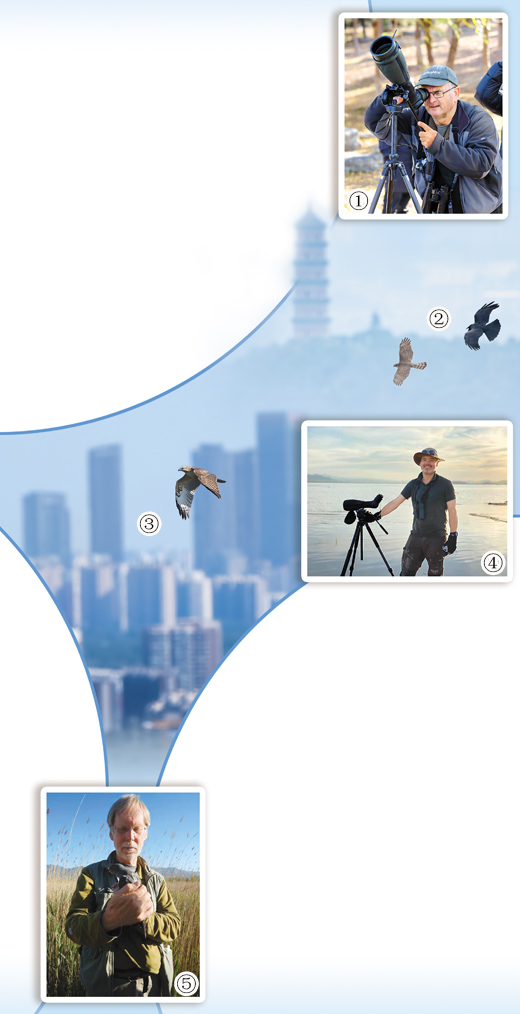
①: Photo shows Paul Holt. (Photo courtesy of the interviewee)
②: A Eurasian sparrowhawk (left) and a large-billed crow (right) fly over Yuquan Mountain in Beijing. (Photo/Xu Zhehao)
③: An Eastern buzzard flies over Beijing's Central Business District. (Photo/Xu Zhehao)
④: Photo shows Terry Townshend. (Photo courtesy of the interviewee)
⑤: Photo shows Lyndon Kearsley. (Photo courtesy of the interviewee)
In January 2026, British birdwatcher Terry Townshend and his collaborators launched the "Beijing Nocturnal Flight Call Library," documenting the calls of migratory birds flying overhead while the city sleeps.
A month later, fellow Briton Paul Holt was back taking children on birdwatching trips around the capital's outskirts. In June, Belgian swift researcher Lyndon Kearsley and his longtime Chinese partners retrieved tracking devices from eight Beijing swifts, which recorded another round trip between Beijing and southern Africa.
All three are foreigners who have built lasting ties to Beijing through birds. Holt has lived in the city for more than 20 years; Townshend has worked on ecological conservation there; Kearsley returns each breeding season to follow the swifts.
When Holt first visited Beijing in the 1980s, he never saw a light-vented bulbul in the city. Today, the loud, white-crowned bird is common downtown — one of several species, including the Chinese blackbird and spotted dove, that have spread to urban Beijing over the decades. Researchers have even found peregrine falcons nesting on high-rise buildings in the city.
Holt was born in Lancashire, in the north of England, and joined the Youth Groups of the Royal Society for the Protection of Birds (RSPB) when he was young. He went on to become a professional birdwatching tour leader, guiding groups across North America, Europe, Africa, Asia and the Indian subcontinent. He settled in Beijing in the early 2000s.
Over the years, Holt has traveled across China, visiting Qinghai, Sichuan and Yunnan provinces more than 30 times each. In Beijing, he has visited Shahe, Olympic Forest Park, Lingshan Mountain and reservoirs on the city's outskirts again and again. Having lived in the capital for years, he has tracked how bird populations have changed — which species pass through only briefly during migration, which have begun breeding in urban areas, and which once-rare "visitors" have quietly become "neighbors."
Townshend had a similar awakening. "When I arrived, everyone told me there were no birds here," he said. He arrived in 2010 for what was supposed to be a one-year stint, but instead found Beijing "phenomenal" for birds — more than he'd seen anywhere in Britain, he said. With over 500 species recorded, he considers Beijing one of the world's best capital cities for birdwatching, comparing it to a major international airport for migratory birds.
Kearsley's fascination follows a different thread: the Beijing swift, first collected and named in the city in 1870. Each April, the birds return to nest in the same beams and crevices of the Summer Palace's Kuoru Pavilion, then depart in July on a migration through Central Asia and the Arabian Peninsula to winter in southern Africa — a round trip of more than 30,000 kilometers across 35 or more countries, tracked since 2014 with the help of lightweight geolocators.
Each birder has built a detailed archive of observations. Holt keeps databases of bird species with more than 1 million entries, cataloging seasonal timing, breeding records and rare sightings — including the first-ever sandhill crane recorded in Beijing's Yanqing district, spotted among common cranes in December 2024.
Holt said building these databases, while time-consuming, has never felt like a chore. Instead, it has deepened his passion for birds and kept him wanting to learn more.
Townshend has focused on nocturnal migrants, which are rarely seen. In 2021, he and partners from Peking University, the Asian Infrastructure Investment Bank, and other institutions installed audio recorders on the roof of the bank's headquarters near the Olympic Forest Park. Over four migration seasons, roughly 3,350 hours of recordings yielded 84,135 flight calls representing at least 111 species or groups, including the critically endangered yellow-breasted bunting.
Kearsley's work involves years of waiting. Since 2007, banders and volunteers at the Summer Palace have tagged swifts with numbered leg rings, achieving a recapture rate above 30 percent. In one overnight session in May 2014, about 50 researchers and volunteers gathered at Kuoru Pavilion, where the Summer Palace team fitted 31 birds with geolocators — far more than European collaborators had expected. The data, however, could only be retrieved the following year, when the same birds returned.
In May 2015, the swifts carrying geolocators returned to Kuoru Pavilion, revealing for the first time their migration route across Asia and Africa.
This year, after downloading the data, Kearsley found that his laptop couldn't handle the processing load, so he sent the files to colleagues in Britain to run on more powerful computers. By the time Britain's workday ends, it's already late at night in Beijing. Kearsley still checks his email in the small hours, waiting to see the Beijing swifts' journeys mapped out.
These records have helped shape policy. Since 2019, Townshend has served on the international team of experts on Beijing's urban biodiversity conservation. According to him, after the team's exchanges with the Beijing Municipal Forestry and Parks Bureau, guidelines for managing green spaces were revised to call for preserving wild areas and diverse habitats.
In September 2024, the city issued guidance on strengthening the protection of bird resources — formally establishing the preservation of diverse habitats for migratory birds as a systematic requirement for urban management.
For all three, the work has also built relationships. Kearsley said he didn't feel like a foreigner when working with his Chinese colleagues. He wanted to bring China's stories back to Europe and keep learning from them.
Photos


Related Stories
- Feature: Rooftop terraces lift Beijing urban renewal to new heights
- Old industrial site transformed into vibrant urban destination in Beijing
- Night view of Shougang Park in Beijing
- HICOOL 2026 Global Entrepreneur Summit opens in Beijing
- Beijing ports see 15 million entry-exit trips, 20 days earlier than 2025
Copyright © 2026 People's Daily Online. All Rights Reserved.
