



In Yan'an, visitors see how CPC turns history into progress
YAN'AN, Shaanxi, Sept. 14 (Xinhua) -- When Ivan Racan was still a boy, not yet 10 years old, his father returned to Croatia from China in 1981, carrying with him a sanxian -- a traditional three-stringed Chinese instrument.
The instrument hung on the wall of his childhood room, bringing a piece of distant China into his everyday life. More than 40 years later, Racan came across a similar instrument at a museum in Shanghai. He was struck by the realization that while the sanxian had remained much the same, China itself had transformed dramatically.
For Racan, a member of the Croatian Parliament and son of former Croatian Prime Minister Ivica Racan, the instrument connects two periods of China's modern history. His father had visited China as an official of the former Yugoslavia. When he returned, he brought back stories that captured the early days of a transformation, one that would go on to reshape the country over the decades to come, Racan said.
Decades later, Racan visited China himself and made a point to travel to Yan'an, which was once a center of the Chinese revolution. During his journey through the city in northwest China's Shaanxi Province, he encountered a modern country that would have been difficult to imagine in 1981.
On Sept. 10, more than 200 representatives from over 50 countries attended a thematic briefing in Yan'an. Through stories of rural development, ecological conservation, industrial upgrading and cultural heritage protection, the event demonstrated how the Communist Party of China (CPC) has translated long-term goals into changes that reach communities and ordinary families.
"This is something that has to be commended, appreciated, studied," Racan told Xinhua.
For Petre Danci, a parliamentary advisor at the Office of the Secretary of the Romanian Senate and secretary of the Romania-China Friendship Group within the Alliance for the Union of Romanians, China's transformation is not an inherited memory. It is part of his own life.
Danci, who speaks fluent Mandarin, arrived in Beijing in 2011. He studied Chinese at the Capital University of Economics and Business before completing bachelor's and master's degrees. During seven years of study and life in Beijing, he experienced China through lectures, friendships and the everyday norms of student life.
"Every single time I come to China, I see a lot of development," he said. "Even if I go to a very familiar city, like Beijing, or Shanghai, or some other big cities, I still see the improvement."
His latest journey to Yan'an brought him face to face with an earlier chapter of China's history.
Danci learned about the period when Yan'an served as a center of the Chinese revolution and said he could still feel the Yan'an spirit in China today.
That connection became clearer when he heard about the development of Liangjiahe Village, the technological upgrading of traditional industries and the restoration of environmentally fragile land through years of afforestation.
"It takes function, leadership and organization," Danci told Xinhua.
He believed China's experience in agriculture, ecological restoration and industrial modernization could offer useful references for Romania. Such experience should not be copied mechanically, he said, but adapted to local conditions through exchanges among people, businesses and governments.
Having studied the Chinese language and experienced the country as a student, Danci said he hoped to help strengthen communication between Romania and China.
The connection between Yan'an's revolutionary history and China's present-day development was expressed most directly by Leevameng Leebouapao, deputy director general of the Land Department at the Ministry of Natural Resources and Environment of Laos.
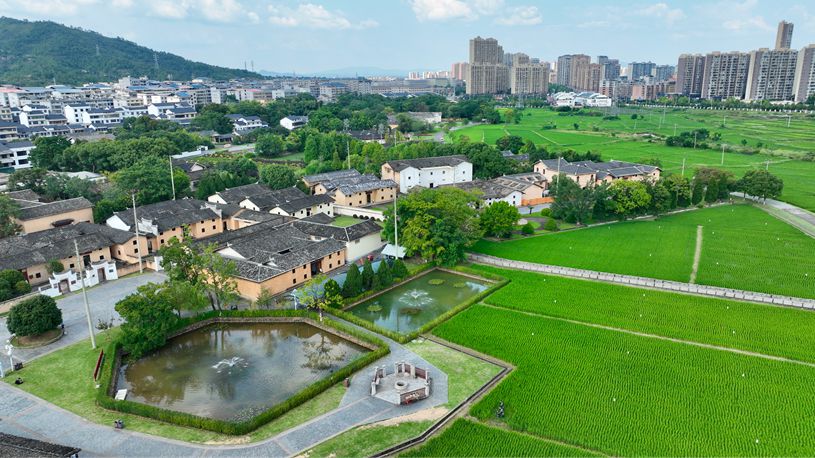
During a visit to Nangou Village in Yan'an, he saw how poverty alleviation, public infrastructure and improvements to the rural environment had changed people's lives.
"Socialism creates conditions for equality," he said. "People have equal access to education, healthcare, transport and other public services. China has demonstrated this in practice."
What impressed him was that development had not been limited to major cities such as Beijing and Shanghai. Roads, communications networks and public services had also reached rural communities.
In Nangou Village, he said, the practical work of the CPC and the government had made life more convenient for villagers and significantly improved their living environment.
He added that China's experience in poverty alleviation and improving people's livelihoods deserved to be studied by other developing countries, including Laos.
Beneath Pagoda Hill in Yan'an, visitors did not simply listen to stories about the CPC's past, but also to how the spirit formed in Yan'an continues to shape China's development today.
Photos


Related Stories
- Revolutionary heritage in cradle of the Chinese revolution continues to tell the CPC story
- Aerial view of Yan'an City, NW China's Shaanxi Province
- Foreign youth visit Yan'an in northwest China
- Combo photos: Yan'an then and now, an old revolutionary base transformed
- Revolutionary heartland Yan'an carries legacy forward into new era
Copyright © 2026 People's Daily Online. All Rights Reserved.
