



China's service exports expand globally
Data released by China's Ministry of Commerce indicated that the country's total trade in services reached nearly 3.78 trillion yuan ($562.47 billion) in the first half of this year, up 8.3 percent year on year. Service exports totaled 1.50 trillion yuan, an increase of 17.6 percent. Behind these figures is the steady improvement in the quality and efficiency of China's services sector.
What new trends and highlights are emerging in China's service exports? People's Daily spoke with industry insiders to find out.
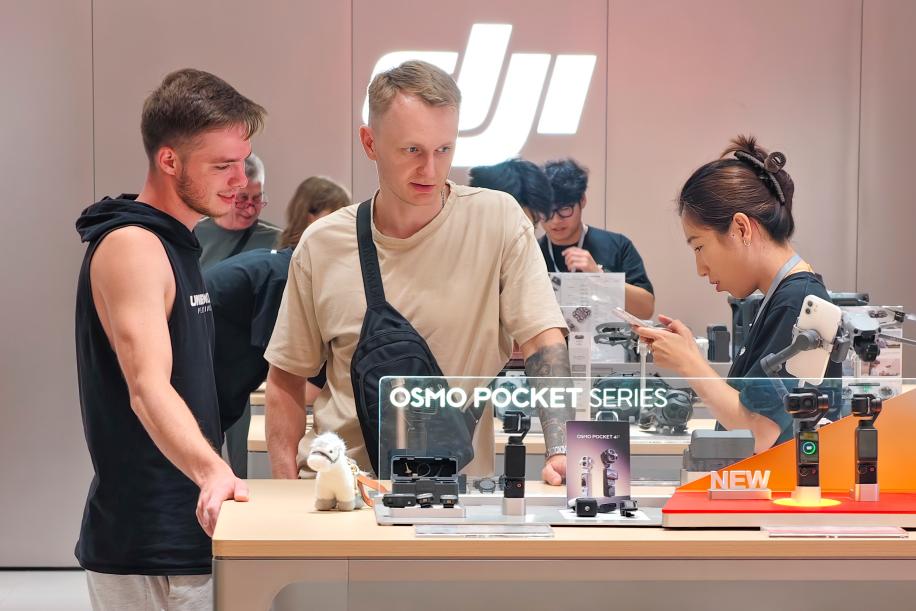
Foreign tourists learn about a gimbal camera at a DJI store in Shanghai. (Photo/Wang Chu)
In the first half of this year, China's travel service exports reached 229.2 billion yuan, up 31.1 percent year on year, the fastest growth among the country's five major service export categories.
Travel services encompass tourism, overseas study and medical care, among other areas. Spending by inbound visitors in China is counted as travel service exports. In recent years, as policies such as visa-free entry and departure tax refund have been further improved, travel to China and shopping within the country have continued to gain momentum.
Starting July 1, a new random inspection system for low-value tax refund claims was implemented nationwide. Applications involving tax-refund purchases of less than 10,000 yuan are now subject to random checks rather than physical verification of every transaction.
In the first month after the policy took effect, Shenzhen Customs in north China's Guangdong province handled 13,000 tax-refund verification cases, involving 170 million yuan in applications, up 2.2-fold and 94.1 percent, respectively, year on year.
According to a Shenzhen Customs official, overseas visitors are now purchasing a wider range of products. In addition to traditional souvenirs such as tea and silk, domestically produced digital products, clothing, and cultural and creative items have become increasingly popular.
As "China travel" continues to gain popularity, foreign visitors are venturing beyond China's major cities to less familiar destinations. Data from online tourism platform Qunar showed that in the first half of the year, inbound flights booked by foreign travelers on the platform covered 160 Chinese cities, 20 more than in the same period last year.
Foreign visitors are also staying longer. According to statistics from Chinese homestay platform Tujia, in the first half of the year, international guests booked homestays in 330 cities across China, with an average stay of 2.8 days, roughly 10 percent longer than in the same period last year. During this summer vacation period, their average stay reached 4.7 days.
"Many foreign tourists are now willing to venture into China's smaller cities, communities and rural areas and spend more time seeing a more authentic and diverse China," said Hu Yang, senior vice president of Tujia.
"China is awesome. I strongly encourage people to visit," Elon Musk, the Tesla and SpaceX CEO, recently wrote on social media. His mother, Maye Musk, later shared the post and echoed the sentiment, saying "Each city has its own charm with different cultural sites to see."
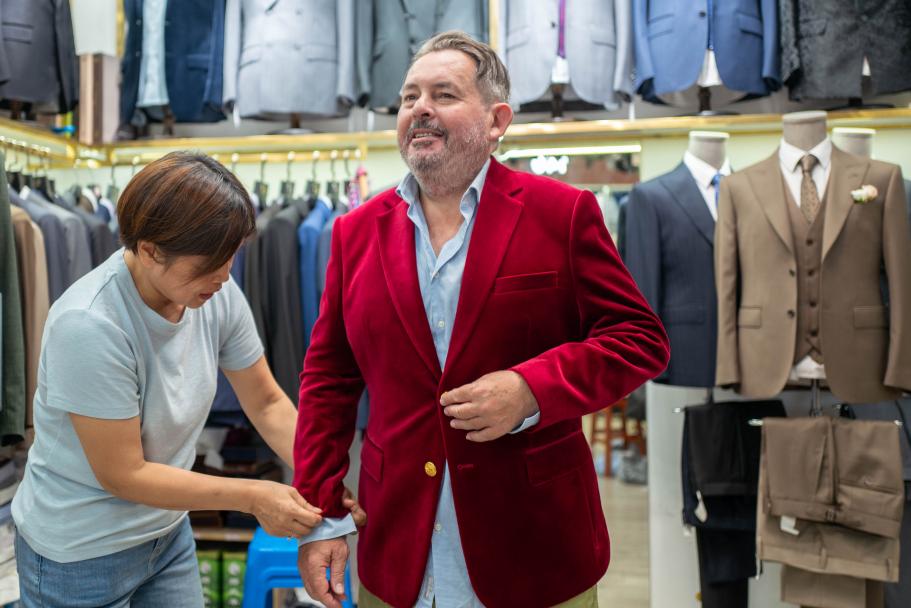
A Spanish tourist tries on a tailor‑made suit at a custom‑tailoring center on Shanghai’s South Bund. (Photo/Wang Chu)
Another highlight of China's growing trade in services is the expansion of knowledge-intensive services. In the first half of the year, China's exports of knowledge-intensive services totaled 805.67 billion yuan, up 12.8 percent year on year and accounting for 53.5 percent of total service exports.
During the period, Chinese biotechnology company XtalPi accelerated its global expansion, delivering intelligent, automated robotic laboratories for drug discovery and process optimization to South Korea's leading pharmaceutical company JW Pharmaceutical, making key progress in strategic cooperation with innovative U.S. biopharmaceutical companies and reaching an AI drug-discovery cooperation deal worth more than $400 million with a major international pharmaceutical company.
"We are turning our independently developed AI algorithms, tools, workflows and automated experimental capabilities into standardized, deliverable solutions for pharmaceutical and materials research and development," said Zhang Peiyu, chief scientific officer of XtalPi. The company has one of the world's largest clusters of AI-enabled chemical robots and has already provided services to several of the world's top 20 pharmaceutical companies.
As technologies such as AI continue to advance, Chinese companies are increasingly shifting from exporting finished technological products to exporting technological services and capabilities.
One emerging area is the export of AI tokens. A token is a basic unit that AI systems use to process and generate information. It can be viewed as a form of digital output produced through the conversion of electricity and computing power.
Chinese companies are now packaging the computing power of mature domestic large language models into standardized application programming interfaces, allowing overseas customers to access and use them without having to build their own computing infrastructure. This flexible and efficient model of tokens export is gaining favor among an increasing number of foreign businesses.
At the same time, as Chinese companies expand overseas, the consumer values and cultural elements associated with Chinese brands are also gaining wider recognition and popularity.
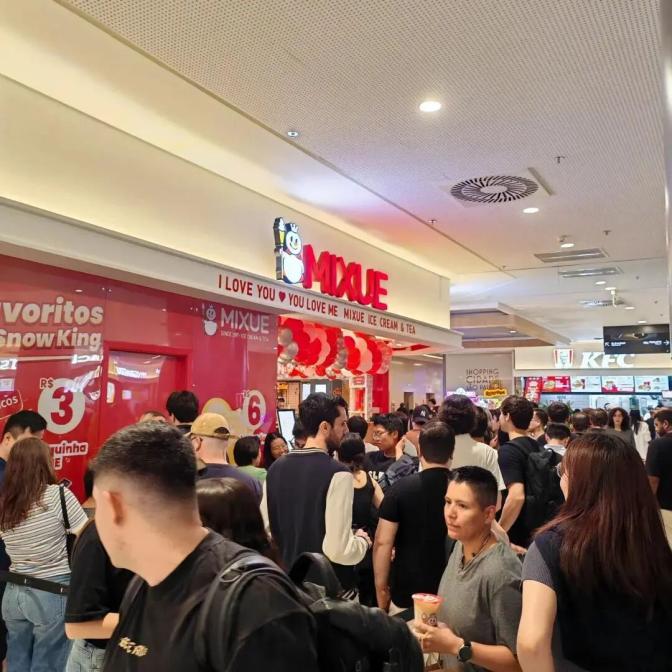
The first MIXUE store is opened in Sao Paulo, Brazil in April 2024. (Photo from JIMU News)
MIXUE, a Chinese tea and beverage chain brand, offers acai berry ice cream in Brazil, provides customers in the United States with a range of sweetness levels and develops tropical flavors tailored to Southeast Asian markets.
By adopting an operating model that combines global standards with regional customization, the company respects and embraces local cultures while bringing Chinese-style tea beverages to local markets. It now operates more than 4,500 stores in 16 overseas countries.
The global footprint of MIXUE is a microcosm of the international expansion of Chinese brands. Chinese companies are focusing not only on expanding their market presence, but also on building emotional connections with local consumers.
From the rapid growth of travel services and the expansion of knowledge-intensive services to the accelerating global reach of Chinese brands, a series of data points and real-world examples chart the transformation and upgrading of China's trade in services.
As China continues to open up its services sector, Chinese services will participate in the global division of labor in increasingly diverse forms, unlocking new sources of growth and injecting fresh momentum into the world economy.
Photos


Related Stories
Copyright © 2026 People's Daily Online. All Rights Reserved.
