



Why are overseas clients flocking to China for business?
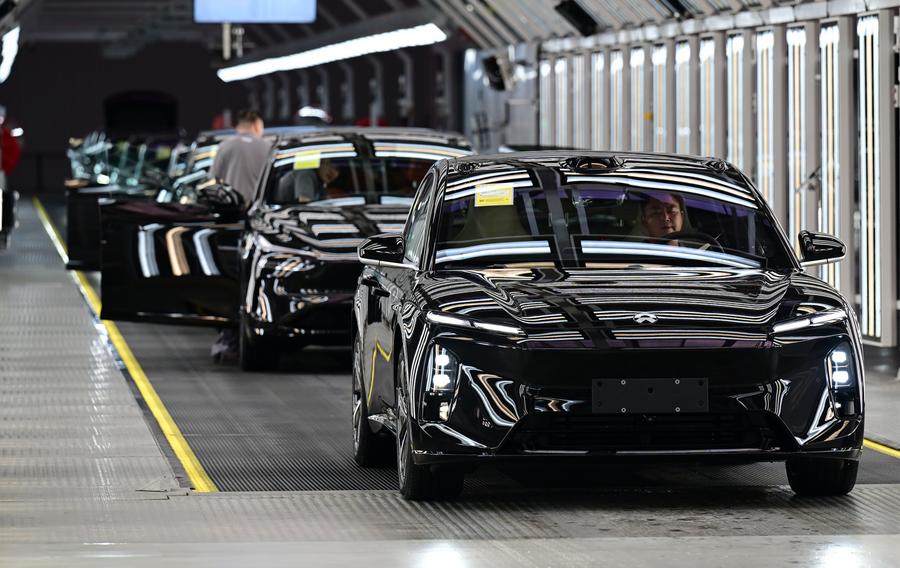
This photo shows a production line of the NIO Second Advanced Manufacturing Base in Hefei, east China's Anhui Province, July 1, 2025. (Xinhua/Zhou Mu)
A new trend is taking shape as more overseas clients come to China on business trips. In the past, Chinese entrepreneurs packed their suitcases with product samples and business cards and traveled the world in search of orders. Today, overseas clients are increasingly taking the initiative to visit China for business inspections and discussions.
What is driving this trend?
The rise of an innovative China and the benefits it continues to generate are undoubtedly the most direct factors.
For years, a common pattern in the global division of labor was that overseas companies handled product design and R&D, while China, known as the "world's factory," focused on manufacturing.
Today, this model is being rewritten. In cutting-edge fields such as the low-altitude economy, large AI models and humanoid robots, some Chinese companies have developed the ability to shape technological trends and define products.
According to real-time rankings released in August 2026 by a major global AI model aggregation platform, the world's top five AI models were all developed by Chinese companies, while Chinese models accounted for more than 63 percent of total usage.
In the first half of 2026, China's innovative pharmaceutical sector recorded 81 outbound licensing deals, with a combined potential value of about $110 billion, equivalent to 80 percent of the full-year total in 2025.
Another key factor is China's ability to rapidly transform ideas into market-ready products.
A Nordic automotive supply chain company visited a Chinese AI technology firm three times within nine months. After witnessing the company's rapid technological advances and commercialization capabilities, the Nordic company moved its annual global innovation summit to the Chinese company's laboratory.
Backed by a complete industrial system and a resilient and efficient supply chain, China has built closely connected industrial ecosystems.
For example, 90 percent of the components used by Chinese embodied AI company AGIBOT can be sourced locally in the Yangtze River Delta region, with core components available within hours. In east China's Anhui Province, an entire new energy vehicle can be manufactured without ever leaving the province. At the Shanghai Brain-Computer Interface Future Industry Cluster, numerous brain-computer interface companies have gathered.
Rich application scenarios are also driving the emergence of new industries and business models, creating new sources of competitiveness.
Today, market competition is no longer just about product performance; it is increasingly about integrated solutions and industrial ecosystems. Overseas clients visiting China for cooperation reflect the market's shift from selling products to selling solutions. Chinese companies are going beyond delivering products and services. They are becoming more deeply involved in defining challenges, designing products, validating applications and continuously refining solutions.
China's advantages as a large-scale market with diverse application scenarios are helping China solutions reach the global stage. As AI empowers industries across the board, many new technologies, products and services are moving rapidly from laboratories into real-world applications, where they can be tested and improved.
China's vast market, diverse needs and abundant application scenarios provide an ideal environment for rapid validation and iteration. Challenges faced by overseas clients can find solutions in China, where successful practices can then be replicated and promoted globally.
Photos



Related Stories
- Nearly 4,800 foreign-funded companies expand investment in China in H1
- Foreign investment in China expected to sustain growth momentum: regulator
- China sees more foreign investment inflows than outflows overall: commerce ministry
- Chinese premier to attend 17th Annual Meeting of New Champions
- China unveils action plan to better utilize foreign investment
Copyright © 2026 People's Daily Online. All Rights Reserved.
