



China's Ecological and Environmental Code: Original value and global contributions

Volunteers collect litter along an embankment in Lizi village, Taiji township, southwest China's Chongqing municipality. (Photo/Yang Min)
The Ecological and Environmental Code of China officially took effect on Aug. 15, 2026. It is China's second law to be named a "code," after the Civil Code, and the world's first code specifically named after the ecological environment.
The compilation of the Code is rooted in China's own practical experience and directly addresses the country's real-world challenges. It represents an important step toward developing an independent knowledge system for China's environmental law.
Unlike Western countries, where environmental problems emerged gradually and sequentially over centuries and environmental legislation mainly focused on end-of-pipe treatment, China is simultaneously undergoing two major transformations: from a traditional agricultural society to a modern industrial society, and from a modern industrial society to an ecological civilization society.
These two transitions overlap closely in time and intersect in space. As a result, China must address the environmental pollution and ecological degradation arising from rapid industrialization and urbanization, while also responding to the pressures of low-carbon transition driven by global climate change.
This dual environmental pressure means China must avoid following the old path of "pollute first and clean up later" taken by some Western countries. Instead, it must pursue development while protecting the environment and achieve environmental protection through development. Against this backdrop, the Ecological Environment Code could not simply copy Western models; it had to be grounded in China's own practices.
Guided by Xi Jinping Thought on the Rule of Law and Xi Jinping Thought on Ecological Civilization, the Code also draws on the wisdom of China's fine traditional ecological culture, including the ideas of harmony between humanity and nature and following the laws of nature.
Homegrown Chinese practices such as the river chief and lake chief systems, differentiated management and control of the ecological environment, and ecological conservation red lines have all been incorporated into the Code. These institutional innovations developed on Chinese soil provide the strongest practical foundation for the Code.

White egrets frolic over the Jinghe River in Tengzhou, east China's Shandong province. (Photo/Li Zhijun)
The integrated codification of legal norms covering three major spheres -- pollution prevention and control, ecological conservation, and green and low-carbon development -- represents an important contribution to the world in terms of legislative technique.
These three areas correspond directly to the three planetary crises identified by the United Nations Environment Programme (UNEP) in its 2021 report, Making Peace with Nature: climate change, biodiversity loss and pollution.
For a long time, environmental legislation in most countries has taken a fragmented approach, relying on separate laws for individual areas. Such a fragmented legislative framework has struggled to address the complex and interconnected environmental challenges facing the world today.
The Ecological and Environmental Code brings these three areas together under a unified structure comprising general provisions, pollution prevention and control, ecological conservation, green and low-carbon development, legal liability, and supplementary provisions.
This integrated approach moves beyond the traditional compartmentalized model of environmental law, which divides regulation according to environmental "media" such as air, water and soil, and instead establishes a systematic approach centered on "problems, objectives and means."
A standalone part dedicated to green and low-carbon development embodies the core of this integrated model. By embedding the green transition of development and consumption patterns into law, the Code tackles the global dilemma of balancing development and protection from a fundamental perspective.
Through establishing and improving incentive mechanisms for green consumption, advancing waste recycling systems, and facilitating coordinated green transition among upstream and downstream enterprises, the Code translates the principle of prioritizing ecological conservation and advancing green development into legally binding rules observed by the whole society.
This three-in-one structure -- covering pollution prevention, ecological conservation, and green and low-carbon development -- offers a legislative paradigm for systematically addressing ecological and environmental challenges worldwide.
For developing countries in particular, this approach offers an important reference. It provides a viable path: protecting the environment through development, and pursuing development while protecting the environment. This helps resolve the long-standing dilemma between economic growth and ecological conservation that many developing countries face.
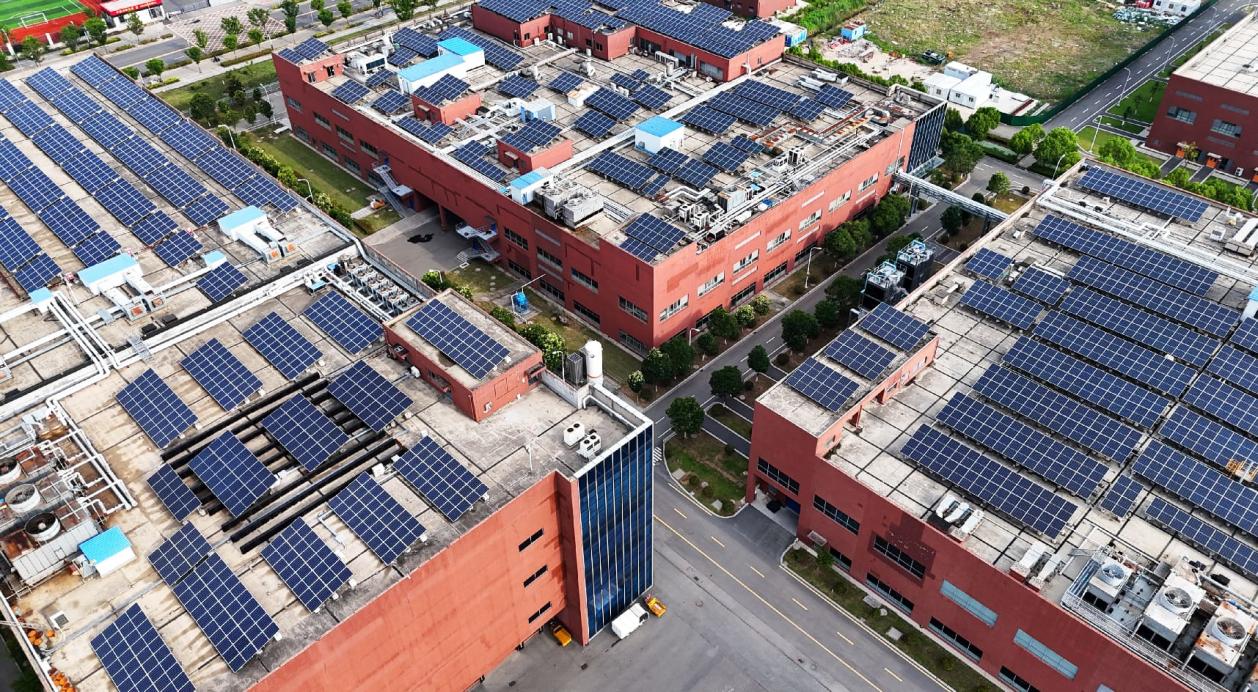
Photo shows roof-top solar panels on buildings in an industrial park in Lianyungang, east China's Jiangsu province. (Photo/Geng Yuhe)
The Ecological and Environmental Code embodies the concept of a community of life between humanity and nature, viewing both as an interconnected whole rather than as a subject-objects dichotomy. It thus marks a shift from managing individual environmental factors to pursuing systematic governance.
This philosophical perspective moves beyond the traditional dichotomy in Western environmental law between anthropocentrism and ecocentrism and establishes the pursuit of harmony between humanity and nature as a fundamental value.
The adoption of the Code is only the first step toward making good laws; more importantly, it is about achieving good governance. The international influence of the Ecological and Environmental Code will depend not only on the institutional design set out in its text, but also on how effectively it is implemented.
The Code has already demonstrated important value at the international level. Its part on green and low-carbon development includes a dedicated section on international cooperation, setting out provisions on actively participating in and leading global climate governance and conducting multilateral and bilateral exchanges and cooperation on addressing climate change.
Through codification, the Ecological and Environmental Code sends a clear message to the international community: China is firmly committed to pursuing a path of ecological conservation and green development through the rule of law, and is ready to work with countries around the world to build a clean and beautiful world.
(Qin Tianbao is the head of the Research Institute of Environmental Law of Wuhan University.)
Photos




Related Stories
- China boosts protection, support for domestic workers
- China's high-tech transformation fuels global investors' bullish outlook
- China implements new system to enhance IP protection in seed industry
- China-U.S. law enforcement cooperation yields tangible results
- Commentary: "China Squeeze" just another fallacy of zero-sum mentality
Copyright © 2026 People's Daily Online. All Rights Reserved.
