



China's MAZU initiative expands global access to AI-powered early warnings
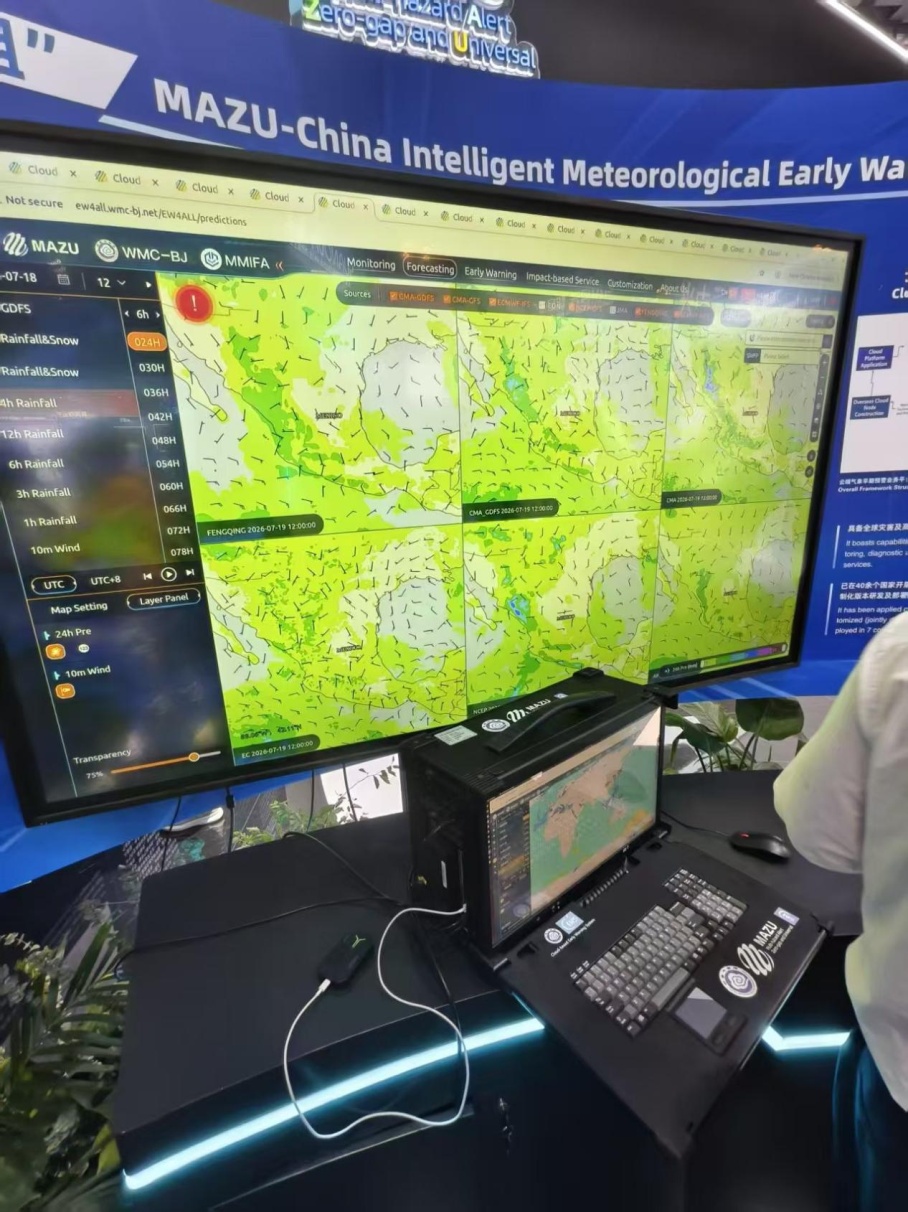
Photo shows the core carrier of the MAZU solution, the cloud-based meteorological early warning operational platform. (People's Daily/Huan Xiang)
At the opening ceremony of the 2026 World AI Conference and High-Level Meeting on Global AI Governance, Chinese President Xi Jinping announced that China will enable 30 countries to use the AI-powered meteorological warning system, or MAZU, to safeguard homes around the world.
The announcement demonstrated the commitment of China, a responsible major country, to bolstering global AI development and strengthening international AI capacity building.
"The exhibition hall has been packed from opening to closing every day. Everyone is here to learn about MAZU," a staff member at the meteorology exhibition area of the conference told People's Daily. The enthusiastic response reflected growing international recognition of China's AI-powered weather early warning solution.
As climate risks intensify and extreme weather events become more frequent, insufficient early warning capacity remains one of the most critical weaknesses in disaster prevention and mitigation across many developing countries.
In response to this global challenge, China launched the MAZU (Multi-hazard, Alert, Zero-gap, Universal) intelligent meteorological early warning initiative in July 2025, in support of the United Nations' Early Warnings for All initiative.
The initiative aims to build a global early warning network featuring multi-hazard monitoring, seamless coverage, and universal accessibility, helping narrow disparities in disaster prevention and mitigation capacity among countries.
Thanks to its strong presence at this year's conference and its expanding international deployment, MAZU continues to attract worldwide attention. Why has this Chinese solution been able to cross borders and benefit countries around the globe? The achievements unveiled at this year's conference provide a clear answer.
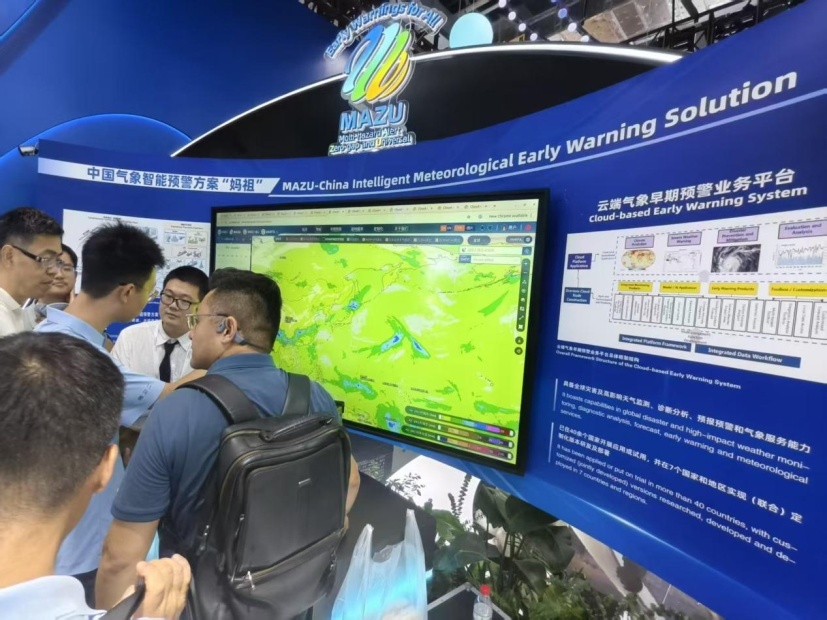
Photo shows staff introducing the MAZU solution to visitors. (People's Daily/Huan Xiang)
Advanced technology backed by comprehensive support services provides the foundation for MAZU's global reach.
On the technological side, the initiative combines data from China's Fengyun meteorological satellite series with AI-powered weather forecasting models, delivering industry-leading forecasting accuracy.
During this year's conference, China released the MAZU-FengYun Satellite AI Box and officially delivered MAZU-Djibouti 2.0 to Djibouti, further enhancing the system's ability to meet local operational needs.
China also places strong emphasis on capacity building. Through professional training programs, scholarships, and academic exchange opportunities, it has already provided technical guidance to nearly 1,000 professionals from more than 100 countries and regions, helping to strengthen disaster preparedness and early warning capabilities around the world.
China's mature AI industrial ecosystem provides strong support for the continuous upgrading of MAZU.
China combines world-class AI innovation with extensive experience in deploying AI technologies at scale. Its abundant application scenarios, well-developed engineering capabilities, and vibrant open-source ecosystem represent unique strengths that many countries currently lack.
In 2025, the value of China's core AI industry exceeded 1.2 trillion yuan ($177.36 billion), while AI adoption rate across key industries surpassed 80 percent. Supported by capabilities ranging from advanced computing infrastructure to large-scale industrial applications, MAZU has the industrial foundation needed for large-scale international deployment and broader global accessibility.
An open and cooperative approach is another key reason MAZU is benefiting the world.
At the conference, China unveiled Fenghe, a large language model-based AI meteorological service system, marking the commencement of its global open-source initiative, and established a China-Thailand joint laboratory for intelligent prediction and early warning of meteorological disasters, proactively sharing key technological achievements with international partners.
Meanwhile, representatives from 29 countries signed an agreement on establishing the World Artificial Intelligence Cooperation Organization (WAICO), while China also released the AI Cooperation and Development Action Plan, creating a new platform for inclusive, mutually beneficial global AI governance.
China's AI development has consistently been guided by the principle of fairness and inclusiveness, helping other developing countries seize opportunities presented by digital technologies, strengthen their development capabilities, and promote more balanced global AI governance.
A commitment to ensuring AI serves humanity and advances the common good lies at the heart of the MAZU initiative.
The initiative focuses on the urgent disaster prevention needs of developing countries by providing affordable and customizable early warning services. In Pakistan, the system has supported rapid responses to flood emergencies, helping strengthen emergency management. In Mongolia, meteorologists have successfully forecast major sandstorm events using monitoring and forecasting data generated by MAZU's early warning platform.
Today, MAZU has been deployed on the ground in seven countries and is providing cloud-based services in more than 40 countries, making it an important international public good serving countries across the Global South.
For centuries, Mazu, the revered sea goddess in Chinese culture, has symbolized protection for those traveling across the seas. Today, the technological MAZU is helping safeguard lives and livelihoods around the world.
While its form has evolved from a traditional cultural symbol to a modern global public technology platform, its underlying spirit remains unchanged: protecting people, serving the public good, and promoting mutual assistance.
Through inclusive technological innovation, China is helping narrow global gaps in meteorological disaster preparedness. Through openness and cooperation, it is contributing to global climate governance and continuing to offer Chinese wisdom and Chinese strength for building a community with a shared future for humanity.
Photos


Related Stories
- Major industrial firms' H1 profits grow 18.7% amid AI, chip boom
- Serbia, China pledge deeper cooperation in AI, green technology
- Mobile AI redefines industry value, paves way for win-win future
- New growth drivers fuel China's industrial profit gains
- AI partnership for a brighter future
- News analysis: Cooperation with China in AI, emerging technologies boosts Ethiopia's tech capabilities
- Inspired by Xi's words: China's youth ride AI wave
- Working together to advance AI for the positive, for good and for humanity
- What is AI's true mission? Insights from Daniel Kammen
- Embodied intelligence gains traction in factories, homes and stores
Copyright © 2026 People's Daily Online. All Rights Reserved.
