



As climate risks grow, China centers disaster preparedness on saving lives
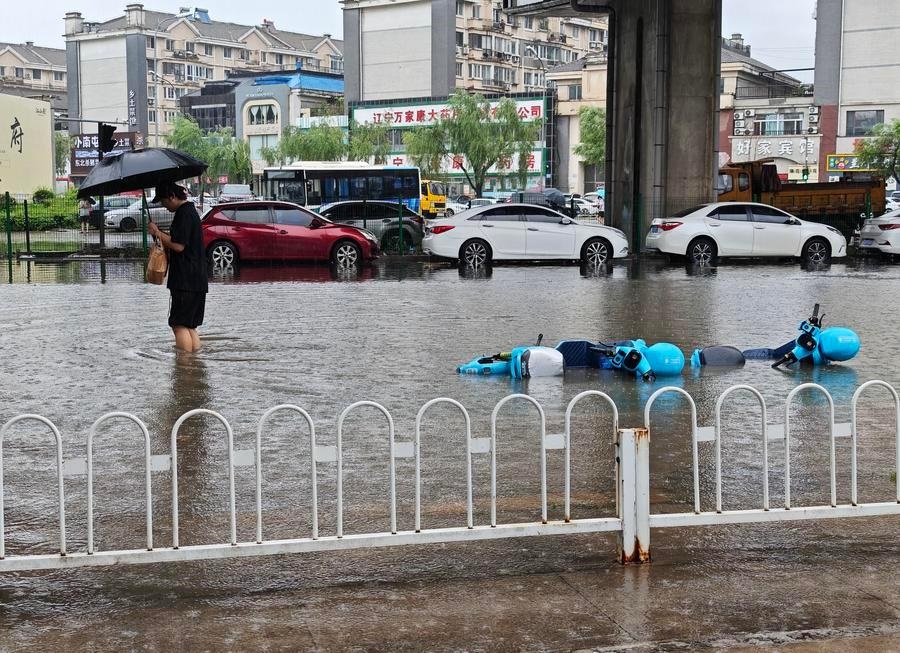
A man walks on a flooded road amid rain in Shenyang, northeast China's Liaoning Province, on July 13, 2026. (Xinhua/Li Gang)
BEIJING, July 17 (Xinhua) -- This year's flood season has brought unusually severe weather across China, with torrential rains, floods, typhoons and other natural hazards affecting multiple regions, causing significant casualties and economic losses.
Against this backdrop, the principle of putting people and their lives first has become central to China's approach to disaster prevention, mitigation and relief.
SAVING LIVES FIRST
As night fell over Huanggang City in central China's Hubei Province, fire engines pushed through streets strewn with broken bricks and shattered glass, passing factories torn apart by one of the strongest tornadoes the region had seen in years.
Nearby, 19-year-old firefighter Chang Yanhao, who had been with the corps for less than two years, was taking part in his fourth rescue mission. Wiping sweat from his face, he returned to clearing debris. "It's tiring, but it's an honor," he said. "I just hope we can finish sooner, so local people suffer fewer losses."
Nearly 1,000 firefighters, together with police officers and emergency personnel, took part in rescue efforts following the July 6 tornado. Amid the wreckage, Xu Changyou, political commissar of the Hubei fire rescue mobile corps, coordinated rescue operations as firefighters searched damaged homes and cleared debris.
"The people's interests always come first," Xu said. "We will do everything we can to save people from danger and help them through hardship."
Emergency response efforts in Hubei reflect China's evolving approach to disasters in light of these shifts -- one prioritizing people's lives and safety not only in emergency responses, but also in disaster prevention.
Ahead of the landfall of Typhoon Bavi in east China's Zhejiang Province, more than 2.68 million people were evacuated. Local authorities opened over 19,000 emergency shelters, while schools suspended classes and construction sites and tourist attractions were closed.
Emergency resources are also deployed before disasters strike. In east China's Fujian Province, fire and rescue teams inspected and serviced emergency equipment ahead of approaching storms, while power utilities pre-positioned repair crews, generators and drainage vehicles to restore critical services as quickly as possible.
These local relief efforts align with China's improving emergency response mechanism. Under a national plan released last month, the country aims to build a modern emergency management system centered on prevention by 2030, with significantly enhanced intelligent and digital capabilities.
That transition has become increasingly urgent in the longer term, analysts say. "As the climate warms, extreme weather is becoming more frequent and more complex, while climate patterns are undergoing significant changes," said Chen Tao, chief forecaster at the National Meteorological Center.
HUMAN-CENTERED TECHNOLOGY
For decades, flood rescue in China depended largely on people -- rescue workers navigating raging waters in inflatable boats, often putting themselves at considerable risk. Today, technology is increasingly taking on the most dangerous tasks.
In flood-ravaged Hengzhou in south China's Guangxi Zhuang Autonomous Region, an unusual rescue captured nationwide attention.
An oil tanker was almost completely submerged, with two people stranded on its roof as floodwaters continued to rise. With no safe way to reach them, a drone lowered a rescuer onto the stranded vehicle, who then helped the trapped residents to safety.
"In principle, drones are not meant to carry people. But people come before principles," read one widely shared online comment that resonated with many Chinese netizens.
Liang Weilei, vice president of the Hengzhou drone association, said the rescue left responders with little choice. "If we hadn't used the drone, the floodwaters would have swept them away," he was quoted by the Beijing Daily as saying.
Technology is no longer confined to the rescue phase. Across China, drones, powered pontoon bridges, automated monitoring systems and AI-driven technologies are accelerating evacuations and increasingly helping authorities detect risks before disasters unfold.
During recent torrential rains in Longgang District in south China's Shenzhen, an AI-powered monitoring system analyzed some 243,000 surveillance images in real time, tracking flooded roads, rising rivers, blocked drains and fallen trees across the district.
It issued more than 1,500 alerts, each pinpointing the location and nature of the risk, allowing emergency crews to respond before conditions worsened.
"In the past, flood control relied on staff watching surveillance cameras around the clock, and it was easy to miss something," said Wang Wei, head of information support at Longgang's emergency management bureau.
Now AI scans the footage, detects potential risks and automatically alerts emergency responders, allowing people to focus on responding rather than searching, he added.
Photos



Related Stories
- Relief efforts launched in N China's Chengde after heavy rainfall
- Chinese vice premier stresses flood control, disaster prevention
- Flood relief and recovery efforts underway in south China's Guangxi
- China allocates 30 mln yuan for post-disaster recovery in typhoon-hit Jilin
- Flood relief and recovery efforts underway in flood-hit Guangxi
Copyright © 2026 People's Daily Online. All Rights Reserved.
