



External meddling cannot legitimize the so-called "South China Sea Arbitration Award"
Recently, certain countries outside the South China Sea region issued a joint statement on the 10th anniversary of the so-called "South China Sea Arbitration Award." The statement disregards historical facts and basic norms of international law, wrongly denies China's legitimate rights and interests in the South China Sea, groundlessly criticizes China's lawful exercise of jurisdiction and its actions to safeguard its rights there, and attempts to justify the so-called "award," which has been illegal, null and void from the very beginning.
The South China Sea is not a "hunting ground" for extra-regional countries, still less should it become an arena for great-power rivalry. Countries including the U.S., Japan and Australia, as well as the European Union, are not parties to the South China Sea issue and ought to maintain an objective and neutral stance on the territorial disputes in the region. Instead, driven by their own geopolitical interests, they have repeatedly endorsed the so-called "award," encouraged and emboldened the Philippines to take provocative actions that infringe on China's rights, and deliberately sought to sow discord among regional countries.
With the overall situation in the South China Sea remaining stable, these actions by external forces go against the common pursuit of people in the region for peace and development, and are extremely irresponsible in terms of the interests of regional countries and the peace and stability of the international community.
Some extra-regional countries have a horrible track record of stirring up trouble. Major international crises they have caused in the Middle East, Europe and elsewhere remain unresolved, with turmoil and division still unfolding. Now these countries are attempting to repeat the same playbook to interfere in the South China Sea, and their intent to disrupt the region and contain China is obvious.
The U.S. has not yet ratified the United Nations Convention on the Law of the Sea (UNCLOS), yet it makes unwarranted accusations against and blatantly interferes in other countries' legitimate maritime activities, laying bare its hegemonic logic and hypocrisy.
During World War II, Japan committed innumerable crimes that caused untold suffering on China and its people, including the illegal occupation of islands and reefs in the South China Sea. Instead of reflecting upon what it has done, Japan, in the name of a "stakeholder," is again attempting to meddle in the South China Sea. This reminds people of Japan's history of aggression and expansion, and heightens their vigilance against Japan's neo-militarism agenda.
The so-called "South China Sea arbitration" is political circus dressed up as legal action, unilaterally initiated by the Philippines and emboldened and supported by external forces, and the so-called "award" has never carried any legal force. It is untenable on both procedural and substantive grounds. Land territorial issues are not subject to UNCLOS. With the optional exceptions declaration China made in 2006 pursuant to Article 298 of the Convention, maritime delimitation disputes have been excluded from the compulsory dispute settlement procedures under UNCLOS.
The Philippines' unilateral initiation of the arbitration violated the bilateral agreement it reached with China, as well as principles for the resolution of disputes established under the Declaration on the Conduct of Parties in the South China Sea (DOC). "The arbitral tribunal exceeded its jurisdiction and issued an illegitimate ruling, reaching numerous erroneous conclusions. Most notably, it wrongly characterized Taiping Dao (the Taiping Island), the largest island in Nansha Qundao (the Nansha Islands), with an area of 500,000 square meters, as a rock rather than an island.
By the same logic, islands and reefs belonging to external countries would also be denied the basis for claiming maritime rights and interests. May we ask, have those countries supporting the "award" voluntarily waived the maritime rights and interests deriving from their relevant islands and reefs? China urges relevant countries to think this through before pointing fingers at it.
China's sovereignty and the relevant rights and interests in the South China Sea have been established in the long course of history, and are solidly grounded in history and the law. Chinese activities in the South China Sea date back to over 2,000 years ago. China has sovereignty over Nanhai Zhudao (the South China Sea Islands), and sovereign rights and jurisdiction over the relevant waters and the seabed and subsoil thereof. China has historic rights in the South China Sea. China's exercise of jurisdiction and law enforcement activities in relevant islands, reefs and waters of the South China Sea fully comply with its domestic laws and international laws including UNCLOS, and are professional, restrained, justified and lawful. China's sovereignty and related rights and interests over the South China Sea are not affected at all by the "award."
China has firmly safeguarded its territorial sovereignty and maritime rights and interests, kept the South China Sea peaceful and stable, and properly handled maritime differences through negotiation and consultation.
For years, China and ASEAN countries, guided by the principles of mutual respect and consensus through consultation, have fully implemented the DOC in an effective way, steadily advanced consultations on a Code of Conduct in the South China Sea (COC), and deepened practical cooperation in maritime search and rescue, environmental protection, and disaster prevention and mitigation. Together, they have explored a path of maritime governance suited to regional realities while taking into account the interests of all parties.
The current situation in the South China Sea is generally stable. There isn't any problem with the freedom of navigation and overflight that countries enjoy in accordance with the law. Facts have fully demonstrated that China and regional countries have the capability and wisdom to properly manage differences, defuse tensions and jointly safeguard peace and tranquility in the South China Sea. China will take firm and resolute countermeasures against any infringement or provocation in accordance with the law, and will resolutely defend its sovereignty, security, and development interests.
Peace, stability and prosperity in the South China Sea can only be led and safeguarded by regional countries, and require no interference or disruption from any external force. China urges relevant countries outside the region to recognize the overarching trend and immediately stop stirring up trouble in the South China Sea. Certain regional countries should also see through the malicious intentions of external forces and return, as soon as possible, to the right track of handling maritime disputes through consultation among countries concerned and observing the spirit of the DOC.
(Zhong Sheng is a pen name often used by People's Daily to express its views on foreign policy and international affairs.)
Photos
 Night market of Xishuangbanna sees surge in visitor arrivals during summer peak tourism season
 Pulu weaving tradition thrives in Kyimxi township, SW China's Xizang
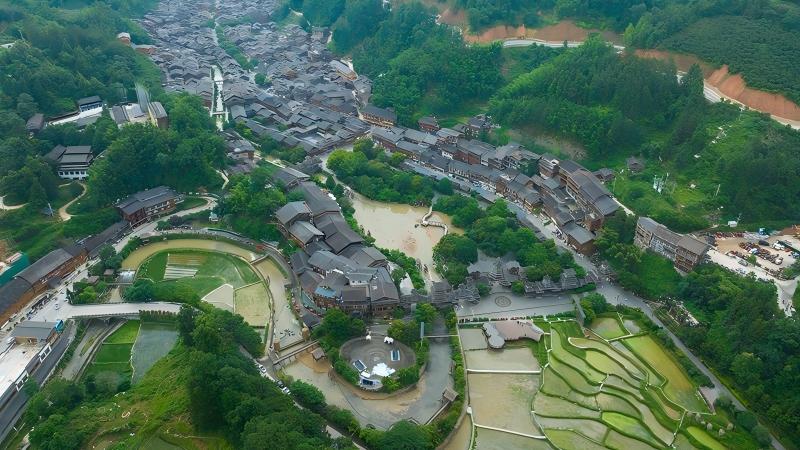 Intangible cultural heritage breathes new life into Dong village in SW China's Guizhou
 Badminton shuttlecocks boost development of county in SW China's Guizhou
Related Stories
- Int'l law experts denounce "South China Sea Arbitration Award" as politically manipulated, legally void
- Commentary: Japan must stop its meddling in the South China Sea
- China urges Europe to act prudently on South China Sea issues
- PD Explainer | Ten years on: debunking the South China Sea 'arbitration' farce
- Chinese embassy lodges protest against Japan's words, deeds concerning so-called "South China Sea arbitration award"
- Int'l law experts rebuke so-called "South China Sea Arbitration Award"
- Never allow 'neo-militarism' to wreak havoc in the South China Sea
- Feature: How researchers, locals safeguard ecological harmony in China's Xisha Islands
- Commentary: Invalid South China Sea "arbitration" belongs in dustbin of history
- Who does the 14-country statement intend to intimidate? The Chinese people neither believe in fallacy nor fear evil forces
Copyright © 2026 People's Daily Online. All Rights Reserved.
