



Clued-in | X's auto-translation feature exposes Japan's wartime denialism to the world
Earlier this year, when X (formerly Twitter) improved its algorithms and rolled out automatic translation on a much wider scale, the platform aimed to connect internet users from around the world and make global communication easier.
Yet the change has unexpectedly opened a window onto Japan's long-standing denial of its World War II atrocities, helping to raise global awareness of a brutal past the country has long tried to hide.
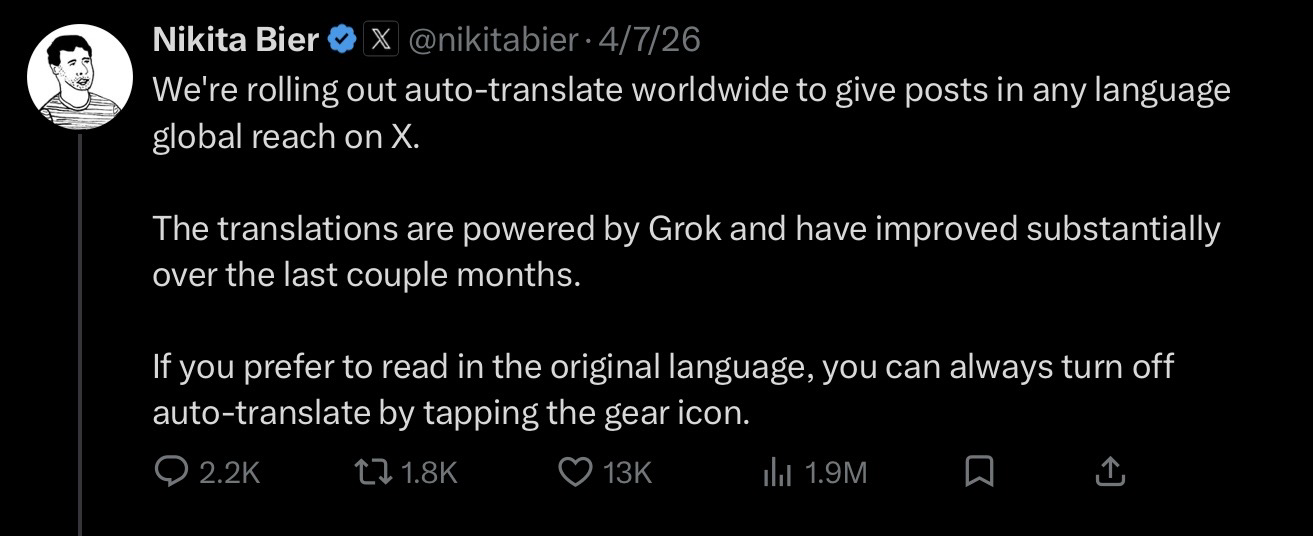
Earlier this year, Nikita Bier, head of product at X, announced the rollout of auto-translation and algorithm improvements. He explained that the changes would help break down language barriers, making it easier for people around the world to discover and see each other's popular content. (Screenshot/X)
In the past, conversations inside Japan about World War II and territorial disputes rarely reached beyond Japanese speakers. The language barrier, combined with the platform's earlier recommendation system, kept most of these discussions circulating in their own bubble.
Even when Japanese right-wing users or politicians posted extreme claims, such as denying the Nanjing Massacre, questioning the existence of "comfort women," or pushing disputed territorial demands, their words usually stayed within a small circle and had little impact outside Japan.
That insulation is gone now. Thanks to the new algorithm and instant auto-translations, those same posts are automatically converted into English, Chinese, Korean, Spanish, Arabic and many other languages, then recommended to users around the world who would never have seen them before. Content that once remained in niche communities is suddenly appearing in front of much larger, more diverse audiences. The removal of language barriers has not only made communication easier; it has also sparked a direct and often heated global debate over history.
Japanese accounts that twist historical facts have quickly felt the change. Posts that once drew mostly supportive reactions at home are now attracting large numbers of comments in many different languages.
Far from winning new supporters, their attempts to deny or downplay well-established historical facts have triggered strong backlash, widespread questioning and firm rebuttals from people across many countries.
Instead of staying quiet, netizens, historians and people who care about historical truth have pushed back. They have begun sharing clear evidence, including old documents, photographs, survivor testimonies and records from international war tribunals, about events like the Nanjing Massacre and Unit 731.
These materials, now available in multiple languages, have spread rapidly and reached far more people than ever before. What began as a reaction soon turned into a broad, grassroots effort to defend historical facts.
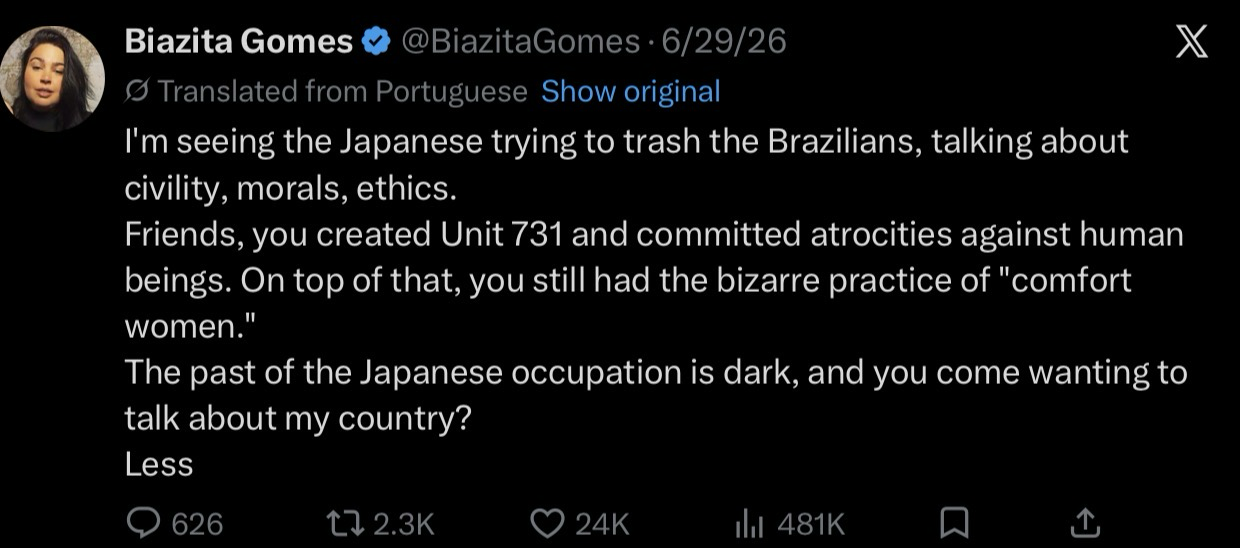
A Brazilian user on X recently criticized Japan's wartime invasions across Asia, highlighting atrocities such as the "comfort women" system and the horrific experiments of Unit 731. Topics like these were once rarely discussed on X, but thanks to the new auto-translation feature and improved algorithms, more people around the world are now discovering and confronting these historical truths. (Screenshot/X)
On X, Brazilian user Biazita Gomes called out Japan's double standards, pointing out that the country committed war crimes such as Unit 731 and the exploitation of "comfort women." The post quickly racked up over 24,000 likes, with netizens around the world echoing her claims and urging Japan to honestly confront its brutal past.
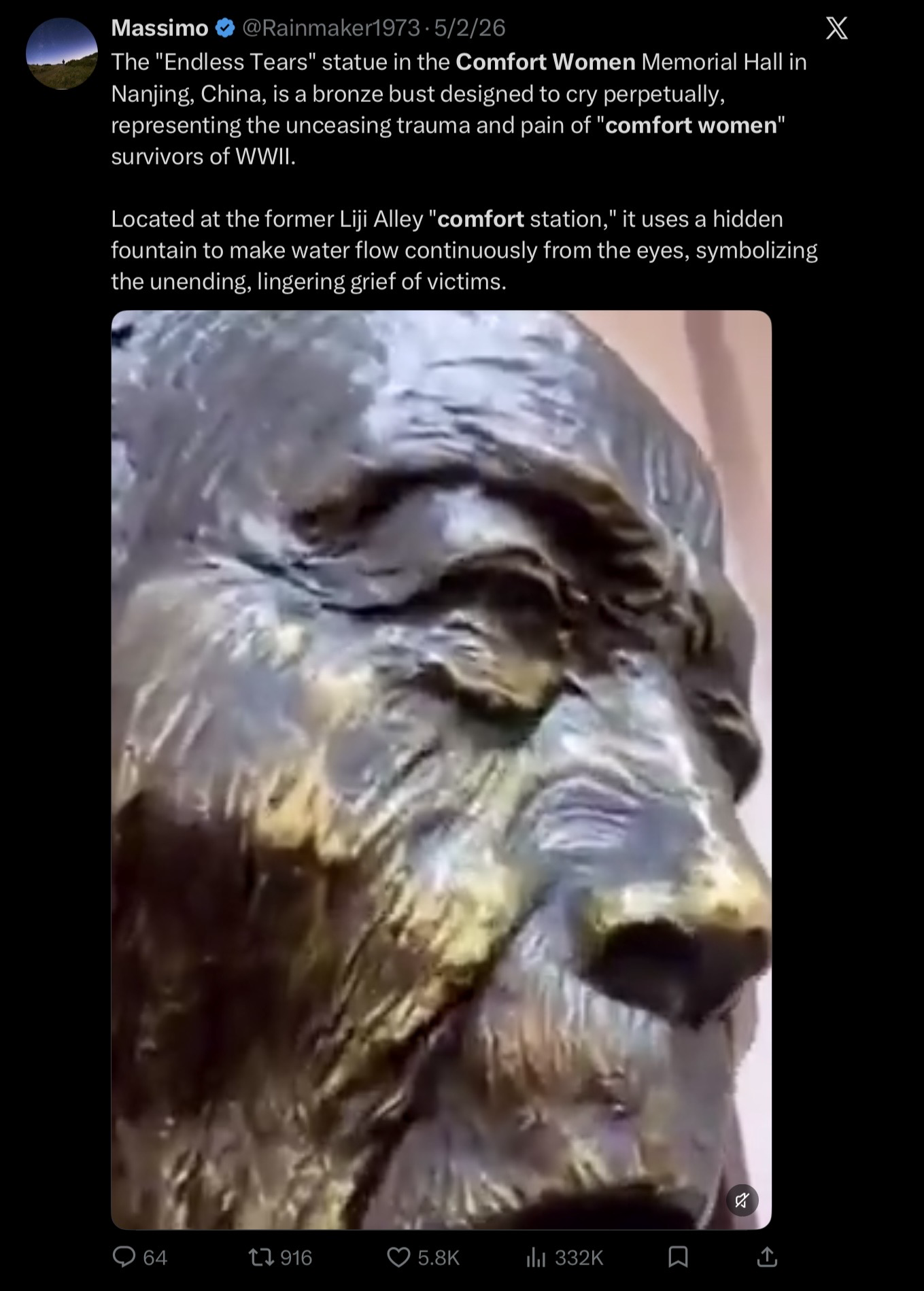
Massimo (@Rainmaker1973), an account on X with over 4.3 million followers, has been sharing the truth about the horrific suffering of the "comfort women" with his audience.
This wave of online discussion has been amplified by recent developments in Japan itself. For example, the Nagasaki Atomic Bomb Museum's plan to replace the term "Nanjing Massacre" with the softer "Nanjing Incident" was widely criticized as an attempt to downplay history.
Similarly, statements by Prime Minister Sanae Takaichi and other politicians on historical and territorial issues have drawn fresh international attention and criticism once they reached a global audience. Japan's long-promoted image as a peaceful nation has taken another blow.
For years, certain groups in Japan have tried to avoid or minimize brutal parts of the country's wartime past. They relied on language barriers and limited international exposure to keep scrutiny low. But in today's environment, with information flowing freely across languages, those old strategies no longer work as effectively.
Ironically, every revisionist post now tends to draw more attention to the very facts its authors hoped to obscure. Detailed historical evidence is reaching more people, in more languages, than before.
History cannot be easily rewritten. In the face of clear evidence and growing international awareness, attempts to deny or distort the past are failing. As these conversations continue on X, the platform's changes have unintentionally revealed something important to the world: no matter how hard some try to hide or twist the truth, the voices calling for justice and historical honesty are only growing stronger.

Photos

Related Stories
- Large protest held in Tokyo, online against Takaichi government's dangerous policies
- Clued-in | Japan begins new Fukushima water discharge, leaving the world to bear the cost
- Chinese military spokesperson slams Japan for weaponizing, militarizing space
- Japanese civil groups call for squarely facing history on 89th anniversary of July 7 Incident
- The Tokyo Trials: Justice endures
Copyright © 2026 People's Daily Online. All Rights Reserved.
