



Handcrafted economy thrives in China
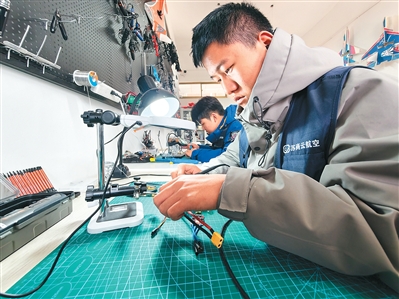
Students practice assembling and repairing drones at a training center for one-person companies (OPCs) at a vocational school in Suqian, east China's Jiangsu Province, March 24, 2026. (Photo/Ding Huaming)
In January 2025, Xu Ting posted a message on the social media platform Xiaohongshu. "I want to build an app that uses AI to chat with elderly people and write their memoirs," she wrote. "Is anyone interested in joining me?"
A handful of strangers, drawn in by the post, helped her turn the idea into a working product now in public beta testing.
Xu's story reflects a broader trend in China known as the handcrafted economy, in which individuals or small teams use AI and social media to bring ideas to market at a relatively low cost.
Rather than assembling the dozens of specialists a traditional app team would require, Xu recruited three or four collaborators online and used AI coding tools to build the product herself, despite having no programming background.
Posting online has effectively replaced costly market research, Xu said, noting that user feedback and media attention poured in within a day of her post, all at no cost. Falling prices for AI-generated tokens, driven partly by Chinese large language models such as DeepSeek, have also made development affordable for entrepreneurs without big-company resources, she added.
Such a trend has been gaining traction. Nearly 23,000 AI applications now exist on the "Studios" channel of Alibaba's ModelScope community, one of China's largest open-source platforms for AI large models, with about 95 percent developed by individuals.
Li Ning, a professor at Tsinghua University's School of Economics and Management, said AI has sharply cut costs in technology development, manpower and market validation, expenses that once forced many people to abandon good ideas. Small teams can now achieve what once required hundreds of employees, he said, adding that their flexibility also gives them an edge in disruptive innovation that large, risk-averse companies often lack.
"The rise of the handcrafted economy has injected fresh vitality into the creativity of society. This small-team-driven model of innovation complements the broader innovation ecosystem of society as a whole," Li said.
Yet technology alone does not guarantee success. Li identified two common types of successful entrepreneurs: those with deep expertise in a field who use AI to scale their skills, and those with sharp insight into overlooked needs who use AI to act quickly.
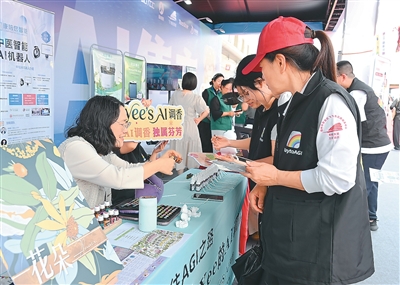
An OPC entrepreneur (left) demonstrates AI-powered fragrance blending with essential oils to visitors at an AI market during an expo in Fuzhou, southeast China's Fujian Province, April 28, 2026. (Xinhua/Lin Shanchuan)
Xu falls into the latter category — her app idea stemmed from a desire to preserve her aging grandfather's life stories, leading her to position the product as elderly-friendly and emotionally supportive rather than a substitute for family companionship.
Human judgment, Li said, remains irreplaceable in decisions about whether a product is worth developing, whether a design will resonate, or which business model will win customers. These are the kinds of judgment calls where AI's capabilities still fall short.
Intrinsic motivation also matters. As AI lowers the technical barriers to entrepreneurship and innovation, having a clear goal — and the willingness to pursue it through long-term, hands-on effort — has become a key variable in whether a project succeeds. Passion and curiosity, he added, are becoming more valuable than traditional credentials such as work experience or academic background.
"As long as you can identify a genuine pain point within an industry, a team of just three to five people can generate output value in the hundreds of millions or even billions of yuan (1 yuan equals about $0.14)," Li said, indicating the enormous potential of the handcrafted economy.
Examples of breakout success abound. Chen Yunfei, a former internet industry worker with no technical training, built a phone flash app in about an hour using AI after noticing his girlfriend struggled with lighting for photos. The app topped Apple's paid app charts within four hours of launch. A 17-year-old student built a calorie-counting photo app that has generated more than $30 million in annual revenue within two years.
China had more than 16 million one-person companies (OPCs), a new form of AI-enabled startup, as of April 2026, according to a nationwide industry report.
Li attributed the boom to the rapid iteration of AI capabilities and falling costs, combined with China's strengths in both software and hardware.
This is exemplified by AI recording device maker Plaud, whose founder turned the idea into reality thanks to a robust hardware supply chain in Shenzhen, south China's Guangdong Province. Within four years, the company's products, valued at roughly 10 billion yuan, have been sold in 170 countries worldwide.
Still, scale is not the only measure of success. Many thriving projects remain deliberately small and niche, rooted in a deep understanding of specific user groups. "What sustains our team isn't valuation or the next funding round, but warm feedback from users and a genuine sense of fulfillment," Xu said.
Photos
 Residential community activates misting system amid hot weather in China's Shanxi
 Immersive theater village inspired by poverty alleviation story opens in NW China's Ningxia
 Night scenery of Huishan Yingyueli area in China's Jiangsu
 Smart plant factory produces high-quality vegetables, creates jobs in Kuqa, NW China's Xinjiang
Related Stories
- China to strengthen green economy, AI cooperation with Denmark: Chinese FM
- China to promote forging of widely-accepted global AI governance system: vice president
- China to promote forging of widely-accepted global AI governance system: vice president
- China delivers joint statement on AI accessibility at UN
- WEF's Mirek Dušek: How AI can deliver real business value
- Chinese schools embrace AI tools, with caveats
- More 'DeepSeek moments' ahead: Will US continue to build walls or learn?
- Youth seen at Summer Davos as driving force for innovation in AI era
- CISCE 2026 | What are the latest technologies at the 4th China Int'l Supply Chain Expo?
- Clued-in | AI for good: Major countries should shoulder their responsibility
Copyright © 2026 People's Daily Online. All Rights Reserved.
