



Mountainous city in NW China's Shaanxi cultivates thriving plush toy industry
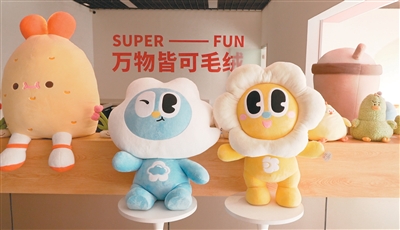
Photo shows plush toys made in Ankang, northwest China's Shaanxi Province. (Photo/Hu Jian)
Production is in full swing at a plush toy company in the Wuli Industrial Cluster in Hanbin district of Ankang, northwest China's Shaanxi Province. In one corner, plush blind boxes are boxed and readied to cross oceans and land on supermarket shelves overseas.
By the end of 2025, Ankang's plush toy industry had surpassed an output value of 10.02 billion yuan ($1.48 billion), with daily production capacity exceeding 1.5 million units. The products were exported to more than 80 countries and regions.
Located in the middle and upper reaches of the Hanjiang River as it winds through the Qinba Mountains, Ankang was once part of a designated contiguous poverty-stricken area. It is also a key water conservation zone along the middle route of the South-to-North Water Diversion Project.
Since the 12th Five-Year Plan period (2011-2015), the city has built 1,364 resettlement communities, enabling 937,800 people to move down from the mountains.
Relocation was only the first step. The real challenge was ensuring people could find stable income and become prosperous. In the water conservation zone, industrial development had to be green, low-carbon and sustainable.
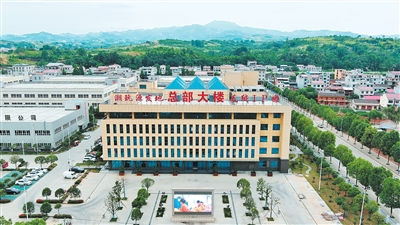
Photo shows the headquarters building of Ankang's plush toy industry, located in the Wuli Industrial Cluster in Hanbin district of Ankang, northwest China's Shaanxi Province. (Photo/Hu Jian)
After extensive research, Ankang turned to plush toys. The industry offered low pollution, high labor demand, long value chains and strong potential for job creation.
Forty-four-year-old Chen Yiping once shouldered her household's farming, child care and elder care largely on her own, with little cash income. After moving into the new community in 2023, she found a factory job right downstairs from her home.
"I used to worry all the time after moving down the mountain, afraid I wouldn't find a job. Now it's different. Life is comfortable, I can walk to work and still take care of my family," she said. Paid by piece, skilled workers can earn around 150 yuan a day. This nearby job has given her stability and more peace of mind.
By the end of 2025, Ankang had 1,022 operating community factories and workshops, employing over 41,000 people.
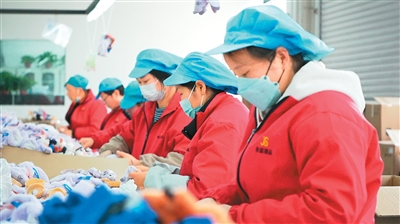
Workers make plush toys at a factory in Ankang, northwest China's Shaanxi Province. (Photo/Hu Jian)
At Ankang Aiduobao Animation Culture Industry Co., Ltd., an AI plush toy called "Saisai Cat" has become a standout attraction. It is an interactive companion that can listen, talk and offer emotional support.
In early 2025, the city's first AI toy was released. In February 2026, 10 AI plush toys integrating advanced technologies were unveiled at a returned talent economy conference. Among them, "Xiao Qi," a smart travel companion blending Terracotta Warrior elements with giant panda charm, offers real-time voice interaction, scenic explanations, cultural interpretation and route planning.
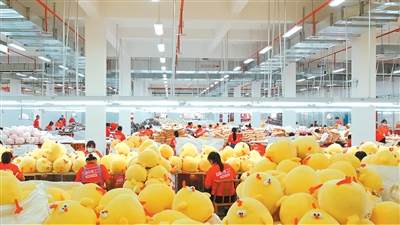
Photo shows plush toys at a factory in Ankang, northwest China's Shaanxi Province. (Photo/Hu Jian)
Ankang's plush toy industry is also moving up the value chain. At Ankang Mixiaodian Brand Management Co., Ltd., a range of well-designed blind boxes draws crowds, with the product now in its 12th generation, each iteration refined to better capture young consumers.
According to General Manager Zhu Minghua, the company now records an annual output value of 130 million yuan, with a growing share from its own brands.
Photos
Related Stories
Copyright © 2026 People's Daily Online. All Rights Reserved.
