



Industrial heritage sites repurposed into popular tourist destinations
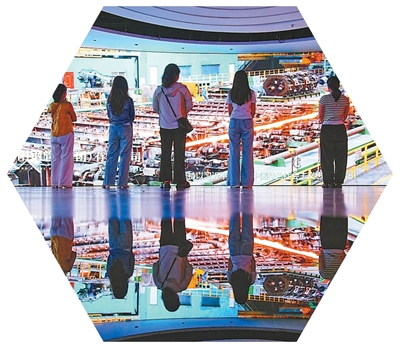
Visitors tour Hengyang Jianxiang Industrial History Museum in Hengyang, central China's Hunan Province. (Photo/Cao Zhengping)
Recently, seven government departments issued a notice calling for the promotion of industrial culture, protection of industrial heritage, and the development of industrial tourism.
In recent years, industrial tourism has surged in popularity, with people visiting time-honored brands, experiencing craftsmanship, revisiting revolutionary sites, and engaging with cutting-edge technology. During the three-day Dragon Boat Festival holiday, industrial tourism once again saw a nationwide boom.
During the holiday, the central plaza of the 699 Cultural and Creative Park in Nanchang, east China's Jiangxi Province, was filled with the fragrance of mugwort.
The 699 Cultural and Creative Park was formerly the Jiangxi Hua'an Knitting General Factory. Hu Nianfu, who worked there for nearly 30 years, witnessed the factory's rise and decline.
The former factory covered 165 mu (11 hectares) and sat in a densely populated area. In 2010, local authorities launched redevelopment plans for the site. They decided to avoid large-scale demolition and instead preserve, restore, and repurpose the old factory buildings and relics.
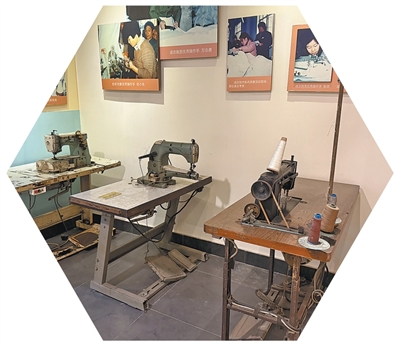
Photo shows old industrial artefacts on display at the history exhibition hall of Jiangxi Hua'an Knitting General Factory in Nanchang, east China's Jiangxi Province. (People's Daily/Zhou Huan)
At the park entrance stands a three-story red-brick building.
"We adhered to the principle of minimal intervention, preserving the red-brick texture and industrial character," said Hu Huaqiang, director of asset engineering at the 699 Cultural and Creative Park.
The restoration team sourced matching old bricks to replace weathered ones, retained the original pine-beam roof structure, and removed rust from the steel window frames while preserving their original form and texture. The site now attracts steady streams of visitors and has become a new urban cultural landmark.
Leveraging its diverse business forms and large space, the management team established more than 20 interest-based communities, including photography, reading, and handicrafts, and regularly organized activities.
Today, the park hosts more than 30 types of businesses, directly creating over 3,000 jobs and generating nearly 2 billion yuan (about $294 million) in annual output.
In Yanta district of Xi'an, northwest China's Shaanxi Province, the Time Culture Park comes alive in the morning. Young people gather to make Zongzi (sticky rice dumplings), families craft colorful sachets, and children take part in land dragon boat games. The park was once the site of a state-owned clock and watch machinery factory.
After production gradually ceased in 2000, the once-bustling factory area became a storage zone. Buildings deteriorated and equipment rusted, while surrounding high-rises rose steadily, creating a stark contrast between old and new.
Within a 3-kilometer radius, 700,000 residents had growing demand for leisure spaces. Meanwhile, more than 80 mu of idle industrial land lay dormant.
In 2021, as Xi'an was selected as a national urban renewal pilot city, Yanta district broke new ground by turning the former factory into a pilot project. Through functional renewal, spatial redesign, and industrial restructuring, Shaanxi Culture Investment Tianzi Culture and Technology Co., Ltd. undertook the project.
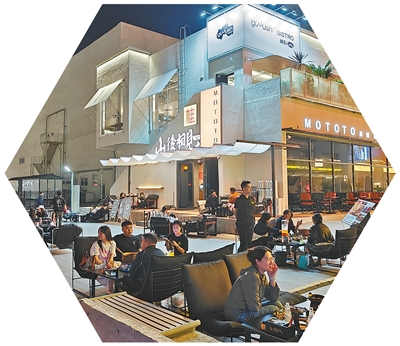
Residents have fun at Time Culture Park in Xi'an, northwest China's Shaanxi Province. (Photo courtesy of the interviewee)
"Eighty percent is preserved, yet one hundred percent is renewed," said Yan Xiangcui, general manager of the company.
The former casting workshop has been converted into a badminton hall, the riveting and wooden mold workshop into a climbing gym, and the painting workshop into a café and Pilates studio. The precision machining workshop has become a dining area, while the mechanical processing workshop now serves as a banquet hall and popular wedding venue.
To date, the park has signed agreements with 50 businesses and attracts an average of more than 1,000 tourist visits per day.
At the 1954 Cultural Park of Chinalco Luoyang Copper Processing Co., Ltd., located in Luoyang, central China's Henan Province, the weight of history meets the vitality of modern life.
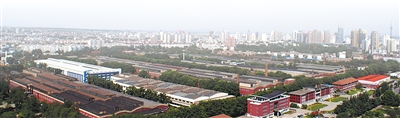
Photo shows a bird's-eye view of the 1954 Cultural Park of Chinalco Luoyang Copper Processing Co., Ltd. in Luoyang, central China's Henan Province. (Photo courtesy of the interviewee)
Under the towering steel frames of former factory buildings, professional indoor badminton, tennis, and basketball courts have been built. The former copper processing plant has been converted into an indoor swimming pool. A former electromechanical workshop now hosts floral and art exhibitions. The old office building has become a hotel, while a former warehouse has been transformed into a hotpot restaurant.
"The defining feature of Soviet-style factories is their spacious, orderly layout, with ceilings often over 10 meters high—ideal for indoor sports venues," said Xiao Xuxuan, deputy general manager of Chinalco Luoyang Copper Processing Co., Ltd.
"Although these buildings are old, they were built with solid foundations and high-quality materials. With minor reinforcement and upgrades that meet environmental, fire safety, and regulatory standards, they can be reopened to the public," said Xiao.
Photos



Related Stories
Copyright © 2026 People's Daily Online. All Rights Reserved.
