



From stalls to smart manufacturing: The rise of China's button capital
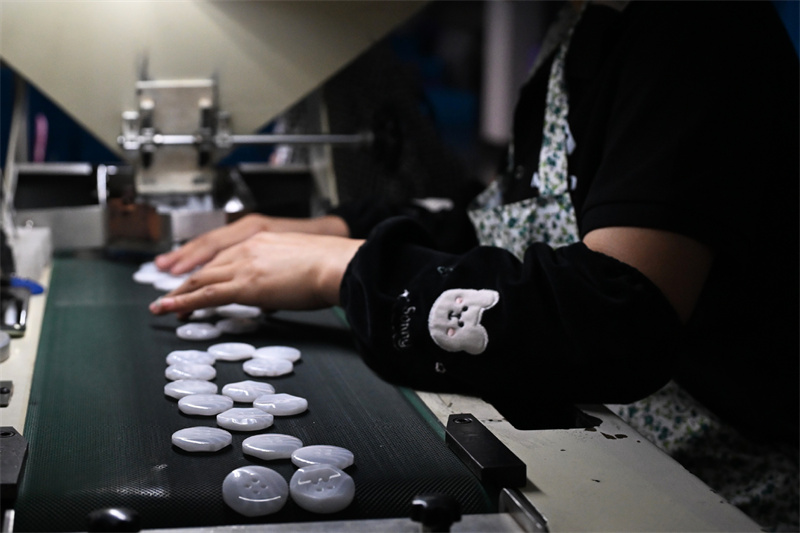
A staff member conducts quality inspection on buttons at a workshop in Qiaotou Town of Yongjia County, Wenzhou City, east China's Zhejiang Province, March 27, 2025. (Photo/Xinhua)
Qiaotou town in Yongjia county, Wenzhou city, east China's Zhejiang Province is known as "China's button capital."
Now 79, Wang Suinai was one of the earliest pioneers of the town's button trade and a living witness to more than four decades of the button industry's development.
In the late 1970s, most residents in the town scraped by on farming. Then came a chance that changed everything. Wang bought a batch of unsold buttons from merchants from central China's Hunan Province and set up a small stall on a stone-slab bridge outside her home. The stock sold out quickly.
"In less than a week, I had made as much as the whole family used to earn in a year," she recalled.
Encouraged by that early success, Wang pressed on. Before long, the makeshift market had grown from two stalls to more than 40, drawing buyers from far and wide.
In 1983, Qiaotou became home to China's first rural specialized small-commodity market — the Qiaotou Button Market — and the original 42 stallholders received business licenses.
Over the following decades, the button industry flourished. At its peak, Qiaotou accounted for 90 percent of the national button market.
In the late 1980s, a Southeast Asian merchant visited the town, was impressed by the sheer variety on offer, and placed an order on the spot. Gradually, more local traders began cultivating overseas clients and eventually organized delegations to the Canton Fair and exhibitions abroad to promote their products.
By 2025, Yongjia county's button-centered garment accessories sector had 23 enterprises above designated size generating output of more than 1.2 billion yuan ($176 million), with over 300 companies involved in button production, processing and sales. In Qiaotou town alone, firms produce roughly 100 billion buttons every year.
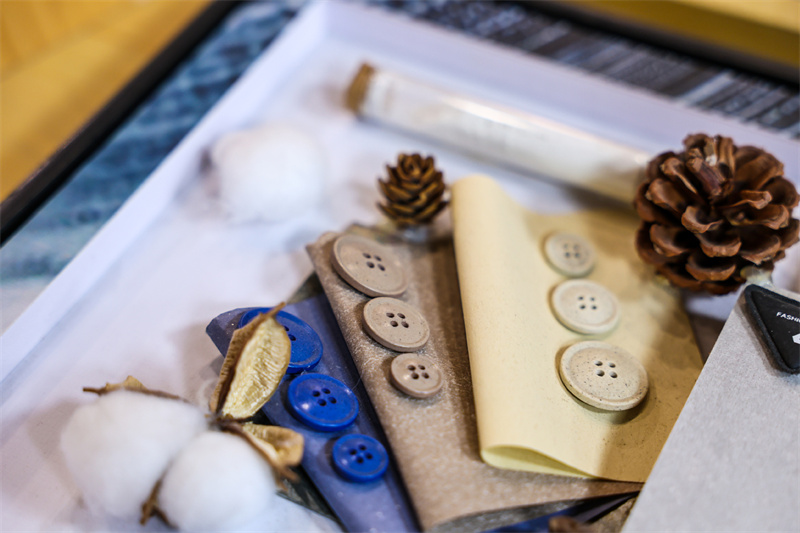
This photo taken on March 27, 2025 shows a type of eco-friendly button made from recycled materials displayed by a button company in Qiaotou Town of Yongjia County, Wenzhou City, east China's Zhejiang Province. (Photo/Xinhua)
Yet success did not come without challenges. Zhejiang New Urban Button Ornaments Co., Ltd. is one of the industry's leading players, with more than four decades in the business.
"After the street-stall era and a long phase of expansion without much refinement, the sector hit a wall," said Chen Haihua, the company's general manager. "Production technology stagnated, processes remained simple, and we found ourselves trapped in the low-end, low-margin segment of the market."
Now in the company's factory, rows of high-speed AI-powered industrial vision inspection machines scan batch after batch of buttons at a remarkable pace — checking 30,000 buttons in less than half an hour.
"Last October, we upgraded the equipment and added six cameras," Chen said. The machines require extensive training data, and the factory's vast catalog of hundreds of millions of button designs proved ideal. Repeated training has boosted inspection efficiency by at least 50 percent.
The workshop of Wenzhou Pengbo Knitted Button Co., Ltd. is lined with 3D-printed molds in intricate shapes and textures, which have become the company's gateway to new markets.
General Manager Lin Pengbo said a single mold used to cost at least 400 yuan, and getting from design to sample took anywhere from a few days to a week. With 3D printing, the same mold now costs 50 yuan, with significantly reduced sampling time and more flexible design tweaks.
3D printing has since become standard practice across Yongjia's button industry. "It cuts development costs dramatically and allows us to build three-dimensional textures directly onto button surfaces, giving designs more creativity," Lin said.
A well-developed industrial cluster has given Yongjia's button makers a clear competitive edge in global markets. From raw materials to design, production, quality inspection and logistics, a complete supply chain has taken shape, operating with high efficiency.
Jin Enyi, executive vice-president of the Button Chamber of Commerce of Qiaotou Town, said the cluster makes production smoother, costs more predictable and products more competitive.
Today, producing a button in Qiaotou town has become highly efficient: from core raw materials such as resin to supporting inputs like electroplating and dyeing supplies, everything can be sourced within half a day, with the full range of materials sometimes assembled in as little as two to three hours.
Advances in technology and design have significantly increased the added value of Qiaotou's buttons.
The surging popularity of new Chinese-style clothing, "China-chic," and traditional Hanfu clothing has driven demand for personalized and custom-made buttons. At the showroom of a company in Qiaotou town, a selection of knot buttons — known as pankou — could easily be mistaken for jewelry. The company settled in Yongjia county in 2017 and carved out a niche in Chinese-style handcrafted knot buttons. A single knot button can fetch 120 to 200 yuan, and the company has built a stable customer base of more than 50,000 buyers both online and offline, at home and abroad.
The industry's evolution has shifted its focus from selling products to providing services, with upstream and downstream segments integrating at an accelerating pace.
In 2025, the Yongjia branch of the national-level Wenzhou Intellectual Property Protection Center was formally established. According to Zhang Zhirong, director of the branch, the button and zipper sectors logged 156 new design patents in 2025, with 72 granted through an expedited review channel that reduced approval times by 90 percent compared with the standard process.
"Going forward, we will focus on key areas such as design and development, brand building and intelligent manufacturing to steer traditional buttons toward a more fashionable, functional and digital future — and make the 'China's button capital' name shine even brighter," said Ye Manman, deputy director of the county's bureau of economy and information technology.
Photos



Copyright © 2026 People's Daily Online. All Rights Reserved.
