



China's AI large models frequently used by overseas users
An increasing number of people overseas are using Chinese artificial intelligence (AI) large models to boost efficiency. Every interaction with a model uses up a digital resource known as "tokens." A token is the smallest unit of text that an AI language model processes. It might be a full word, part of a word, a punctuation mark, or even a single character.
China's average daily token usage exceeded 140 trillion in March this year, representing a more than 1,000-fold surge from the beginning of 2024.
Yan Yijun, vice president of AI unicorn MiniMax, explained that users care about whether the model is smart, fast, and genuinely useful, as well as whether it can handle complex problems and if the pricing is reasonable and sustainable.
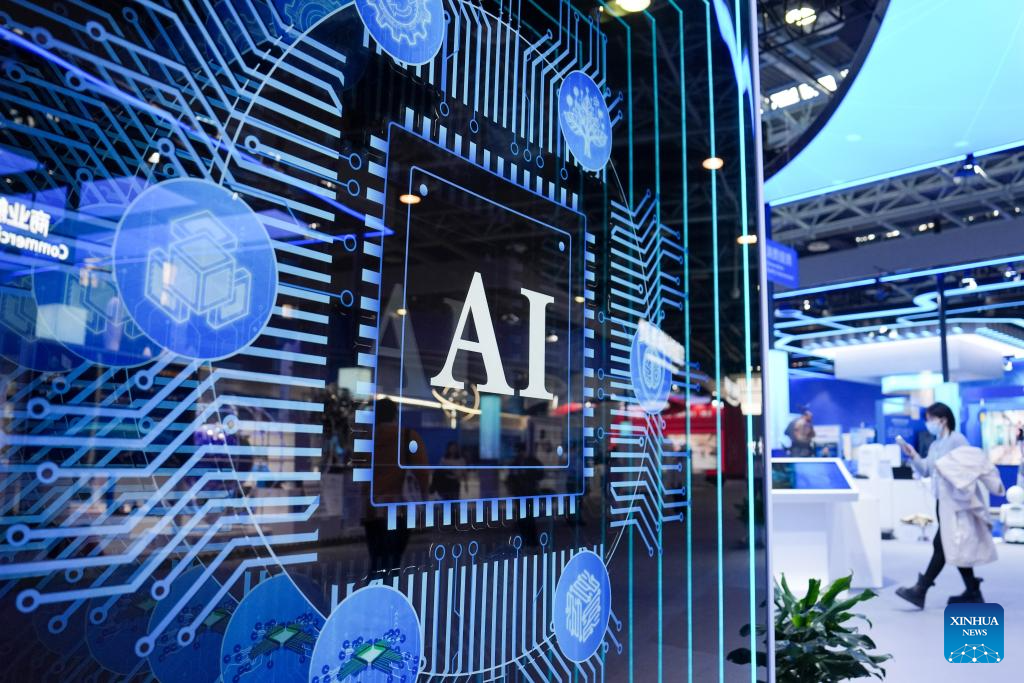
A woman visits the permanent exhibition at the Zhongguancun Exhibition Center in Beijing, capital of China, March 25, 2026. (Xinhua/Ju Huanzong)
"Chinese AI models are increasingly being adopted across the globe. That's a clear vote of confidence from users around the world," said Yan.
For large models, achieving both smarter performance and lower costs is a challenge.
Yan explained that with the "MiniMax M2.5" model, they've developed more efficient algorithms, enabling the model to generate answers with fewer tokens. Additionally, they focus on maximizing the value of each token.
With an impressive throughput of 100 tokens per second, the model only costs $1 to run for an entire hour. According to estimates, for the same level of performance, the cost of Chinese models is roughly one-tenth that of U.S. models.
"The drop in costs is not just due to the technological advancements of Chinese AI companies, but also a result of China's advantages in electricity and supply chains," said Li Zhiqing, a professor at the School of Economics at Fudan University.
By December 2025, the number of generative AI users in China had reached 602 million, a 141.7 percent increase from December 2024.
The rapid growth in user numbers is driving AI to expand beyond the internet and into more complex fields like office collaboration and industrial design, turning AI from a cutting-edge technology into an everyday tool. As AI applications spread, they also provide ongoing data feedback, improving models and increasing their ability to tackle complex tasks, creating space for future development.
Electricity costs are a key consideration in the global expansion of the computing power industry.
"This is where China has a distinct advantage. With the world's largest electricity supply system, combined with ultra-high voltage power grids and consumption of green electricity, China's self-sufficient, controllable power infrastructure ensures stable, cost-effective computing power," Li added.
"Additionally, a complete AI supply chain has further lowered costs," said Li. He pointed out that strong collaboration across sectors such as AI chips, servers, computing infrastructure, cross-border networks, edge computing, and international payments, has created advantages along the supply chain.
Li explained that for traditional products, one kilowatt-hour of electricity usually generates one to two times its value. But for tokens, that value can increase by dozens, or even hundreds, of times.
"Today, we've turned China's energy and manufacturing strengths into digital value that reaches the world, so while the electricity stays in China, its value is already felt globally."
Photos




Related Stories
- From page to progress: Burgeoning sci-fi reflects China's tech-savvy modernization
- Interview: China's advancements in AI drive inclusive growth, says Malaysian expert
- China accelerates smart economy to unleash growth potential
- Chinese AI firms start to crack profit code in niche markets
- Top AI conference NeurIPS issues apology for following US sanctions policy after boycott from Chinese academic community
- China Focus: China's open-source AI ecosystem facilitates sovereign AI development in Global South: experts
- Token becomes buzzword at ZGC Forum, seen as key to AI development and competition
- Experts call for broader AI integration in healthcare at national conference
- Humanoid robots highlight China's rise in embodied AI industry
- How China's Shenzhen is transforming into an AI-powered city
Copyright © 2026 People's Daily Online. All Rights Reserved.
