



'Handcraft trend' showcases creativity of Chinese manufacturing
China is witnessing a growing wave of "handcraft" turning ordinary creativity into a testing ground for grassroots innovation.
Think of a vlogger selling a smart massager built from foam rollers and small motors to customers worldwide; a high school student constructing a 10-kilometer-class rocket in his spare time; and a college student in his early 20s who started with discarded electronics from scrapyards, then designed, 3D-printed, and programmed a smart interactive mechanical suit. These are just a few examples of how hands-on creativity is flourishing across the country.
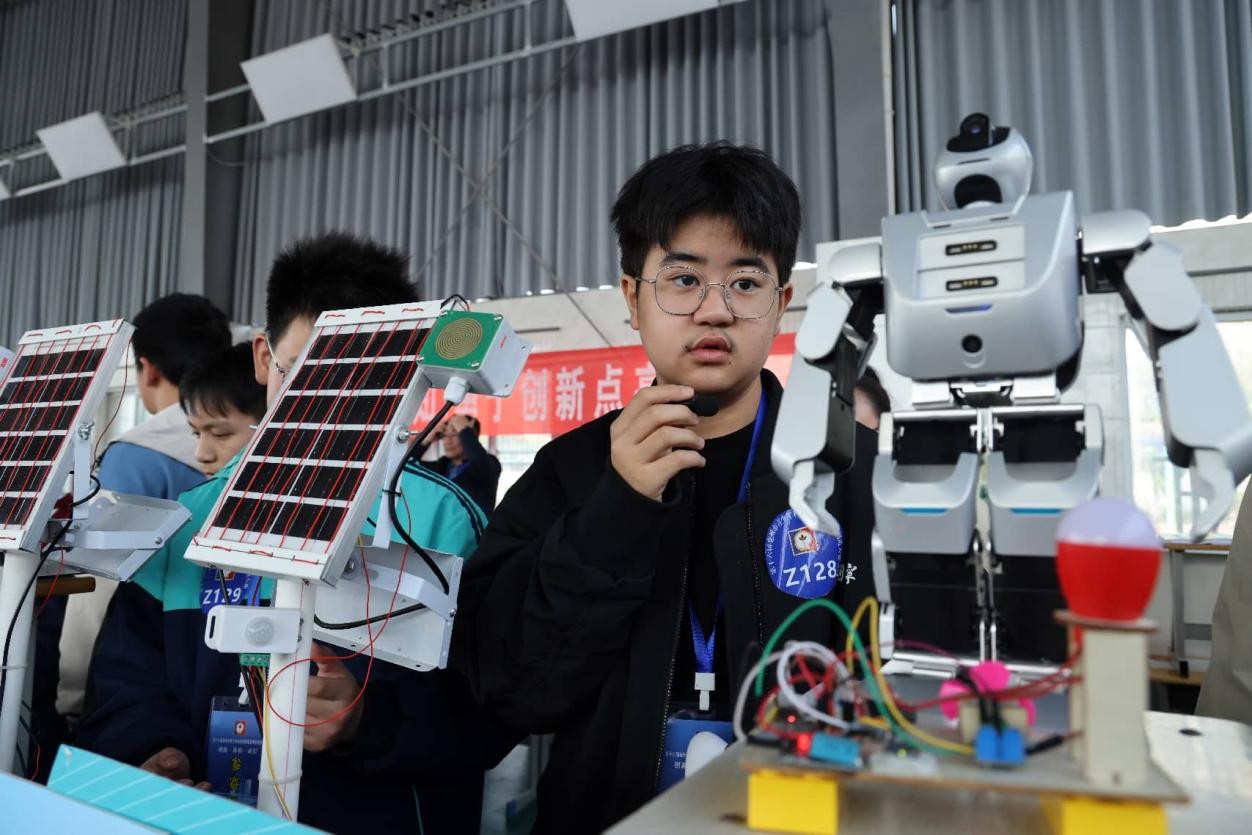
Competitors showcase their tech innovations at a youth innovation contest held in Bozhou, east China's Anhui province. (Photo/Hu Weiguo)
At its core, innovation is about meeting social needs and advancing production through creative practice. In this context, "handcraft" does not imply something trivial or makeshift; rather, it refers to turning ideas into reality using one's own hands, often using simple, accessible tools.
By shaping, assembling, and refining, people watch how innovation takes form--as individual creativity aligns with real-world demand, three enablers accelerate this trend: science popularization, affordable materials, and user-friendly technologies.
Technological evolution demonstrates the movement's impact. Back in 2009, 19-year old Wang Xingxing could not afford a 3D printer. Instead, he hand-built parts for just 200 yuan (about $28.94) to make a walking bipedal robot. Today, his company Unitree Robotics produces humanoid robots performing intricate dance and martial arts routines -- proving how modest experiments can yield major breakthroughs. True innovation emerges not exclusively from laboratories, but from persistent curiosity and execution.
This kind of grassroots innovation is not merely a reflection of individual talent and effort; it also mirrors the broader opportunities of the times.
Gao Xingyu, born after 2000, built high-quality mecha models in his dorm room, gained market recognition, launched his own brand, and later partnered with a listed company.
Elsewhere, a platform specializing in small-batch customization of electronic components reported nearly 8 billion yuan in revenue and close to 1 billion yuan in net profit in 2024, with strong year-on-year growth.
In Huaqiangbei, one of China's largest electronics markets in Shenzhen, south China's Guangdong province, international makers collaborate with local engineers and solution providers, creating a powerful hub for innovation.
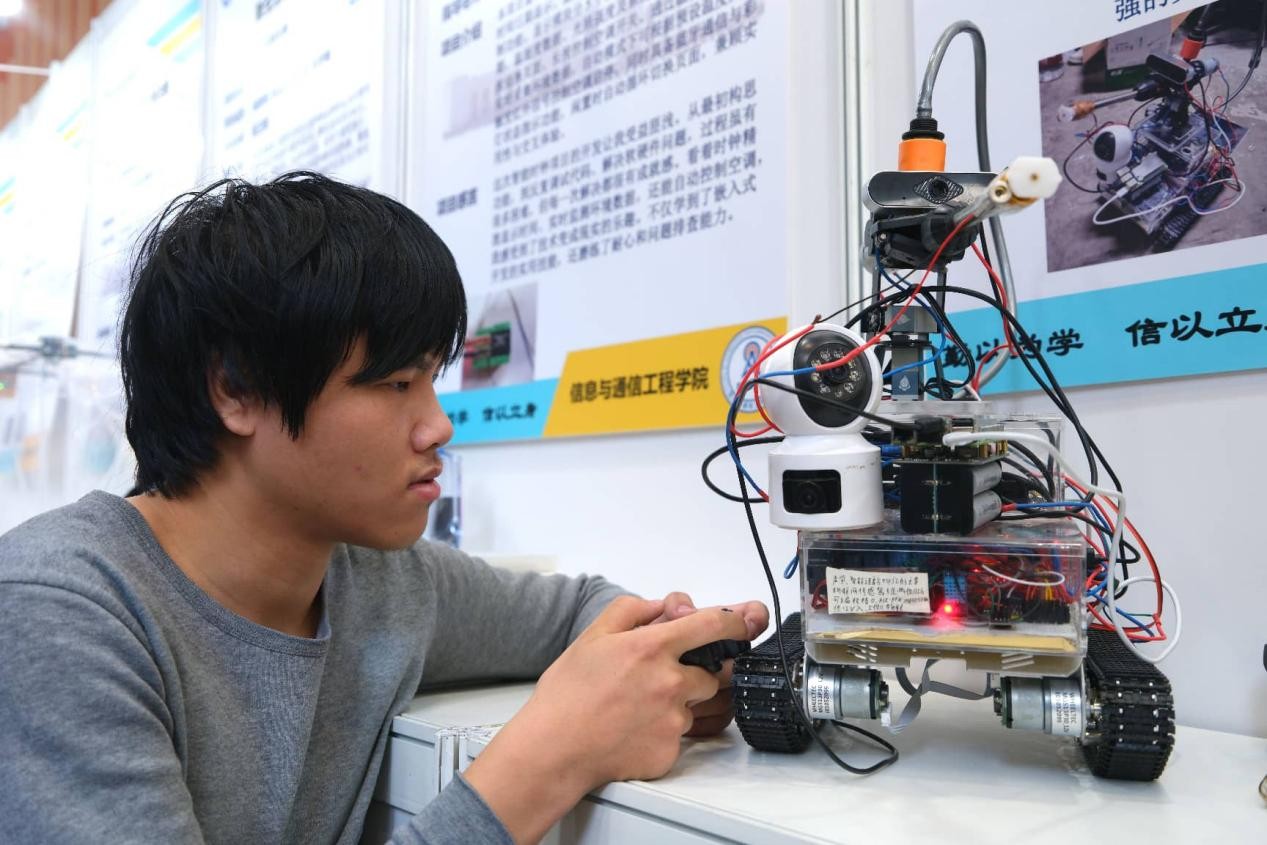
A student tunes a smart irrigator at the first maker competition for freshmen majoring in electronic information held in Beijing, Nov. 19, 2025. (Photo/Guo Junfeng)
In this way, handcraft culture serves as a bridge, linking different parts of the industrial chain and even bridging domestic and international markets. It also acts as a lever, facilitating the flow of resources and capital, and generating new momentum through the interaction between innovation and market demand.
Turning creative ideas into tangible results depends primarily on individual initiative, but supportive public services also play an important role. Across China, regions are working to unleash creativity by better understanding the needs of grassroots innovators and providing tailored support.
For example, Huaqiangbei has established innovation communities that offer full-cycle support for AI entrepreneurs, from idea incubation to market application. In Qingdao, east China's Shandong province, a "solo entrepreneur + AI" platform integrates computing power, data, and technology resources to create a new model for innovation.
By building ecosystems, integrating resources, and providing better tools and support, these efforts are helping more ideas take shape and driving both technological progress and industrial development.
Each innovation represents an upward step. By nurturing the seeds of creativity found in everyday life and unlocking the extraordinary potential within ordinary people, China's manufacturing sector is moving toward a more dynamic and innovative future -- one bold idea at a time.
Photos



Related Stories
- Tech-industry integration fuels China's innovation surge
- Interview: China's innovation leads way in future industries, says British business leader
- Innovation economy posts strong growth in Jan-Feb, tax data show
- Foreign firms bet big on China's innovation drive under 15th Five-Year Plan
- Stable policies, fertile ground for innovation, shared future: People's Daily 'He Yin' commentary
Copyright © 2026 People's Daily Online. All Rights Reserved.
