



Shanghai pioneers AI-driven scientific research paradigm
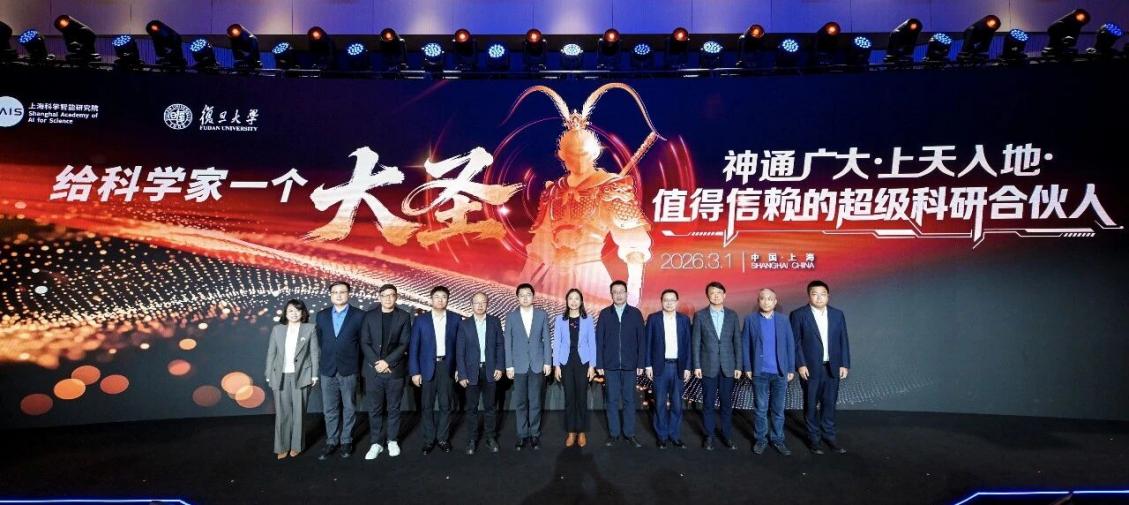
On March 1, NovaInspire announces an upgrade of its platform and launches super scientific research partner Dasheng. (Photo/Lyu Qianming)
In June 2023, Fudan University launched its campus-based cloud intelligent computing platform.
Building on this initiative, Professor Qi Yuan and colleagues proposed to Shanghai's municipal leadership that China develop large-scale scientific AI models, drawing inspiration from leading global projects.
Their proposal received approval within a week. By September of that year, the Shanghai Academy of AI for Science (SAIS) was officially established.
More than two years later, the institute has become a benchmark for "new research infrastructure," with a steady stream of breakthroughs.
On March 1, 2026, SAIS unveiled super scientific research partner Dasheng, an intelligent agent capable of autonomously breaking down research tasks and advancing projects based on natural language instructions.
Dasheng is highly versatile. It supports research across life sciences, earth sciences, humanities and other fields. Powered by strong foundational model tools, it can even generate multiple parallel "instances" to handle complex and time-intensive tasks simultaneously.
Dasheng is developed under the NovaInspire platform jointly built by SAIS, Fudan University, and Shanghai-based AI company INF. The platform made its debut at the World Artificial Intelligence Conference 2025, where it introduced the concepts of "scientist-centered design" and "accelerating scientific discovery."
Through continuous iteration, the platform has integrated over 400 scientific models and tools, accumulated 22 petabytes of high-value data, and incorporated more than 500 million academic papers and patents, generating a growing number of innovations.
At SAIS, several domain-specific scientific models -- named after figures from Chinese mythology -- are designed to address key scientific challenges in high-value industrial applications.
In materials science, the Suiren model has built a candidate library of 12,000 molecules to train generative models, accelerating the discovery of new electrolyte formulations for lithium batteries.
In drug design, the Nvwa RNA model, combined with a proprietary siRNA database, has overcome key bottlenecks in siRNA drug development. Its goal is to evolve into a "living" scientific AI infrastructure, one that can be repeatedly used and continuously improved by scientists and industry experts.
In earth sciences, alongside the FuXi weather model, SAIS has also developed PI@Climate, a large language model trained on data spanning more than ten primary disciplines. As China's self-developed climate science model, it is already providing intelligent support for climate research, international climate negotiations, and policy-making.
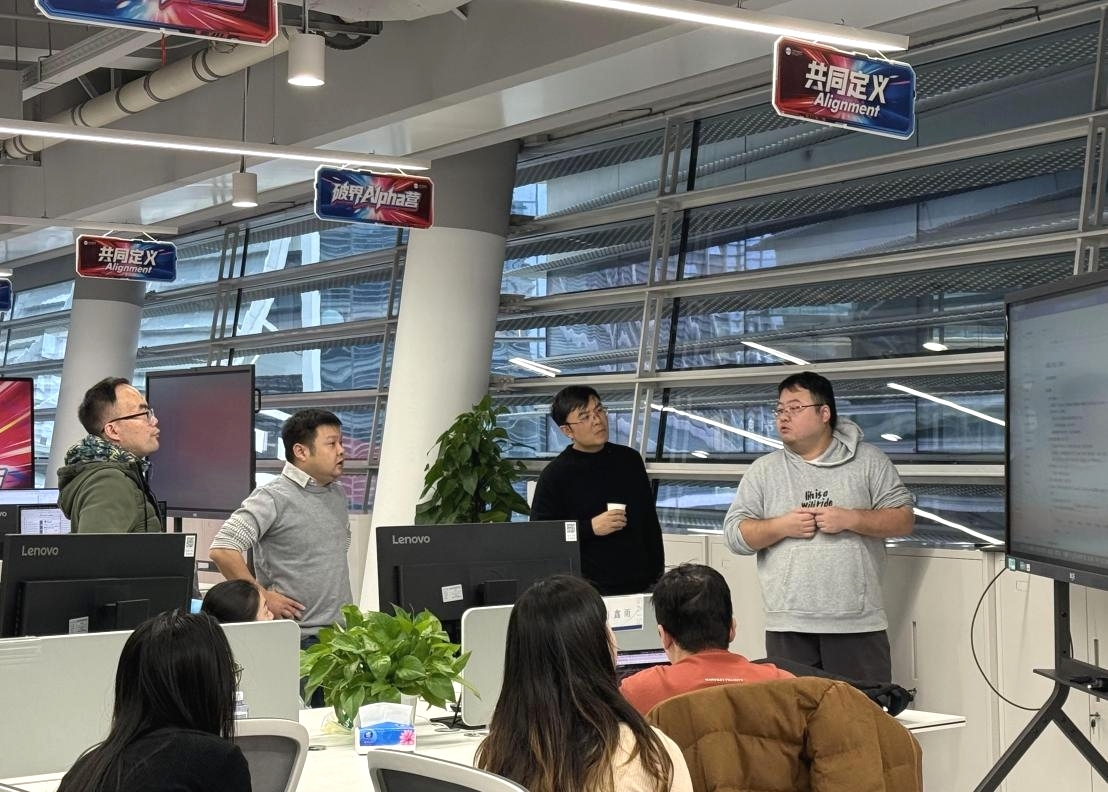
Photo shows members of the Nvwa model team in a discussion. (Photo from the official account of SAIS on WeChat)
According to Wu Libo, assistant president of Fudan University and chair of SAIS, the institute's exploration is helping universities systematically validate a new paradigm for future scientific research. SAIS has already established in-depth collaboration with 43 teams at Fudan University, supporting the creation of 18 interdisciplinary centers for scientific intelligence.
"We aim to break down the boundaries between disciplines, engineering, platforms, and talent development," Wu said.
SAIS fosters innovation through initiatives like its "research bar," where young researchers can receive a free drink in exchange for sharing their ideas and innovations -- an initiative that reflects a vibrant and youth-driven culture.
The institute's multidisciplinary team averages 33 years in age. About 31 percent recruited from overseas universities and leading AI labs, while 40 percent bring extensive engineering experience from top tech companies. "Our greatest strength lies in these young talents," Wu noted.

Photo shows a "research bar" at SAIS. (Photo from the official account of SAIS on WeChat)
What attracts such a dynamic group of innovators?
Sun Xiuyu, an AI scientist in earth sciences, pointed out that under an organized research framework, SAIS provides participating teams with high-quality computing resources and considerable research autonomy, enabling young researchers to turn ideas into reality through continuous experimentation.
Wang Wenli, a materials science researcher, values the institute's collaborative environment, where scientists, AI experts, and engineers interact face-to-face on a regular basis. "What we create here naturally integrates the genetic strengths of multiple disciplines," she said.
Jiang Ruoxi, an AI scientist at SAIS, added, "What initially attracted me was the close integration with industry, but the speed of progress has exceeded all expectations."
"Our goal is to build a world-class scientific intelligence institution by 2030," said Qi Yuan, president of SAIS, expressing strong confidence in the institute's future.
Photos


Copyright © 2026 People's Daily Online. All Rights Reserved.
