



China's first humanoid robot 7S store in Hubei province generating buzz
In China, car dealerships are commonly known as 4S stores, a model that integrates sales, spare parts, service, and surveys under one roof. Now, a groundbreaking concept is emerging: a robot 7S store in Wuhan, capital city of central China's Hubei province.
This pioneering store expands beyond the traditional 4S functions to include solutions, showcase and skills training. This model covers nearly the entire humanoid robot value chain, from key components and complete units to real-world application scenarios.
Inside the store, humanoid robots of different sizes and forms are busy at work: some kick footballs, some assist with sales, others play music.
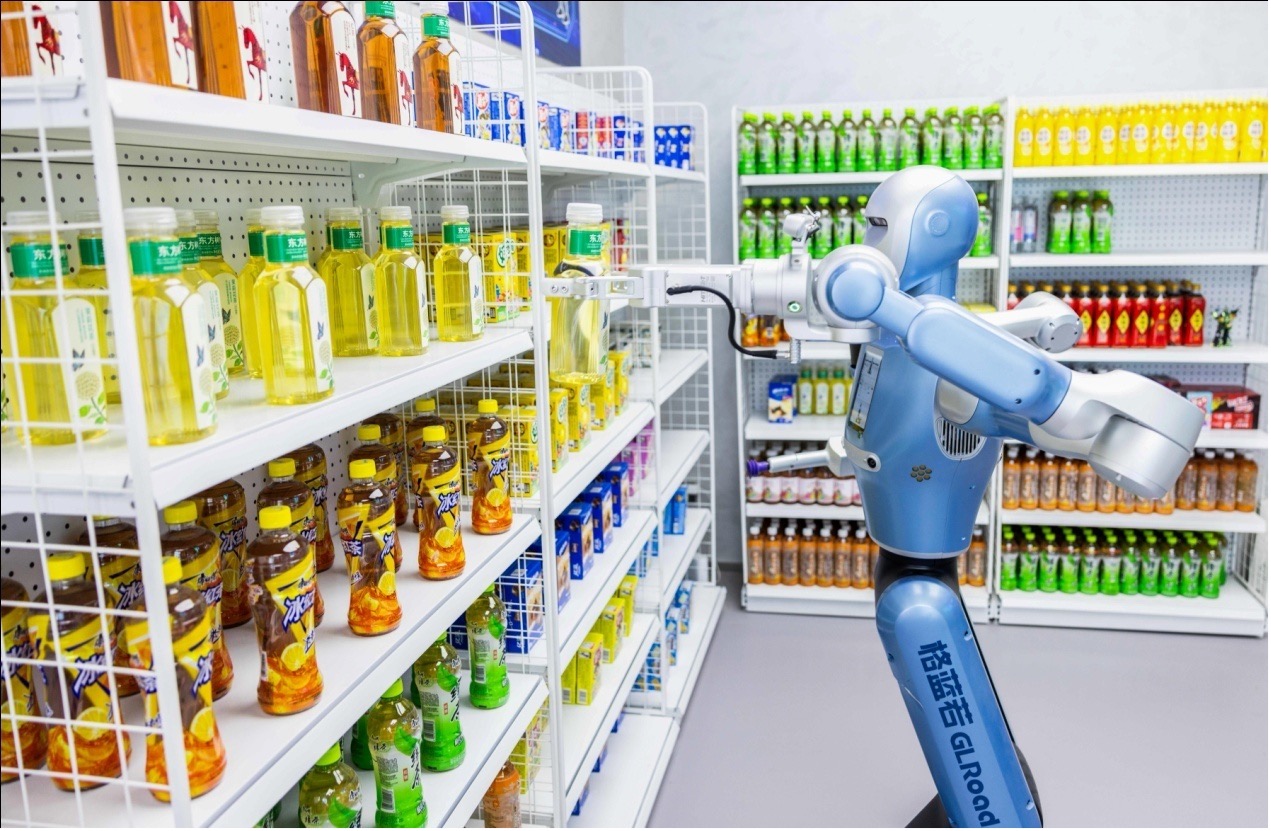
A humanoid robot is facing shelves in the humanoid robot 7S store in Wuhan, capital of central China's Hubei province. (Photo/Xue Ting)
We currently have 17 models of humanoid robots on display, priced from 7,999 yuan ($1152.89) to 700,000 yuan," said store manager Hu Longdan. "They can be used in more than 10 scenarios, including industrial manufacturing, tourism guiding, elderly care and rehabilitation, and special operations."
At the entrance of the store, a humanoid robot with wheels beneath its feet greets visitors. Named Yuanyou (meaning "traveling far"), the robot stands 158 centimeters tall, weighs 72 kilograms, and can move at a speed of 1.5 meters per second.
"Yuanyou is a homegrown 'Hubei native,'" Hu explained. For the past nine months, it has been working at Xianning Central Hospital in Hubei province, providing services such as patient guidance, explanations, and moxibustion therapy. It is the first humanoid robot in Hubei to work in a hospital.
"Before developing Yuanyou, we conducted extensive research into user needs," said Yuan Chao, general manager of HandX, the developer of the robot. "We designed different 'organs' and 'tissues' -- hardware, software, and algorithms -- and then assembled them into a complete humanoid robot."
He noted that a team led by Academician Liu Sheng from Wuhan University's School of Microelectronics provided solutions in sensors and AI, while Hubei's local humanoid robot enterprises supplied more than 80 percent of the hardware components.
"Hubei has 20 core companies engaged in humanoid robot components and nearly 1,000 related enterprises," Yuan said. "Key components such as the 'brain,' 'skeleton,' and 'electronic skin' can all be sourced locally."
The journey from research and development to production was remarkably swift, taking only six months. In April 2025, the first Yuanyou robot rolled off the production line, and the product has now entered mass production. According to Yuan, the company has built four automated humanoid robot production lines with an annual capacity of 1,500 units.
Manufacturing robots is just the beginning; effectively deploying them is equally critical. To address this, Hubei established the Hubei Humanoid Robotics Innovation Center in June 2025 -- effectively a "school" for humanoid robots. Every newly manufactured robot can undergo systematic training there under the guidance of data collection specialists.
"We offer 23 simulation scenarios and more than 10 temporary ones, allowing over 100 humanoid robots to train simultaneously," said Liu Chuanhou, chief operating officer of the center. "We can collect over 1 million real-machine data entries each year. After verification, labeling, and cleaning, the data are fed into large-model training, enabling the robots to continuously evolve."
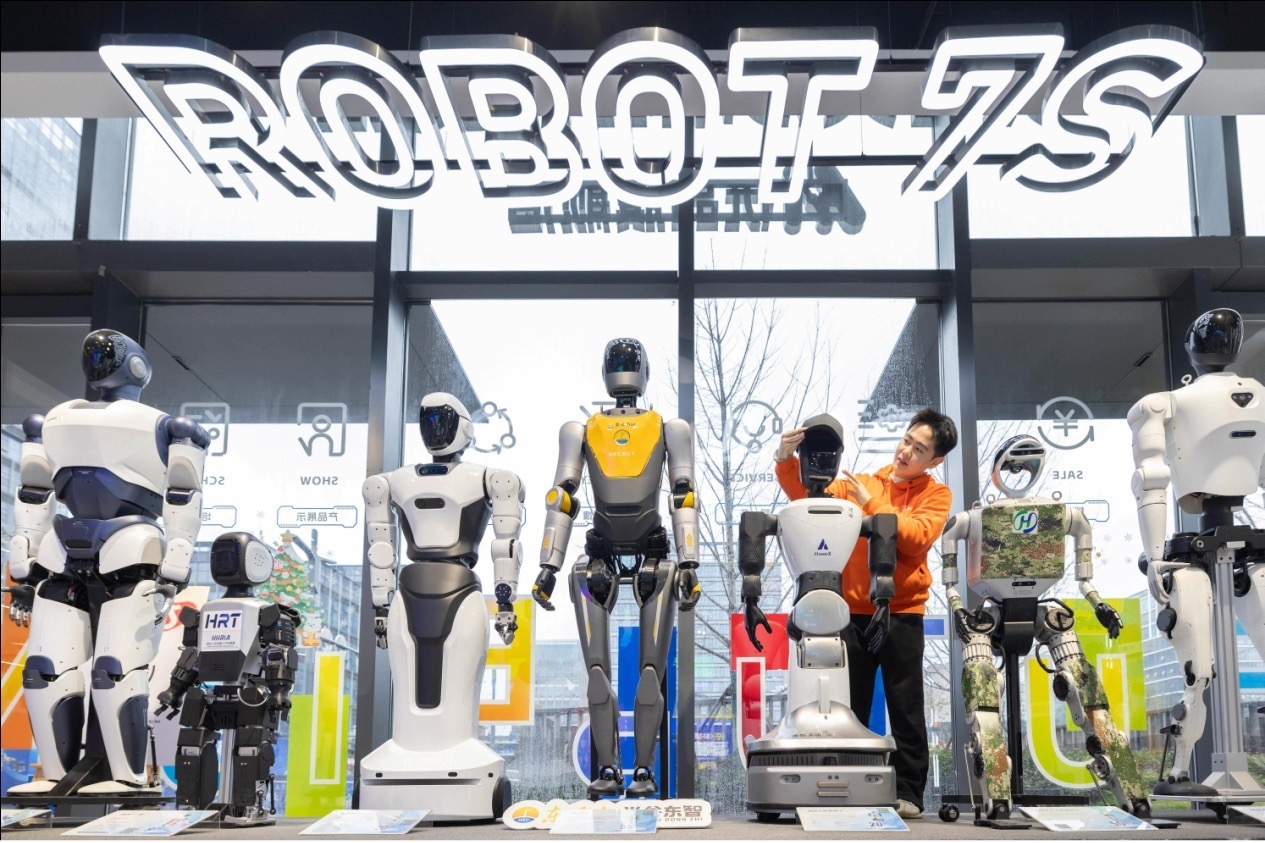
A staff member of the humanoid robot 7S store in Wuhan, capital of central China's Hubei province places robots in their right positions. (Photo/Xue Ting)
So far, the 7S store has achieved revenue exceeding 600,000 yuan from various businesses including experiential consumption, sales, tours, and robot rentals. Hu noted that the store is backed by Hubei's increasingly robust industrial ecosystem for humanoid robots.
"The current capabilities of humanoid robots are still limited," Hu acknowledged, "but they are poised to enter households and serve diverse industries in the near future, becoming integral to daily life."
As one of the world's most dynamic innovation hubs in the humanoid robot sector, China has in recent years seen rapid improvements in overall robot performance and expanding application scenarios, ranging from automobile manufacturing and computer, communication and consumer electronics assembly to warehousing, logistics, and smart elderly care.
Li Miao, a professor at the School of Robotics at Wuhan University, noted that the industry's surge is the result of multiple forces converging.
"Large AI models provide robots with a 'brain,' open-source operating systems lower development barriers, and the costs of key hardware such as motors, sensors, and reducers continue to fall, making high-performance humanoid robots feasible," he said.
Meanwhile, the digital and intelligent transformation across manufacturing and service sectors has generated substantial market demand, while robust national strategies and policy support are accelerating the influx of capital and talent. "Over the next five years," Li added, "China's humanoid robot industry is poised to transition from a phase of intense attention to one of tangible maturity."
Photos



Related Stories
- Champion robots invite global teams to Beijing humanoid games
- Humanoid robot firms launch consumer push with entertainment ventures
- Humanoid robots break new grounds for Chinese consumer market
- Feature: How an army of robots helps build China's "Ice Disneyland"
- Feature: Inside China's robot valley, where the future gets built at speed of proximity
Copyright © 2026 People's Daily Online. All Rights Reserved.
