



How construction of Xi'an-Yan'an High-Speed Railway ensures reliable network coverage
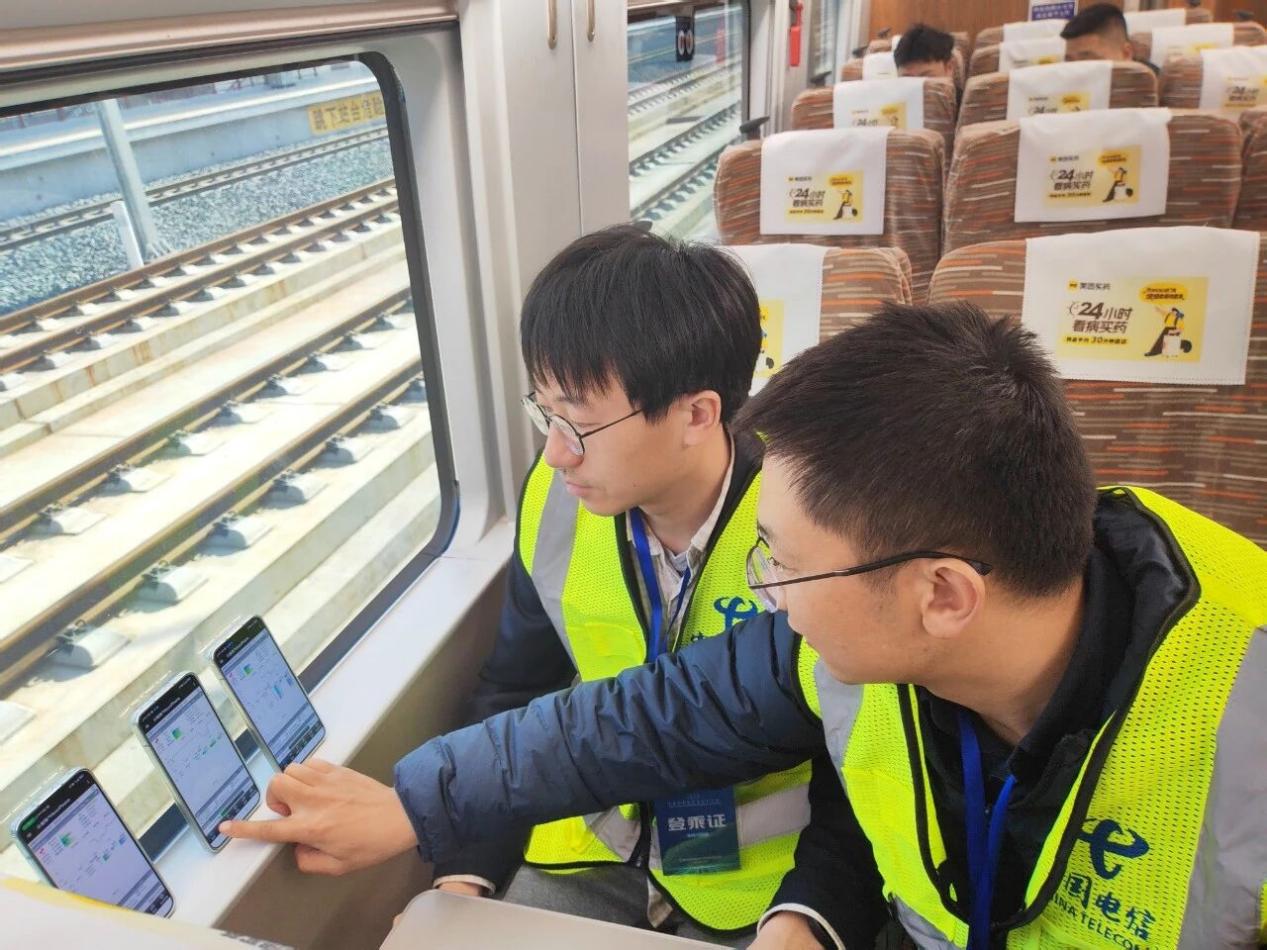
Network signals are tested on a train running on the Xi'an–Yan'an High-Speed Railway. (Photo provided by the Shaanxi branch of China Telecom)
For many passengers, reliable internet connectivity has become an essential expectation of modern travel. However, maintaining stable mobile signals remains technically challenging on high-speed railways traversing mountainous terrain with extensive tunnel networks.
This makes passenger Wang Ying's experience particularly noteworthy. While traveling on the Xi'an-Yan'an High-Speed Railway in northwest China's Shaanxi province, she enjoyed uninterrupted high-definition video streaming, video calls, and document transfers throughout her journey. Remarkably, despite over 55% of this railway crossing the Loess Plateau through tunnels, "the signal inside tunnels was even stronger than outside," she observed.
The secret lies in integrated infrastructure development. During the construction of the Xi'an-Yan'an High-Speed Railway, a 5G public network was simultaneously deployed, achieving full coverage along the entire line. The exceptional tunnel connectivity results from embedding the necessary infrastructure directly into their walls.
Take the New Yan'an Tunnel along the railway as an example. This 16-kilometer tunnel features more than 80 recessed chambers along both sides, with two cable troughs pre-installed for power supply and communication signaling. Of these chambers, 16 are used to house base stations, providing roughly one base station per kilometer throughout the tunnel.
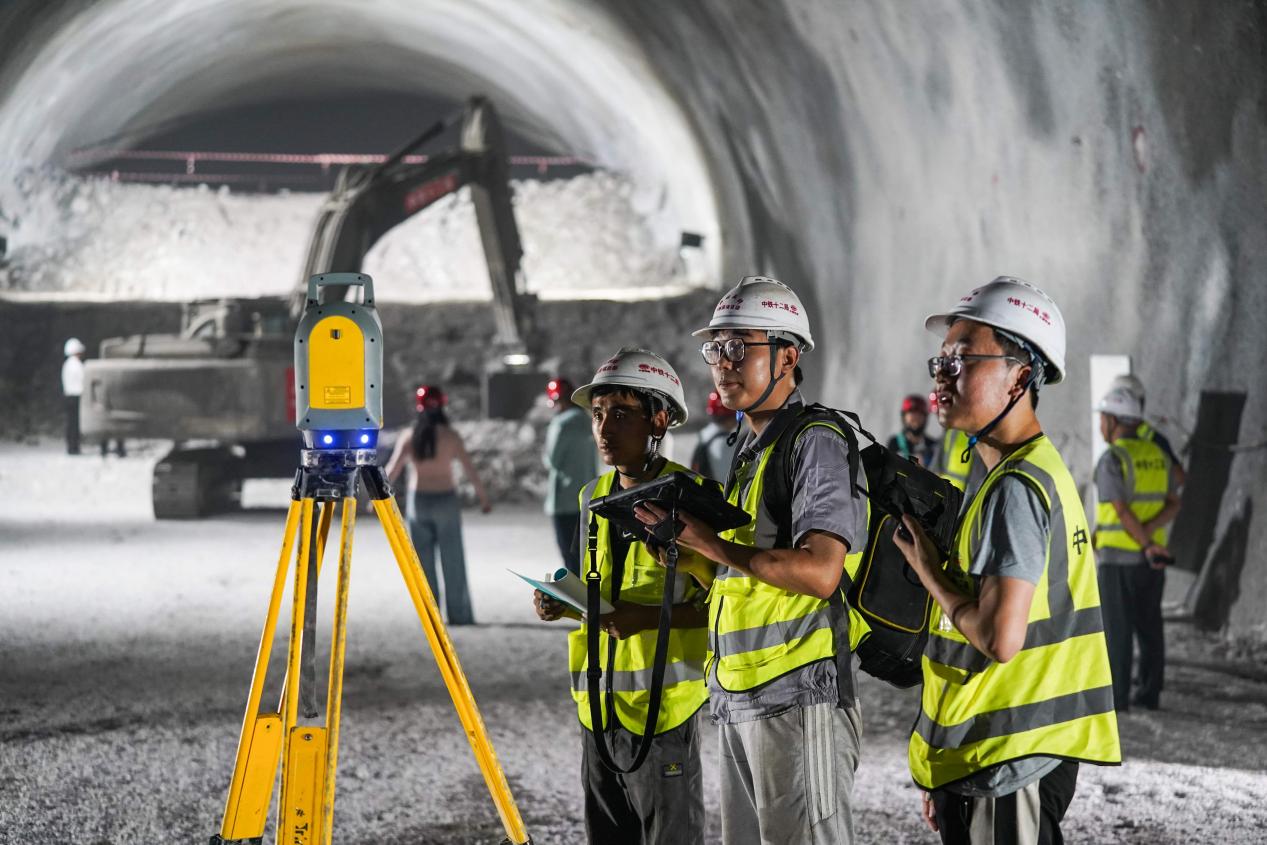
Constructors are surveying a tunnel along the Xi'an–Yan'an High-Speed Railway in Tongchuan, northwest China's Shaanxi province, Aug. 10, 2024. (Photo/Liu Xiang)
Beyond base station density, uninterrupted signal transmission relies significantly on leaky coaxial cables (radiating cables).
These cables are designed with periodic slots in their outer conductor. As electromagnetic waves travel along the cables, signals are uniformly radiated through the slots into the tunnel space. The effect is similar to deploying a continuous series of wireless routers inside the tunnel, creating a stable, controllable "signal corridor."
"All tunnels along the Xi'an-Yan'an High-Speed Railway are equipped with three leaky coaxial cables mounted on the tunnel walls, aligned with the roof of the trains and the upper and lower edges of the carriage windows," explained Wang Fei, director of the high-speed railway office of the Xi'an communications section under China Railway Xi'an Bureau Group.
"The cables aligned with the window edges are dedicated to the 5G public network. This height configuration ensures comprehensive signal coverage throughout the passenger cabin," Wang added.
Installing these cables presented significant engineering challenges. High-speed trains generate intense aerodynamic forces in tunnels, creating substantial wind pressure that tests cable mounting durability.
The design team leveraged wind tunnel data from Central South University's National Engineering Laboratory for High-Speed Railway Construction Technology. Their simulations calculated transient aerodynamic loads on cable clamps, revealing that in standard 52 m² tunnels, each clamp endures approximately 17 newtons of force. As Wang noted: "For a sub-100-gram clamp, this equals dozens of times its own weight -- with over 100 daily occurrences."
Conventional expansion bolts could not meet the installation and fixation requirements. After a nationwide search, the design team ultimately selected a new type of fastening product.
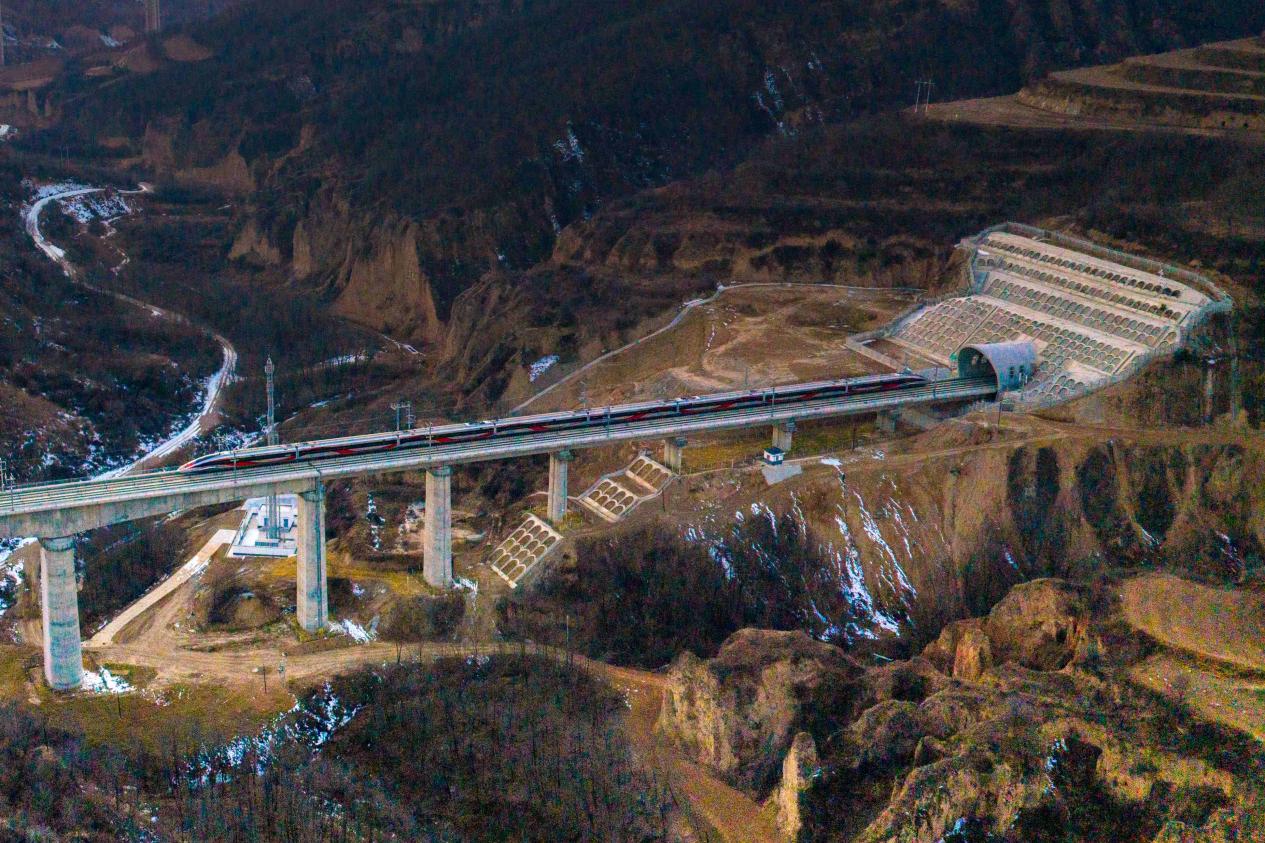
A Fuxing bullet train runs along the Luochuan-Fuxian section of the Xi'an–Yan'an High-Speed Railway, Dec. 26, 2025. (Photo/Liu Yijiang)
With a tensile bearing capacity of 15 kilonewtons -- nearly 900 times the calculated aerodynamic load -- the new fastening product offers ample safety margins. It had also successfully passed 2 million cycles of ultra-high-cycle fatigue testing, equivalent to withstanding decades of vibration impacts caused by high-speed train operations.
High-performance materials alone are not enough; precision construction is equally critical. The Xi'an communications section of China Railway Xi'an Group worked with design and construction partners to build a full-scale, 1:1 simulation communication equipment room.
This facility faithfully replicates the communication equipment configuration of a typical section of the Xi'an-Yan'an High-Speed Railway. Here, technicians conducted system testing and process verification under a range of extreme operating conditions.
Eventually, the design team developed a refined installation plan: drilling depth and diameter tolerances controlled at the millimeter level; hole cleaning performed with high-pressure air to ensure zero dust; adhesive injected using specialized syringes starting from the bottom of the hole to eliminate air bubbles. Every step was executed with surgical precision.
With the toughest challenge—ensuring tunnel signal coverage—successfully addressed, how was signal quality ensured along the rest of the route?
"In open bridge and embankment sections, we adopted conventional base station deployment," Wang explained. For short tunnels under 200 meters or transition sections between bridges and tunnels, a "continuous leaky cable" strategy was applied. This ensures physical continuity of the radiating cables, preventing handover failures or signal attenuation that could cause call drops or data interruptions.
As a result, the Xi'an–Yan'an High-Speed Railway achieved full 5G signal coverage, enabling passengers to enjoy a smooth and uninterrupted online experience throughout their journey. The full-scale simulation communication facility has also delivered substantial results, generating more than 190 construction standards that have since been extended to multiple other high-speed railway projects currently under development.
Photos




Related Stories
- China boasts world-leading optical fiber, mobile communications network
- China's network development injects new vitality into digital society
- MWC 21 sizzles with Chinese 5G ware
- Nation set to expand its oil and gas pipeline network
- 5G pilot cities to start testing the Internet of Things
- Urumqi to build citywide free Wi-Fi network
- China pledges expansion of fiber-optic networks
- Nationwide ETC Network Now Available in China
- China's improved rural power network feeds investment
- Commentary: New wave of China-bashing irresponsible, harmful to Sino-U.S. ties
Copyright © 2026 People's Daily Online. All Rights Reserved.
