



Commute times under 45 minutes for 77 percent in major Chinese cities
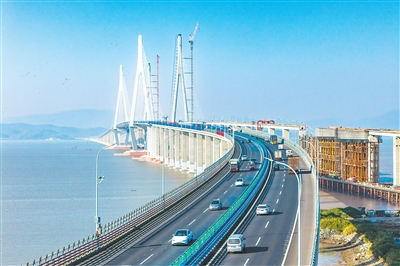
Photo shows the Xiangshan Port Cross-Sea Bridge in Ningbo, east China's Zhejiang Province. The bridge will connect downtown Ningbo with Xiangshan county upon completion. (Photo/Hu Xuejun)
When commuting, people are always focused on how long the journey takes and how convenient it is. A report on commuting in major Chinese cities in 2025 by the China Academy of Urban Planning and Design (CAUPD) under the Ministry of Housing and Urban-Rural Development offers a detailed look at commuting patterns in Chinese cities.
Every day, around 100 million Chinese rely on rail transit for efficient travel, another 100 million take buses to navigate the streets, and 100 million more use taxis or ride-hailing services for door-to-door travel. These figures were shared by an official from the Ministry of Transport at a press conference held by the State Council Information Office.
Data shows that China's urban rail network spans approximately 11,000 kilometers — the largest in the world — and the total length of urban bus routes across the country totals 1.75 million kilometers.
The report reveals that between 2020 and 2024, major Chinese cities added 3,700 kilometers of rail transit lines. Cities like Hangzhou, Chengdu and Qingdao each added over 100 kilometers, while Nantong, Luoyang and Shaoxing built rail systems from scratch.
The report shows that in 2024, 77 percent of commuters in major cities had a commute time of 45 minutes or less, an increase of 1 percentage point from 2020.
"The share of commutes completed within 45 minutes measures the proportion of commuters in central urban areas whose one-way trip to their destination takes 45 minutes or less," explained Zhao Yixin, director of the Urban Transport Research Center at CAUPD.
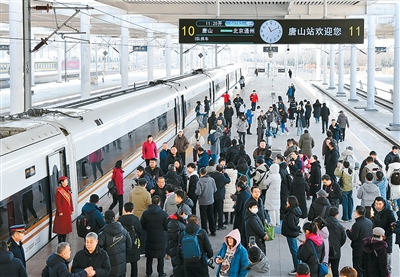
The inaugural train running between Beijing's Tongzhou district and Tangshan in north China's Hebei Province arrives at Tangshan Railway Station. With the recent opening of Beijing Tongzhou Railway Station, a one-hour commuter belt around Beijing has gradually taken shape. (Photo/Sun Lijun)
Zhao added that in mega and super-large cities, having 80 percent of commuters able to reach their destination within 45 minutes is a sign of high urban efficiency and quality of life.
The report notes that nearly 4 million people commute across city boundaries each day in 22 of China's mega and super-large cities, accounting for about 4 percent of all commuters in these cities. Intercity commuting is most closely integrated in the Guangdong-Hong Kong-Macao Greater Bay Area. As a strong central hub, Beijing attracts a large number of daily commuters from surrounding areas.
Zhao explained that every city has its own center and periphery. In this framework, "center-to-center" refers to travel between the downtown cores of two cities. "Center-to-periphery" describes commuting from a city's core to the outer districts or counties of a neighboring city. "Periphery-to-periphery" refers to travel between the outer areas of two different cities.
According to the report, periphery-to-periphery commuting accounts for 64 percent of all cross-city commuting, with an average distance of nearly 25 kilometers. Center-to-periphery commuting makes up 26 percent of intercity commutes. This highlights the spillover effect of major cities on surrounding areas.
The report also reveals that over half of urban residents nationwide now enjoy a more pleasant commuting experience. Defined as commutes of 5 kilometers or less, this metric reflects close proximity between jobs and housing and the feasibility of walking or cycling to work. Across China's major cities, 52 percent of commutes fall within this range.
Another key concept introduced in the report is "jobs-housing separation," which refers to the distance between where people live and the nearest place of employment. It is used to assess how well residential and employment areas are aligned within a city. Shorter distances signal a better jobs-housing balance.
On average, the distance between workplaces and residences is 4.5 kilometers in megacities and 3.9 kilometers in super-large cities. In 2024, 32 of the country's 45 major cities saw no further widening of jobs-housing separation, with 26 remaining unchanged and six recording year-on-year declines.
Xiamen posted the most balanced jobs-housing relationship, with an average separation of just 2.4 kilometers. Beijing was the only city nationwide where the figure reached 7 kilometers.
Photos




Related Stories
Copyright © 2026 People's Daily Online. All Rights Reserved.
