



LatAm rallies for stronger Global South cooperation against external pressures
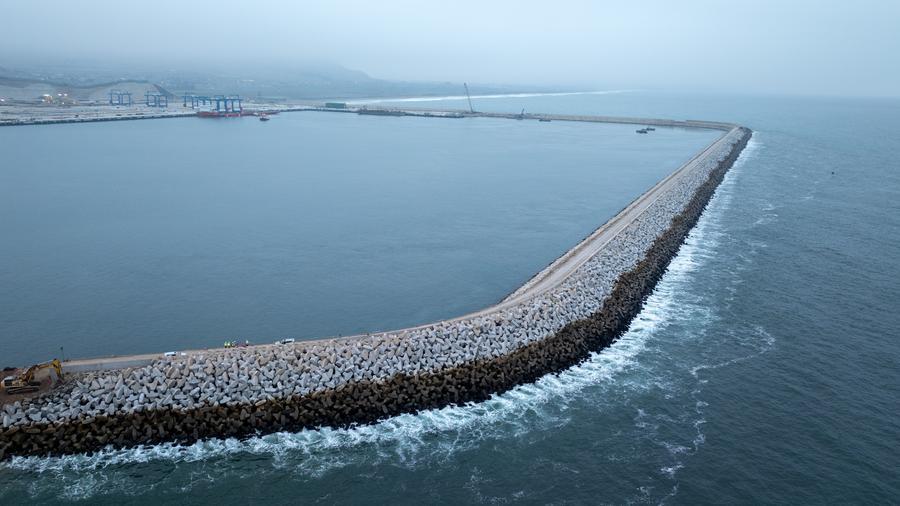
An aerial drone photo shows a view of a breakwater at Chancay Port, Peru, on June 21, 2024. (Xinhua/Li Muzi)
MEXICO CITY, Jan. 2 (Xinhua) -- Over the past year, Latin America has been seeking stronger cooperation within the Global South to address a changing political landscape marked by a revival of right-wing powers and governance challenges.
Against the backdrop of growing external interference and hegemonic pressure, people in the region have been increasingly aware of the significance of safeguarding sovereignty and pursuing strategic autonomy. The idea of unity and cooperation in the Global South has also been gaining momentum.
Meanwhile, China, the world's biggest developing country, and Latin American countries have maintained frequent high-level exchanges, steadily strengthened practical cooperation across various fields, and taken solid steps to advance the building of a China-Latin America and the Caribbean (LAC) community with a shared future.
POLITICAL PENDULUM SWINGS TO RIGHT
In 2025, the political tensions between the left and the right in Latin America intensified, with the pendulum swinging to the right.
In Chile's recent election, the far-right party candidate won the presidential election. In Ecuador the presidential candidate of the right-wing party was re-elected, and Bolivia ended its nearly 20-year history of left-wing governance.
Meanwhile, the far-right ruling coalition in Argentina has further expanded its advantage in the parliamentary elections.
Analysts said that politics in Latin America has shifted markedly to the right as a result of the interplay of internal and external factors. Domestically, the countries that held elections this year were grappling with sluggish economic growth, limited improvements in living standards, and deteriorating public security leading up to the poll. In this context, right-wing parties have put forward targeted campaign platforms that have resonated with a frustrated electorate. Externally, the resurgence of conservative currents in the West -- reflected in the return of right-wing parties to power in several countries -- has produced a "demonstration effect" across Latin America.
Nevertheless, an analysis of the election situation in some LAC countries suggests the traditional ideological division between the "left and right" has gradually weakened. Voters' orientation has become more pragmatic, focusing more on governance capacity and practical solutions to issues such as the economy, employment, public security and people's livelihood.
The Economic Commission for Latin America and the Caribbean (ECLAC) predicted that the economy of the LAC would grow 2.4 percent in 2025. The industrial transformation for Latin American countries remained full of challenges due to sustained low economic growth, insufficient internal driving forces, and constraints from external factors such as the intervention by the United States.
In 2026, Costa Rica, Colombia, Peru, Brazil and other LAC countries will hold general elections. The election results will not only influence the domestic political trends of these countries, but may also have a profound impact on the regional political landscape and geopolitical pattern.
UNITY AGAINST INTERFERENCE
Since the start of his second term as U.S. president, Donald Trump has intensified intervention in Latin American affairs.

People participate in the opening of the People's Assembly for Peace and Sovereignty of Our America in Caracas, Venezuela, Dec. 9, 2025. (Photo by Marcos Salgado/Xinhua)
The U.S. National Security Strategy released in December advanced a "Trump corollary" to the Monroe Doctrine, calling for restored U.S. dominance in the Western Hemisphere and a readjustment of the U.S. military presence, which caused widespread alarm across Latin America.
In recent months, the United States has deployed large-scale air and naval forces near Venezuela under the pretext of combating "narco-terrorism." Thirty-five "drug trafficking vessels" have been sunk in the Caribbean and eastern Pacific, killing more than 115 people.
Venezuela has accused Washington of attempting to force regime change and expand its military presence in the region. The U.S. actions have also drawn opposition from Cuba, Colombia, Brazil and other countries.
After returning to the White House, Trump sparked controversy by renaming the Gulf of Mexico the "Gulf of America," repeatedly threatened to "take back" the Panama Canal, implemented harsh deportation policies, re-listed Cuba as a "state sponsor of terrorism," and openly intervened in elections in Argentina and Honduras in support of right-wing forces.
Washington's tariff hikes have also weighed heavily on Latin American economies. ECLAC reported that the new tariff measures significantly weaken the region's ability to attract foreign direct investment (FDI). In the first half of 2025, newly announced FDI projects in Latin America and the Caribbean totaled just 31.37 billion U.S. dollars -- down 53 percent year-on-year and 37 percent below the 2015-2024 average.
The United States has repeatedly weaponized tariffs for political purposes. This year, it threatened higher duties on Colombia over migration and counternarcotics issues, and wielded tariff pressure over the legal case involving former Brazilian President Jair Bolsonaro.
Confronted with unilateralism and hegemonic behavior, Latin American countries have strengthened their resistance to intervention and become more determined to safeguard regional peace and pursue development cooperation and integration.
At the April Community of Latin American and Caribbean States (CELAC) Summit in Honduras, members called for deeper regional integration and joint responses to U.S. tariff and migration pressures. In Ecuador's constitutional referendum in November, more than 60 percent of voters rejected the establishment of foreign military bases, signaling public opposition to possible U.S. military presence in the country.
CHINA-LAC COOPERATION OPENS NEW CHAPTER
In 2025, China and Latin America maintained close high-level engagement and deepened mutual trust. Heads of state of Latin American countries, including Brazilian President Lula and Grenadian Prime Minister Dickon Mitchell, have visited China, injecting strong momentum into bilateral ties.
Multilateral and regional cooperation also advanced. China formally became an observer state to the Andean Community, a move welcomed by member countries eager to expand cooperation. As the CELAC chair, Colombia joined the Belt and Road Initiative, in an apparent bid to strengthen ties with China and diversify diplomacy.
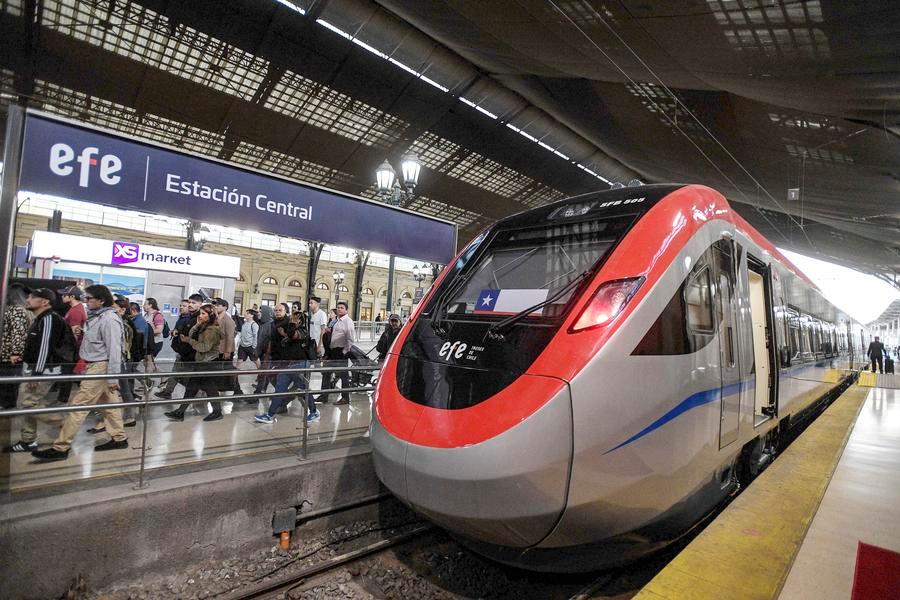
An electric and combustion dual-power train manufactured by China Railway Rolling Stock Corporation (CRRC) Qingdao Sifang Co., Ltd. awaits departure at the central station in Santiago, Chile, Jan. 19, 2024. (Photo by Jorge Villegas/Xinhua)
Eduardo Regalado, a researcher at the International Policy Research Center of Cuba, said the steady growth of China-LAC relations is a driving force for Global South self-reliance, creating trade, financial and technological pathways that benefit the developing world.
In December, China released its third Policy Paper on Latin America and the Caribbean, laying out goals and priority areas for cooperation under new circumstances.
The policy paper said China stands ready to join hands with Latin America and the Caribbean to promote the five programs on solidarity, development, civilization, peace and people-to-people connectivity to advance shared development and revitalization, and write a new chapter in building a China-LAC community with a shared future.
Marcos Pires, a professor of political economy at Sao Paulo State University, said the document is widely expected to inject new vitality into China-LAC ties and expand cooperation in technological innovation, the green economy and regional governance.
Across the region, Belt and Road cooperation has delivered tangible results.
At Peru's Chancay Port, South America's first green smart port, container throughput exceeded 270,000 twenty-foot equivalent units (TEUs) in its first year of operation, while bulk cargo surpassed 1.366 million tons, making it Peru's third-largest port. The project has become a symbol of mutually beneficial China-LAC cooperation and improved regional connectivity.
In Cuba, all photovoltaic stations of the 35 MW Chinese-assisted solar project went online, boosting energy security and accelerating the green transition.
People-to-people exchanges have grown stronger, injecting new vitality into cultural dialogue. China and LAC countries have jointly advanced the Global Civilization Initiative and successfully held the 8th China-LatAm civilization dialogue.
China has granted visa-free access from June 1 to holders of ordinary passports from Brazil, Argentina, Chile, Peru and Uruguay -- boosting travel and mutual understanding.
China's high-quality development and high-standard opening-up offer greater cooperation opportunities for Global South nations, helping Latin America advance economic transformation and sustainable development while promoting the building of a China-LAC community with a shared future, said Juan Carlos Capunay, former executive director of the Asia-Pacific Economic Cooperation (APEC) Secretariat and former Peruvian ambassador to China.
Photos




Related Stories
- U.S. urged to reflect on its hegemony over LatAm, Caribbean: Chinese foreign ministry
- News photography exhibition featuring China-Mexico exchanges kicks off in Mexico City
- Mexican Senate president says willing to strengthen media, cultural exchanges with China
- Mexico firmly opposes U.S. remittance tax proposal
- San Marcos Fair Livestock Exhibition held in Aguascalientes, Mexico
Copyright © 2026 People's Daily Online. All Rights Reserved.
