



Technology fuels Shandong's push to become modern fishery powerhouse
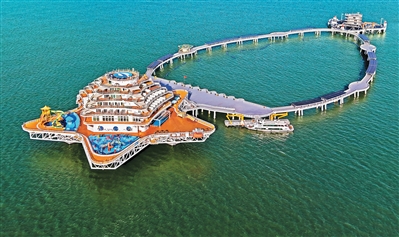
Photo shows the "Genghai No. 1" marine ranch complex off the coast of Laishan district, Yantai city, east China's Shandong Province. (Photo/Sun Wentan)
In recent years, east China's Shandong Province has accelerated efforts to become a modern fishery powerhouse through technological innovation and coordinated land-sea development, driving high-quality growth in the sector.
At the Nanhuangcheng Island National Marine Ranch Demonstration Zone in Changdao, Shandong, deep-sea cages from the Jinghai series, independently developed by CIMC Raffles Offshore Ltd., dot the surrounding waters.
"Jinghai 005," a large intelligent deep-sea cage, measures 68 meters in both length and width, with a cultivation volume of 94,000 cubic meters, capable of holding 1 million black sea bream, according to Liu Yulei, manager of the Jinghai Series Intelligent Deep-sea Aquaculture Platform.
Daily operations of the platform require just two people. Following Liu into the platform's control room, an engineer monitors a large screen displaying a smart fishery Internet of Things platform, which streams real-time data from more than 500 monitoring points.
"See those blinking red dots? That's the fish school. Through underwater sonar and advanced 'fish facial recognition' technology, we can not only count accurately but also track each fish's length, weight and even health status," Liu said.
The engineer activates the fully automated feeding system. With a simple mouse click, the system analyzes wind direction, water currents and other factors, automatically selecting the optimal feeding port and issuing precise instructions.
"What used to take 10 workers a full day now takes one person half an hour, and feed waste has dropped by more than 40 percent," Liu said. The intelligent system has stabilized fish survival rates above 90 percent while significantly improving product quality.
Technology has not only made fish farming more efficient and manageable but has also enhanced production safety at sea.
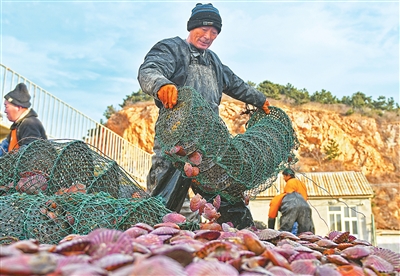
Fishermen sort scallops at a fishing port on Zhifu Island in Yantai city, east China's Shandong Province. (Photo/Sun Wentan)
Off the coast of Laishan district in Yantai city, the "Genghai No. 1" marine ranch complex, invested in and constructed by Shandong Marine Group Ltd., integrates aquaculture and tourism facilities.
"This facility fully adopts the '5G plus marine ranch' model, achieving intelligent management across the entire process, from environmental monitoring to automated feeding. It has enhanced cultivation precision while effectively reducing operational costs," said Zhao Quanfu, senior manager of the safety management department at Shandong Marine Group's Genghai Technology Company.
Beyond smart aquaculture, Genghai No. 1 also serves as a tourist destination. Visitors can book fishing trips via a mobile app, check real-time fish conditions or experience virtual reality "undersea tours." A marine fishery exhibition hall features interactive displays that appeal to children and adults alike.
"Genghai No. 1 combines dining, accommodation, transportation, tourism, shopping and entertainment, achieving integrated development," Zhao said.
Lanshan district in Rizhao city has turned its attention to recreational sea fishing, capitalizing on abundant fishery resources restored through marine ranches. The local government funds training programs to guide fishermen toward career transitions. Many former fishermen, including Song Youjin from Guancaowang village, have become sea fishing guides or fishery guesthouse owners.
"Now instead of chasing fish, we wait at our ranch for customers to come," Song said. Today, sea fishing in Lanshan has spurred the development of guesthouses and dining establishments in coastal villages, with annual revenue exceeding 200 million yuan ($27.5 million).
At the Tuoyang Fishery Cooperative in Taoluo town, Donggang district of Rizhao, more than 30 types of highly processed foods have been developed, including shrimp balls. "When seafood is processed, its value doubles," said Fu Guanqiang, head of the cooperative.
The key to this value addition lies in the cooperative's integration of four neighboring fishing villages, forming a complete chain from cultivation and processing to sales. The key to expanding markets has been e-commerce livestreaming.
Currently, the cooperative engages fishermen from more than 750 households in 23 surrounding villages through contracts and employment, helping increase each household's income by more than 25,000 yuan.
In late 2023, the establishment of the Changdao "Blue Granary" Marine Economic Development Zone was approved, making it China's first offshore economic development zone. Working in tandem with enterprises, Changdao has built a national-level marine ranch and an intelligent aquaculture system, shifting the development approach from "taking from the sea" to "protecting the marine ecological environment."
According to an official with the Department of Agriculture and Rural Affairs of Shandong Province, Shandong has built 71 national-level marine ranches, accounting for 38 percent of the national total.
Thanks to measures including summer fishing moratoriums, the release of fish fry and the construction of marine ranches, fishery resources and ecological conditions have markedly improved. By developing integrated aquaculture systems that cultivate multiple species together, the province has created a number of eco-friendly ocean farms spanning 10,000 mu (667 hectares) to 100,000 mu.
"Moving forward, we will coordinate efforts to improve both the quality and reasonable growth of the fishery sector, and comprehensively build a modern fishery system featuring strategic planning, advanced equipment, and green, safe, intelligent and efficient development, providing solid support for ensuring the effective supply of important agricultural products," said Song Wenhua, deputy director of the Department of Agriculture and Rural Affairs of Shandong Province.
Photos
Related Stories
Copyright © 2026 People's Daily Online. All Rights Reserved.
