



Chinese researchers successfully cultivate self-glimmering plants

A researcher prepares to transfer a tray of self-glimmering plants into a dark room for observation at the laboratory of Magicpen Bio in Hefei, east China's Anhui Province, Dec. 3, 2025. Chinese researchers have successfully cultivated a number of gene-edited plants that steadily glimmer in dark environments. They managed to introduce gene fragments from organisms such as fireflies into plant cells, allowing the latter to glimmer by themselves. (Xinhua/Zhang Duan)

A reseacher checks the growth of seedlings at the laboratory of Magicpen Bio in Hefei, east China's Anhui Province, Dec. 3, 2025. Chinese researchers have successfully cultivated a number of gene-edited plants that steadily glimmer in dark environments. They managed to introduce gene fragments from organisms such as fireflies into plant cells, allowing the latter to glimmer by themselves. (Xinhua/Zhang Duan)

This undated file photo shows self-glimmering plants cultivated by Magicpen Bio in Hefei, east China's Anhui Province. Chinese researchers have successfully cultivated a number of gene-edited plants that steadily glimmer in dark environments. They managed to introduce gene fragments from organisms such as fireflies into plant cells, allowing the latter to glimmer by themselves. (Magicpen Bio/Handout via Xinhua)

This undated file photo shows self-glimmering plants cultivated by Magicpen Bio in Hefei, east China's Anhui Province. Chinese researchers have successfully cultivated a number of gene-edited plants that steadily glimmer in dark environments. They managed to introduce gene fragments from organisms such as fireflies into plant cells, allowing the latter to glimmer by themselves. (Magicpen Bio/Handout via Xinhua)

A reseacher checks the growth of seedlings at the laboratory of Magicpen Bio in Hefei, east China's Anhui Province, Dec. 3, 2025. Chinese researchers have successfully cultivated a number of gene-edited plants that steadily glimmer in dark environments. They managed to introduce gene fragments from organisms such as fireflies into plant cells, allowing the latter to glimmer by themselves. (Xinhua/Zhang Duan)
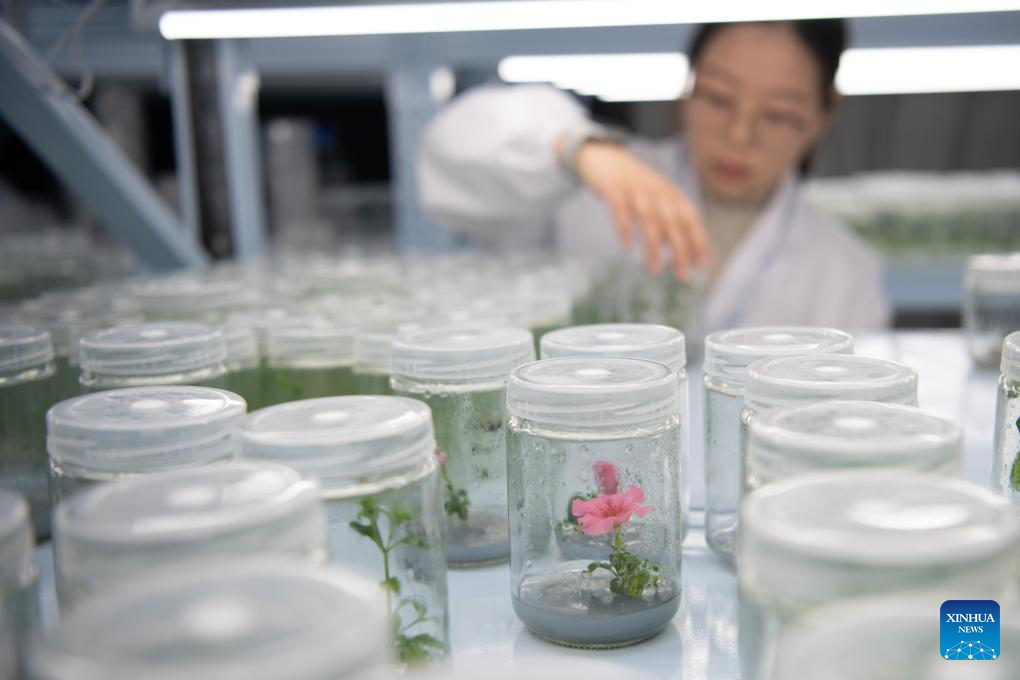
A reseacher checks the growth of seedlings at the laboratory of Magicpen Bio in Hefei, east China's Anhui Province, Dec. 3, 2025. Chinese researchers have successfully cultivated a number of gene-edited plants that steadily glimmer in dark environments. They managed to introduce gene fragments from organisms such as fireflies into plant cells, allowing the latter to glimmer by themselves. (Xinhua/Zhang Duan)

This photo taken on Dec. 3, 2025 shows self-glimmering sunflowers cultivated by Magicpen Bio in Hefei, east China's Anhui Province. Chinese researchers have successfully cultivated a number of gene-edited plants that steadily glimmer in dark environments. They managed to introduce gene fragments from organisms such as fireflies into plant cells, allowing the latter to glimmer by themselves. (Xinhua/Zhang Duan)

A reseacher checks the growth of seedlings at the laboratory of Magicpen Bio in Hefei, east China's Anhui Province, Dec. 3, 2025. Chinese researchers have successfully cultivated a number of gene-edited plants that steadily glimmer in dark environments. They managed to introduce gene fragments from organisms such as fireflies into plant cells, allowing the latter to glimmer by themselves. (Xinhua/Zhang Duan)
Photos




Related Stories
- World's first gene-edited black goat fit for hot days
- Chinese researchers uncover gene defect as key driver of lupus
- China's gene therapy research making strides to restore sight for RP patients
- China carries out world’s first gene-edited whole pig liver xenotransplantation surgery in brain-dead patient
- Chinese researchers find new gene enhancing wheat yields in saline soils
- Chinese, U.S. scientists identify gene flow of modern humans with Neanderthals
- China's home-developed deep-sea biological gene sequencer completes sea trial
Copyright © 2026 People's Daily Online. All Rights Reserved.
