



Europe decries "political war" over new U.S. national security strategy
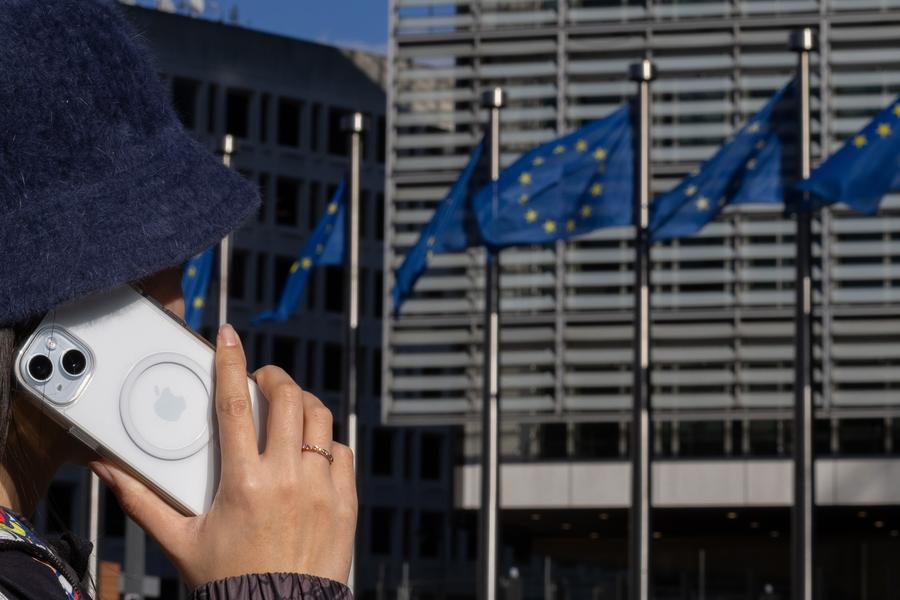
A woman talks through an iPhone at the Berlaymont building, headquarters of the European Commission, in Brussels, Belgium, on March 4, 2024. (Xinhua/Meng Dingbo)
* Washington now believes that a weaker, more divided Europe, with a more assertive U.S. influence on its internal politics, serves American interests.
* "I think they are weak," Trump said in an interview with POLITICO at the White House on Monday, referring to European leaders. "I think they don't know what to do ... Europe doesn't know what to do."
* Behind the ideological clash lie older anxieties about hard security: Europe's defense spending, NATO's strategic direction and the future of the conflict in Ukraine.
* While NATO and Ukraine expose older rifts, Europe's push for digital regulation has triggered a set of new tensions.
BRUSSELS, Dec. 10 (Xinhua) -- European politicians and analysts are accusing Washington of waging a "political war" on Brussels after U.S. President Donald Trump's administration unveiled a new national security strategy, pledging support for "patriotic European parties" and aiming to "cultivate resistance" to the continent's current direction.
The 33-page document, traditionally issued once per presidential term, treats Europe less as a longstanding ally and more as a continent at risk of "civilizational erasure." It criticizes Europe for being hindered by "regulatory suffocation," vulnerable to migration pressures, and politically fragmented.
For many in Brussels, the message is clear: Washington now believes that a weaker, more divided Europe, with a more assertive U.S. influence on its internal politics, serves American interests.
WAR, THREAT, HYBRID ATTACK
"I think they are weak," Trump said in an interview with POLITICO at the White House on Monday, referring to European leaders. "I think they don't know what to do ... Europe doesn't know what to do."
The U.S. strategy document blames transnational bodies such as the European Union (EU) for undermining "political liberty and sovereignty," warns that migration is transforming the continent, and laments "censorship of free speech and suppression of political opposition."
"Should present trends continue, the continent will be unrecognizable in 20 years or less," the document says, questioning the long-term reliability of some NATO members.
It declares that the United States will "cultivate resistance to Europe's current trajectory within European nations" and support those seeking to "restore their former greatness."
Former EU foreign policy chief Josep Borrell said the strategy amounted to a "declaration of political war," arguing that Trump wants a Europe "divided into nations, subordinate to his demands and voting preferences."
European leaders, he said, must treat Trump as an adversary and reinforce the EU's autonomy in technology, security and foreign policy.
European Council President Antonio Costa cautioned Washington against interference. "Allies must act as allies," he wrote on the social platform X. "What we cannot accept is interference in Europe's democratic life."
Pawel Zerka, a senior policy fellow at the European Council on Foreign Relations, called the document "a guide to Trump's culture war with Europe," saying that the United States had abandoned the pretence of staying out of Europe's domestic politics and now frames interference as benevolence: an effort to keep "Europe European."
Other analysts said the document is unusually explicit in signalling Washington's preferred political partners.
Fabian Zuleeg, chief executive of the European Policy Center (EPC), and his colleague Janis Emmanouilidis warned that the strategy "blatantly" aligns with illiberal forces and uses language to approach a "regime-change agenda."
In their view, the United States is attempting to replace its democratic model with illiberal populism, making America "an adversary and a visible threat" to Europe's freedoms and values.
Sven Biscop, who heads the "Europe in the World" program at Belgium's Egmont Institute, labelled the document a "hybrid attack."
"In other words, the Trump administration will continue, and likely even increase, its active interference in our elections, in support of the anti-democratic extreme-right forces, and against the EU," he said, "that is a hybrid attack as unwelcome."
Obviously, European leaders are going to stand for direct political intervention in their politics, said Max Bergmann, researcher with the Center for Strategic and International Studies in Washington, D.C., warning that the national security strategy could "trigger a major collision and potentially the end of the alliance."
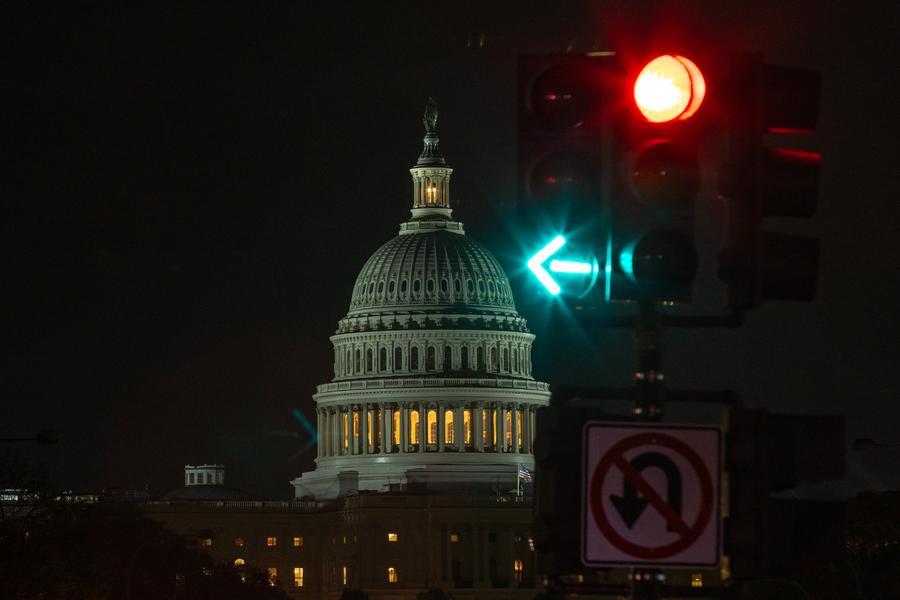
This photo taken on Nov. 9, 2025 shows the U.S. Capitol in Washington, D.C., the United States. (Xinhua/Hu Yousong)
OLD FEARS: NATO AND UKRAINE
Behind the ideological clash lie older anxieties about hard security: Europe's defense spending, NATO's strategic direction and the future of the conflict in Ukraine.
At the Munich Security Conference in February, U.S. Vice President J.D. Vance blasted European governments for pursuing utopian policies on migration while under-investing in their militaries. Delivered on one of the most prominent stages in transatlantic diplomacy, the speech was widely read as an early preview of the arguments now codified in the U.S. National Security Strategy.
The newly published strategy reiterates Trump's demand that allies sharply increase military expenditure, citing the "Hague Commitment" under which NATO members pledged to move toward spending 5 percent of GDP on defense. The strategy insists Europe must "stand on its own feet" and take primary responsibility for its security.
At the same time, it questions "the perception, and the reality, of NATO as a perpetually expanding alliance" and emphasizes "reestablishing strategic stability with Russia." Negotiated settlement of the Ukraine crisis, economic stabilization and preventing escalation are presented as core U.S. interests.
The text also portrays some European capitals as clinging to "unrealistic expectations for the war" while being run by "unstable minority governments."
Such language alarms governments in northern and eastern Europe.
Mika Aaltola, a Finnish member of the European Parliament, said the strategy reshapes the foundations of European security by signalling that U.S. support will be conditional on American interests.
Biscop warned that the strategy amounts to a "conciliatory stance toward Russia," leaving Europe "truly on its own" in Ukraine.
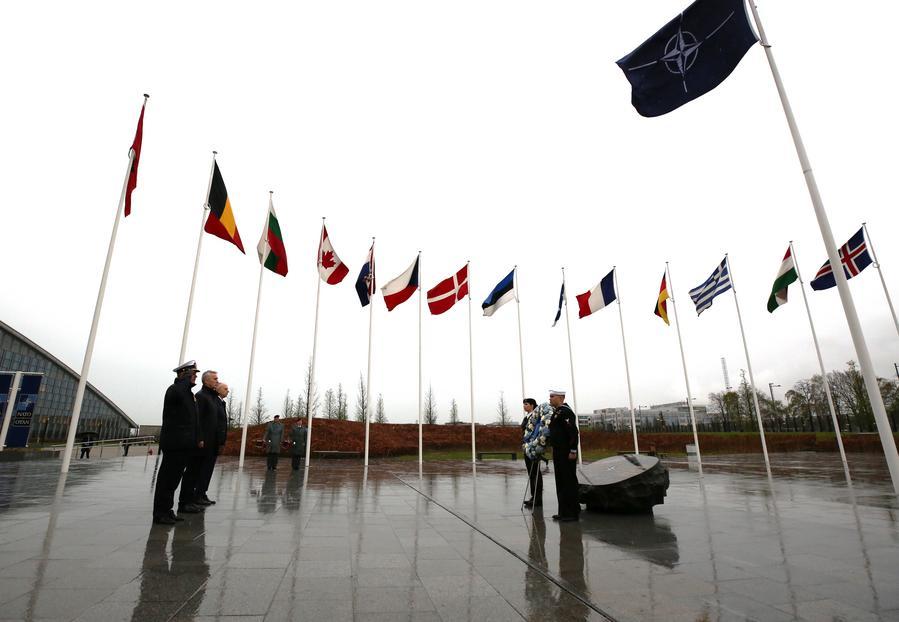
This photo taken on April 4, 2024 shows a wreath-laying ceremony at the North Atlantic Treaty Organization (NATO) headquarters in Brussels, Belgium. (Xinhua/Zhao Dingzhe)
DIGITAL WARS AS NEW FLASHPOINT
While NATO and Ukraine expose older rifts, Europe's push for digital regulation has triggered a set of new tensions.
The EU has spent the past few years rolling out a new regulatory toolkit, including the Digital Services Act (DSA) and Digital Markets Act, to police online content and curb the market power of major tech companies.
Last week, the European Commission imposed a 120-million-euro (140-million-U.S.-dollar) fine on Elon Musk's social media platform X, formerly Twitter, in its first non-compliance decision under the DSA.
The Commission has also opened a formal antitrust investigation into Meta and launched a separate probe into whether Google has breached EU competition rules on Tuesday.
The U.S. response has been unusually strong. Musk wrote on X that "the EU should be abolished," while U.S. Secretary of State Marco Rubio said the fine on X was "an attack on all American tech platforms and the American people by foreign governments."
Deputy Secretary of State Christopher Landau reposted Rubio's comments, writing that what worried him most was that the United States is "in a military alliance with the very countries attacking us via the EU."
"We cannot pretend that we are partners while those nations allow the EU's unelected, undemocratic, and unrepresentative bureaucracy in Brussels to pursue policies of civilizational suicide," he said.
Trump on Monday called the fine "nasty" and said, "Europe is going in some bad directions."
For European analysts, the episode shows how quickly digital regulation has become entangled with broader questions of power and identity.
Zuleeg and Emmanouilidis described Trump's approach as a form of "digital imperialism," which is aimed at sweeping away European constraints on U.S. tech giants and, in the process, opening the digital sphere further to illiberal forces.
The EPC warns that illiberal forces in Europe are "increasingly organized, connected and resourced" and are likely to feel emboldened by a U.S. strategy that pledges to support "patriotic European parties" while attacking EU institutions and rules.
The United States, once the "fiercest advocate of European political and economic integration" after World War II, has shifted its foreign policy toward the continent dramatically and called for direct intervention in the democratic politics of its European allies, said Bergmann.
Photos




Related Stories
- "Weak" people leading "decaying" Europe: Trump
- U.S.-Europe split widens over tech fines, new U.S. security strategy
- Predictable, open, and rules-based industrial policy is Europe's best guarantee of security
- Europe’s reliance on Asian APIs reflects complementarity, not risks
- Eurozone inflation holds steady at 2 pct in July, despite regional variations
Copyright © 2026 People's Daily Online. All Rights Reserved.
