
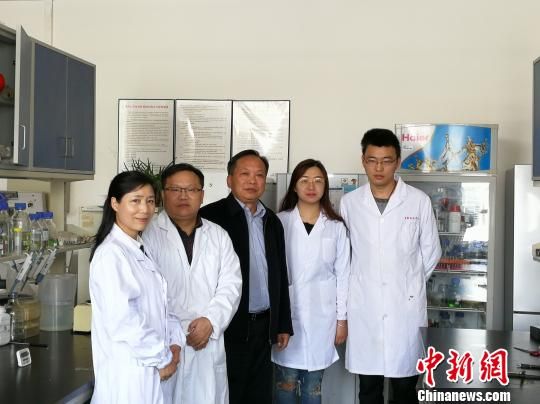
Hunan University (HNU) announced on April 1 that a team of scientists led by Prof. Liu Xuanming from HNU College of Biology, Yang Yuanzhu from Hunan Yahua Seeds Science Academy, and Li Laigeng from Institute of Plant Physiology and Ecology, Chinese Academy of Sciences identified a gene named STRK1 (salt tolerance receptor-like cytoplasmic kinase 1) that limits yield losses in rice plants exposed to salt stress and deciphered the underlying mechanism.
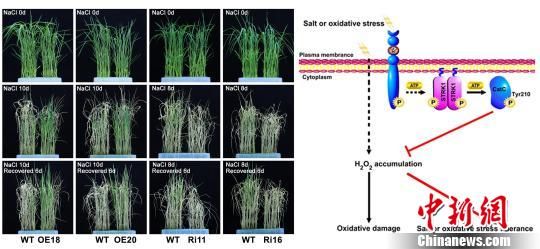
Related research findings were published on PlantCell that ranked first in impact among journals publishing primary research in the plant sciences.
Soil salinity poses a major threat to plant growth and food security. Improving salt tolerance in plants is the common pursuit of global botanists.
HNU team conducted a five-year research on how to improve slat tolerance in rice. “The findings will provide theoretical direction and technical support for breeding salt-tolerant rice varieties,” said HNU College of Biology Associate Professor Li Jianzhong, research member of Prof. Liu Xuanming’s team.
Please refer to www.enghunan.gov.cn when using the article.
Translator: Xiao Juan
Chinese source: hn.chinanews.com
 Fishermen build wall with 2,000 fish in Jilin
 In pics: Americans in 2017
 In pics: Longzhou Danxia landform in NW China
 China's "four great new inventions" in modern times
 Chinese brand becomes largest handset provider in Africa
 Busty Lais Ribeiro steals the Victoria's Secret Fashion Show
 Highlights Victoria's Secret Fashion Show in Shanghai
 China's first cross-sea rail-road bridge takes shape
 A fancy world painted on fallen leaves
 Top 10 most sustainable cities in China
 Top 10 European patent applicants in 2016
 The power of 'She' in China
 Seven most beautiful art museums in China
 Beijing must make clear bottom line on Taiwan question
 89-year-old nude model keeps posing with pride despite opposition from family
 Tattooed musicians told to cover up following ban on footballers in China
 Attendees at Boao Forum for Asia see China making ‘significant headway’
Day|Week


