
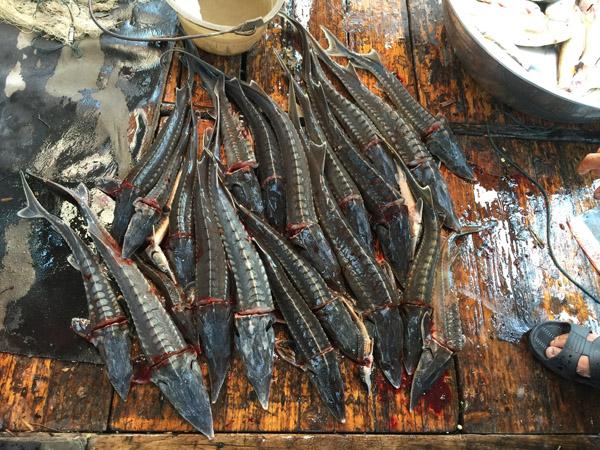
The at-large farm sturgeons found in Yangtze River on July 29
Nearly 10,000 tons of carnivorous farm sturgeons escaped in Central China’s Hubei province during a flood discharge on July 19, 2016, posing an extremely severe threat to over 300 indigenous fish species in the Yangtze River. Among the 300 species is the already endangered Chinese sturgeon. Whose fault is this?
A report from thepaper.cn pointed to a time gap between the warnings received by farmers and the records kept by Hubei Flood Control and Drought Relief Headquarters (FCDRH).
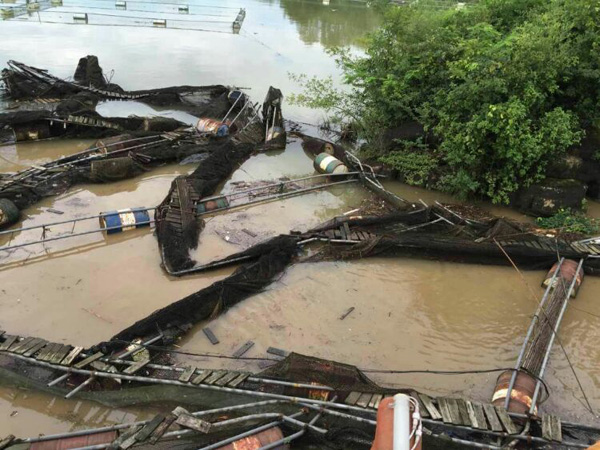
The local sturgeon farm remained a mess after the flood discharge.
A Geheyan Reservoir flood discharge slammed the farm cages in the Qingjiang River, a branch of the Yangtze River in the Hubei province, on July 19th. At 4:40 p.m., local farmers received a text message warning that the discharge volume would be 8,800 cubic meters per second. But Hubei FCDRH has a record saying the order to discharge flood arrived at 5:28 p.m., and that the discharge volume should be no larger than 6,610 cubic meters per second.
Thepaper.cn contacted the local Aquatic Products Bureau several times to verify how the discrepancy came about, but received no direct reply.
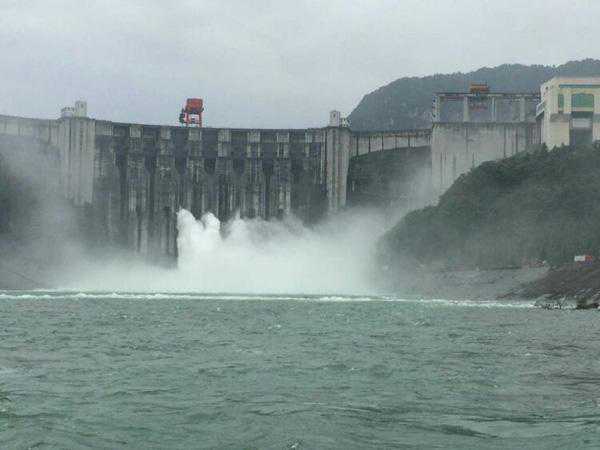
Geheyan Reservoir
Hubei Qingjiang Hydroelectric Development Co., Ltd, the company who is running the Geheyan Reservoir, said that they have “strictly followed the orders given by the FCDRH”, and that they have “informed all the relevant institutions in a timely manner.” That means the warning from the company only reached institutions, and not individuals. It would take the government more time to inform individual farmers.
Plus, records show that the company increased the discharge volume at 5:46 p.m., and reported the increase to the FCDRH only afterwards, at 5:49 p.m.
Farmers believe the crisis could have been avoided with an advanced warning.
However, FCDRH and the company have both emphasized that the flood was the heaviest on record, which it was, and that the steep mountains where the Qingjiang River is located restricted the timeframe for developing an accurate forecast to only 3 hours. The escape of so many sturgeons was purely a “severe natural disaster,” said Jin Wenxia, an official from Qingjiang Hydroelectric Development Company.
There are over 300 types of wild fish in the Yangtze. Each one has struck their own balance with the ecosystem over thousands of years of evolution. How this influx of an alien predator will affect this balance, and to what extent, remains a serious concern.
Besides an imbalanced ecosystem, there is yet another fear: genetic pollution. The critically endangered Chinese sturgeon in the river may mate with the farm fish, making a purebred Chinese sturgeon nearly impossible to find.

 Who Will Fit The Chinese Roles In Game Of Thrones?
 China's Hubei Shennongjia added to World Heritage List
 Cute Dog At Fruit Stand Becomes Latest Internet Sensation
 Top 10 livable Chinese cities
 The last primitive tribe in China
 China's first intelligent security robot debuts in Chongqing
 A Total of 3,552 Subscribers Vanish In Two Days; YouTube Closes All Doors to Users’ Inquiries
 Out of this world! Futuristic UFO-shaped yacht has its own garden and a stunning underwater viewing deck
 An old tea house in Chengdu
 Furious Customer Crushes All the Buns from Vendor Just Because He Was Given the Wrong Flavor


