
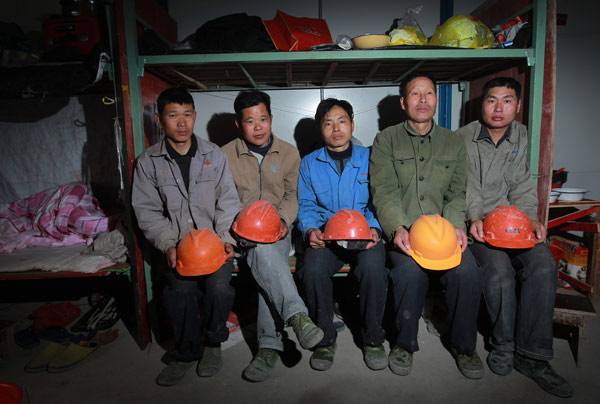
According to a recent survey, 66.1 percent of Chinese migrant workers want to go back to their hometowns by the time they reach a certain age. Given that such a high ratio of migrant workers are reluctant to become urban residents, many people are curious about the reasons behind this preference.
Data from the Chinese Academy of Social Sciences (CASS) reveals the top five motives behind migrant workers returning home: growing older, being unable to take care of kids and aging parents while far away, lacking skills necessary for advancement, being unable to help farm work while far away, and being unfamiliar with cities and towns.
Not all migrant workers in big cities want to become urban residents, and the same goes for migrant workers in smaller counties, said Li Yang, Deputy President of CASS in an interview. Li said that a lot of migrant workers do not want to give up their rural residency status because it entitles them to contracted land, rural house sites and an allocation of collective earnings.
Chinese farmers worry about what benefits they will get if their statuses are changed. Thus, the key to persuading more farmers to change their status would be making farmers eligible for benefits as urban residents, said Li Guoxiang, a research fellow at CASS, in an interview with People's Daily.
Li Guoxiang believes that China should improve its social security system so that Chinese farmers will not have to rely on family members as their major source of financial support in the future. In addition, Li says migrant workers should have access to affordable housing programs and urban public services.
The Chinese government attaches great importance to the careful development of urbanization. Premier Li Keqiang pointed out that China must make progress in both urbanization and agricultural modernization, but the country has to balance development between urban and rural areas.
Premier Li also mentioned China’s goal of granting urban residency to around 100 million people with rural household registration living in urban areas and other permanent urban residents, completing the rebuilding of both rundown areas and “villages” in cities involving about 100 million people, and enabling around 100 million rural residents to live in local towns and cities in the central and western regions.
This survey was included in Industrialization, Urbanization and Agricultural Modernization in China's Midwest: Situation and Countermeasures, a book recently published by CASS.
 The evolution of J-10 fighter
 Top 10 Asian beauties in 2016
 What's happening in Xisha Islands?
 When female soldiers meet flowers
 North Sea Fleet conducts drill in West Pacific Ocean
 Old photos record the change of Sichuan over a century
 Breathtaking aerial photos of tulip blossoms in C China
 Horrific: Pit swallows 25 tons of fish overnight
 Vietnamese Su-30 fighters fly over Nanwei Island in South China Sea
 Top 20 hottest women in the world in 2014
 Top 10 hardest languages to learn
 10 Chinese female stars with most beautiful faces
 China’s Top 10 Unique Bridges, Highways and Roads
 Affection for young actors takes root, who says you have to be a teen to be a fan?
 High-end brands closing mainland stores as Chinese spend more overseas
 Private detectives cash in on China’s rampant marital infidelity
 HRW meddles ineptly in deportation case
Day|Week


