
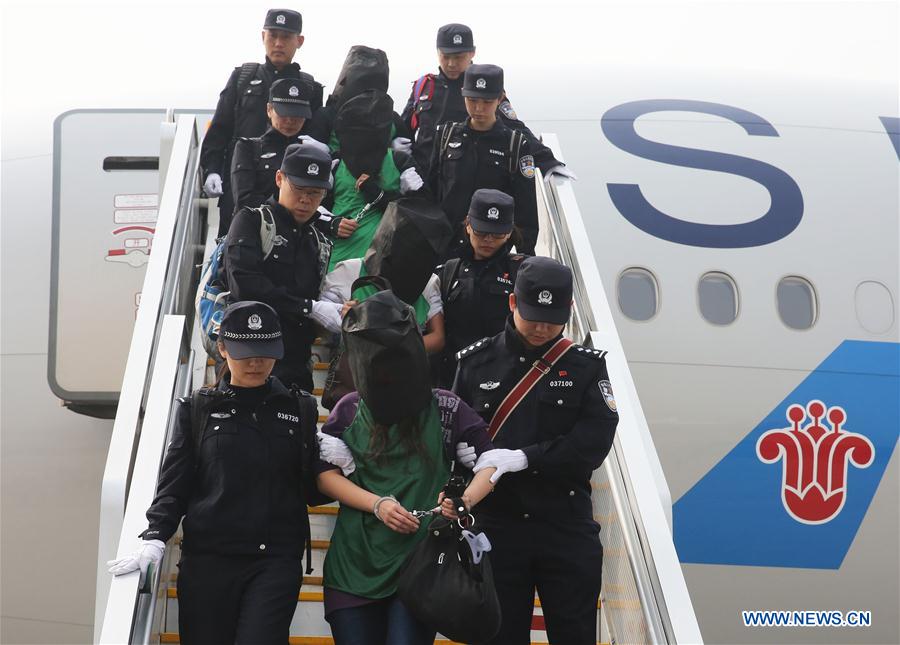
BEIJING, April 13, 2016 -- Chinese telecom fraud suspects deported from Kenya get off a plane after arriving at the Beijing Capital International Airport in Beijing, capital of China, April 13, 2016. Kenyan police deported 77 Chinese telecom fraud suspects, including 45 Taiwanese, to the Chinese mainland. The first group of 10 people had been repatriated on Saturday and the remaining 67 were sent back by a chartered plane on Wednesday. (Xinhua/Yin Gang)
BEIJING, April 14 -- Kenya's deportation of Taiwanese telecom fraud suspects to the Chinese mainland within the past week was lawful and reasonable, according to legal observers on the mainland.
There were 45 Taiwanese among 77 Chinese alleged fraud syndicate members who arrived in the mainland on Saturday and Wednesday. It is the first time that China has such a large group of telecom fraud suspects repatriated from Africa.
"As all victims are from the mainland, judicial organs on the mainland have legal rights of jurisdiction over the repatriated Taiwanese suspects, according to the principle of territorial jurisdiction required in international criminal litigation," said Lin Wei, vice president of China Youth University of Political Studies.
The deportations have sparked debate in Taiwan about the mainland's jurisdiction in the case. Mainland authorities said Taiwan has been too lenient in its handling telecom fraudsters in the past.
In many of the cases handled by Taiwan's judicial organs, suspects were not brought to justice and victims on the mainland were unable to retrieve their lost money, according to the Ministry of Public Security.
Quite a few Taiwanese suspects were released as soon as they were returned to Taiwan and some resumed their wrongdoing soon after, said Liu Huawen, assistant director of the Institute of International Law under the Chinese Academy of Social Sciences.
"They have caused a tremendous loss to people on the Chinese mainland," said Liu.
"Telecom fraud has been regarded as quite a petty act of swindling in Taiwan, with short prison sentences and light financial penalties," said Fan Chongyi, a professor at China University of Political Science and Law.
Taiwanese authorities should be tougher on such criminals, Fan said.
 The evolution of J-10 fighter
 Top 10 Asian beauties in 2016
 Train rides through blossoms
 When female soldiers meet flowers
 North Sea Fleet conducts drill in West Pacific Ocean
 Old photos record the change of Sichuan over a century
 Breathtaking aerial photos of tulip blossoms in C China
 Horrific: Pit swallows 25 tons of fish overnight
 Police officers learn Wing Chun in E. China
 Top 20 hottest women in the world in 2014
 Top 10 hardest languages to learn
 10 Chinese female stars with most beautiful faces
 China’s Top 10 Unique Bridges, Highways and Roads
 Govt vows reform despite failure of tomb-removal campaign
 New Yorker writer’s Chinese food poem sparks racism ruckus
 Too much skin in Tibet Nude photos taken near sacred lake spark outcry
 China strives to solidify authority over reincarnation of Tibetan Living Buddhas
Day|Week


