
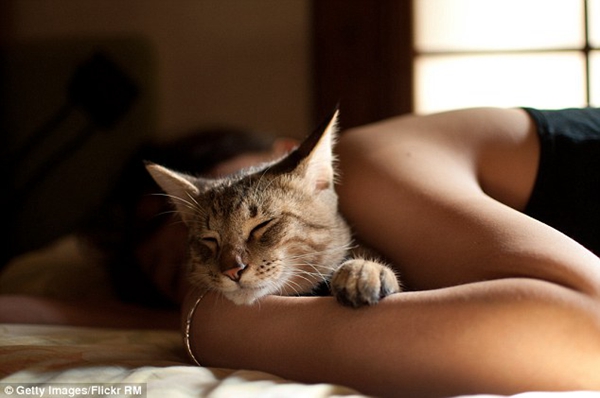
 |
Results from Center for Sleep Medicine at the Mayo Clinic in Scottsdale, AZ
56% of the participants shared their bed or bedroom with a cat or dog
41% said having their pets in bed actually helps them sleep better
Having their pet in the bed relaxed them and made them feel secure
In 2013, 10% partly blamed their animals for their problems
Last year, the Mayo Clinic reported half of the patients that had consultations at its sleep clinic were pet owners who reported being woken up by their furry friends in the middle of the night.
However, today a new study was released that indicates those who cuddle with their cat or dog sleep better.
Researchers surveyed 150 patients about their sleep habits and their pets, and found those who sleep with their cat or dog feel more safe and secure.
But, only 20 percent reported being woken up by their pets and 41 percent said having their pets in bed actually helps them sleep better.
The reason was, having their pet in the bed relaxed them and made them feel secure.
Those who sleep alone felts especially more secure and reported they slept extremely well with their cat or dog under the covers with them.
ARE CAT OWNERS SMARTER THAN DOG OWNERS?
Pet owners have long fought like cats and dogs about whether felines or canines make the best furry companions.
But now a new study claims that cat owners are smarter than dog owners – regardless of their pet's intelligence.
The research revealed that the owners of the two animals tend to have different personalities - with cat lovers being more sensitive and open-minded than dog lovers who are largely energetic.
A study by Carroll University, Wisconsin found that cat owners scored more highly on an intelligence test than dog owners.
Dog lovers tend to be more energetic and outgoing than cat owners and follow rules more obediently, Live Science reported.
Speaking at the annual Association for Psychological Science meeting in Chicago, psychology professor Denise Guastello said that cat owners are more introverted, sensitive and open-minded than dog people. They also tend to be better at breaking rules.
She thinks that the reason for these differences if the types of environment that cat and dog owners are drawn to.
A total of 600 students took a survey to reveal their personality traits and were asked whether they are cat or dog lovers.
Around 60 per cent of people identified themselves as 'dog people' – around six times as many as the number of students who said they love cats.
Around a third of those questioned claimed they liked or disliked both animals equally.
Professor Guastello thinks that people might select a pet based on their own personality so that energetic people are attracted to energetic pets, like dogs.
‘A single 64 year old woman commented that she felt more content when her small dog slept under the covers near her feet, as noted in the study.’
‘Another woman, who was married, described her two small dogs as bed warmers, and a described her cat sleeping on her chest as ‘soothing’.’
Researchers found that 56 percent of pet owners allow their cat or dog to sleep with them at night.
‘Many pet owners view companion animals as family members that they wish to incorporate into as many aspects of their life as possible,’ write the authors of the study.
‘Because humans spend considerable time sleeping, a pet owner's desire to have animals close at night is understandable.’
‘As more households include multiple pets, the challenge of securing appropriate sleeping arrangements is increased.’
Some 10 per cent of pet-owners who attended the clinic’s sleep center in 2013 partly blamed their animals for their problems.
This is up from just 1 per cent in 2002, a sleep conference heard.
The study’s author, Dr Lois Krahn, a psychiatrist, said: ‘The study determined that while the majority of patients did not view their pets intolerably disturbing their sleep, a higher percentage of patients experienced irritation.
‘This may be related to the larger number of households with multiple pets. ‘When people have these kinds of problems, sleep specialists should ask about companion animals and help patients think about ways to optimise their sleep.’
Earlier this year, a study revealed that our beloved companions could give their owners diseases such as tuberculosis, food poisoning and feline conjunctivitis.
f dogs come into contact with an infected cow, get into a fight with a diseased badger or eat meat infected with the bacteria, they can develop tuberculosis — and pass the potentially deadly lung disease on to you.
The risks are tiny, but real. In 2013, a child caught TB from a family dog in Gloucestershire.
The child, who was under ten, made a full recovery, but the dog was put down. Feline Conjunctivitis is the infection of the membrane covering the cat’s eyeball — is a common disease, often caused by the cat version of chlamydia.
This bacterial infection can pass from cats to owners, so it’s best to wash hands after handling a sick cat and not let them rub your face.
 All-star Carnival held in Beijing
 Charming female bodybuilders of Chengdu University
 Polish sports stars strip off for risqué calendar
 Spectacular aerial photos of the Three Gorges
 Contestants of Mrs. Globe pose for photo in Shenzhen
 Bikini models attend hot pot banquet in Hefei
 J-10B fighters with homegrown engine in test fligh
 Photos of U.S. Navy intruding in South China Sea released
 Cats who immediately regretted their life choices in photographs
 Top 20 hottest women in the world in 2014
 Top 10 hardest languages to learn
 10 Chinese female stars with most beautiful faces
 China’s Top 10 Unique Bridges, Highways and Roads
Day|Week