

Kunchok Gyaltsen, founder of the Tongren Natural Birth Center and honorary president of the Arura Hospital in Qinghai province, shows a maternal health handbook. Cheng Yunjie / Xinhua
Resources mobilized
According to Drolkar Ja, the value of the birth center goes beyond offering safe and culturally sensitive delivery to rural women. It also functions as a training workshop to help the local public health authority unleash the power of nonpublic resources in underserved regions.
"When the concept of the natural birth center was first proposed to us in 2006, we didn't expect it to play such a big and positive role," Drolkar Ja said.
"Our biggest concern at that time was that rural and pastoral women might not accept it since they don't even want to go to hospitals. But considering there is only one hospital in Tongren, the medical resources are too limited. We thought it would be worth a try," he said.
With a population of 89,000 scattered over 3,275 square kilometers, Tongren faced a difficult task in improving women's health.
"The birth center remains a rare facility today as many people doubt it can survive. Our initial aim is to realize sustainable operations, attract more people to join the work and help more low-income families," Kunchok Gyaltsen said.
With $90,000 in donations from Kunchok Gyaltsen in startup funds, Tsering Kyi, who is in charge of the center's operations, said she is proud to see the center is self-sustaining.
"In the beginning we lacked money and publicity. There was a time when I felt I could not make it, but when I thought of Kunchok saving money by giving lectures on Tibetan medicine and selling Tibetan calligraphy for charity while studying in the United States, I told myself to hang on," Tsering Kyi said.
To improve the center's publicity and spread health information to rural areas, Kunchok Gyaltsen wrote a script called Lost Happiness, which was made into a TV series. Tsering Kyi played the role of a doctor to spread maternal and childcare knowledge through the TV program.
Kunchok also compiled a handbook of Tibetan-style drawings and pictures to help illiterate Tibetan women understand basic medical information.
In collaboration with local health authorities, more than 300 workshops have been held at the center to teach village and pastoral doctors and midwives, as well as cadres belonging to grassroots women's federations, how to handle emergencies during childbirth.
 |
 J-11 fighters in air exercise
 Beauties dancing on the rings
 Attendants-to-be join Mr. & Miss Campus Contest
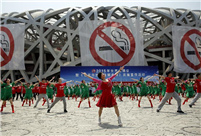 Beijing's toughest anti-smoking law takes effect
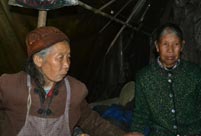 Family lives in cave for about 50 years in SW China
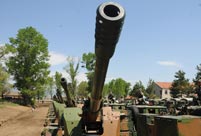 PLA soldiers operating vehicle-mounted guns in drill
 Blind carpenter in E China's Jiangxi
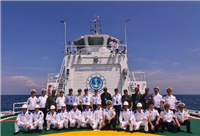 China hosts overseas disaster relief exercise for the first time
 20 pairs of twins who will become flight attendants in Sichuan
 Obama is sowing discontent in S.China Sea
 Rescuers work through night to reach cruise ship survivors
 Driving through limbo
 Facing down MERS
Day|Week