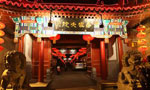
HARBIN, April 9 -- More than 1,500 relics have been excavated at the remains of Japan's notorious Unit 731 headquarters in northeast China's Harbin City, a curator said on Thursday.
Workers unearthed metal and glass vessels after clearing an area of 15,337 square meters at the site of the former complex, said Jin Chengmin, curator of the Museum of Evidence of War Crimes by Japanese Army Unit 731.
The former complex consisted of a bacteria lab and a prison used to house people for biological experiments. It is the core area of the sites of Unit 731.
Unit 731 was a top-secret biological and chemical warfare research base established in Harbin in 1935 as the center of Japan's biological warfare in China and Southeast Asia during WWII. The retreating Japanese invaders blew up the base when the Soviet Union took Harbin in 1945.
A glass and steel structure will be built to cover the remains of the complex as part of the protection plan, said Jin. The project serves to mark the 70th victory anniversary of China's anti-Japanese war as well as the World Anti-fascist War this year.
Harbin has 27 sites related to Unit 731. The ruins of Unit 731 were included on China's tentative list of world cultural heritage sites in 2012.
 J-11 fighters in air exercise
 Beauties dancing on the rings
 Attendants-to-be join Mr. & Miss Campus Contest
 Beijing's toughest anti-smoking law takes effect
 Family lives in cave for about 50 years in SW China
 PLA soldiers operating vehicle-mounted guns in drill
 Blind carpenter in E China's Jiangxi
 China hosts overseas disaster relief exercise for the first time
 20 pairs of twins who will become flight attendants in Sichuan
 Obama is sowing discontent in S.China Sea
 Rescuers work through night to reach cruise ship survivors
 Driving through limbo
 Facing down MERS
Day|Week