Thu,Aug 14,2014
 Amphibious armored vehicle unit conducts open sea drill
 Water relay in Henan
 Ethnic culture feasts eyes of travelers
 80 security dogs assembled in Nanjing police dog training base
 Graffiti artists paint on street walls in Xinjiang
 Story of ceramic artist Zhang Lingyun
 Magic summer night dream in Hongyuan
 Incredible creatures in headwaters drainage region of Lancang River
 The future of rock n' roll seen in young rockers in China
 Magnificent Yanziya Cliff
HARBIN, Aug. 13 -- A museum in northeast China's Heilongjiang Province on Wednesday revealed the testimony of a former driver employed at Japan's notorious Unit 731.
In the video, Sadao Koshi, said he participated in outdoor germ experiments on human beings dozens of times and once 40 people were run over and killed as they tried to escape.
The testimony was donated by Masataka Mori, a professor at Japan's Shizuoka University, who recorded the confessions in 1994, said Jin Chengmin, curator of the Museum of Evidence of War Crimes by Japanese Army Unit 731.
Koshi said, "People were transported to an outdoor experimental field and tied to pillars. Helmets and iron shields were put on them to protect the vital parts of their bodies, leaving only arms, legs and hips outside. then airplanes would drop bombs carrying plague bacillus and collectotrichum."
"When the bombs exploded the bacteria liquid fell like rain, and the victims started to scream," he said.
Koshi said once a man untie himself from the pillar and help others to escape. "We chased them by car and ran them over one by one. Lives are fragile. I can still remember the feeling when I hit them."
As a driver at Unit 731, Koshi went back and forth to pick up "people for experiments" from Harbin Train Station and the Japanese Consulate in Harbin.
"I sometimes went there everyday, sometimes every other day. They would use five to 10 people each day for experiments," Koshi said.
Koshi published a book in 1983 to testify about crimes by himself and Unit 731. Ever since, he has been receiving threatening calls and letters.
"I have to speak the truth, so that if I die there will be no regrets," Koshi said on the video.
Unit 731 was a research base established in Harbin in 1935 as the center of Japan's biological warfare program in China and Southeast Asia.
More than 10,000 people were killed there. Civilians and prisoners of war from China, the Soviet Union, the Korean Peninsula and Mongolia perished at the hands of Japanese scientists.
The retreating Japanese invaders blew up the base when the Soviet army took Harbin in 1945.
 Beijing policewomen posters become a hit
 Armored regiment trains on the sea
 Children spend 'Father's Day' with dads at work
 'Pan Da' appear in Shanghai World Financial Center
 Champions take selfies on podium
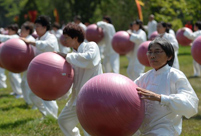 National Fitness Day celebrated around China
 Traditional culture colors summer vacation
 Young athletes fighting for their dreams
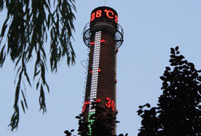 68 meters high thermometer in Shanxi, called ‘fighter’ of thermometers
 The vanishing folk skills
 Intoxicating beauty of Dali, Yunnan province
 Memorable moments of Ludian earthquake
 Bring world together to help elephant
 'Building Dreams'
  Labrang Monastery
Day|Week|Month