
 |
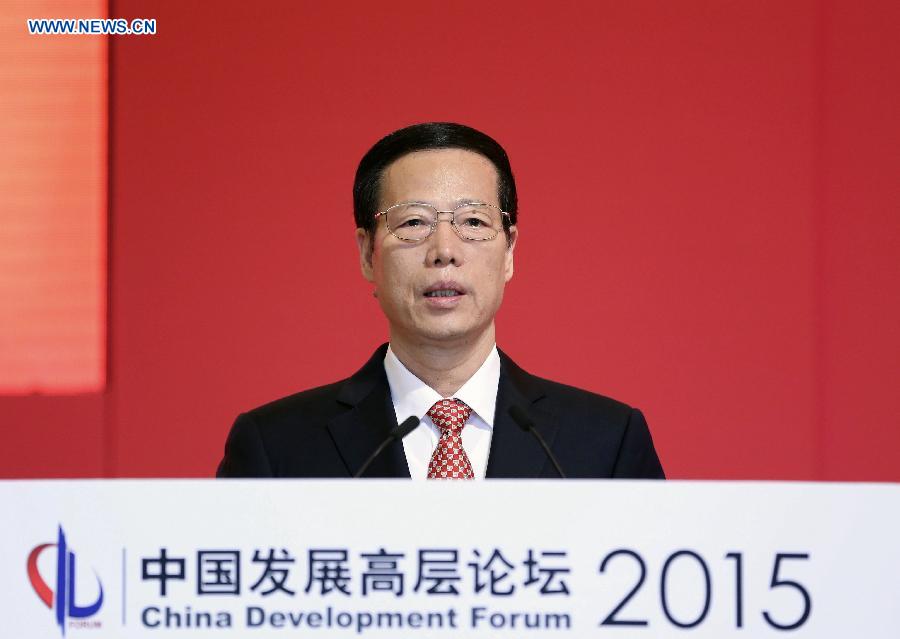
| Vice-premier Zhang Gaoli addresses the opening ceremony of the China Development Forum 2015 held at the Diaoyutai State Guesthouse in Beijing.[Photo by Feng Yongbin / chinadaily.com.cn] |
Mass entrepreneurship and innovation will serve as the twin engines of the country's economic development, said vice-premier Zhang Gaoli at China Development Forum 2015 on Sunday.
The vice-premier added that increased public goods and services will also help serve the economy.
During his speech, Zhang vowed that the country will promote in-depth integration of science and technology with economic and social development, persist in open innovation, and step up intellectual property rights protection.
"Only by promoting entrepreneurship, innovation and creation can China's economy brim with genuine dynamism and vitality," said the vice-premier, adding that innovation is becoming a defining feature of growth.
The country's services sector grew faster than the industrial sector in January and February, the high-tech industry grew faster than the industry as a whole and private investment grew faster than other investments, said Zhang.
In 2014, China's spending on research and development totaled 1.33 trillion yuan ($214 billion), accounting for 2.9 percent of the GDP.
The country will strive to achieve the dual objectives of maintaining a medium-high rate of growth and moving toward a medium-high level of development, said Zhang.
"The growth model featuring high input, high energy consumption and over dependence on external demand is no longer sustainable," said the vice premier, adding that economic growth and upgrading will both contribute to the country's inclusive and sustainable development.
The State Council-backed forum, which is being held at the Diaoyutai State Guesthouse in Beijing from Saturday to Monday, focuses this year on China's economic development under the new normal of slower, more sustainable growth.
Three major strategies to be prioritized
The "One Belt and One Road" initiatives, the Beijing-Tianjin-Hebei region and the Yangtze Economic Belt are to be prioritized, said Zhang Gaoli, China's Vice-Premier at the China Development Forum.
Urban and rural development is so unbalanced that the country will improve policies and measures for regional development, he said.
While per capita GDP of the eastern region is above $10,000, per capita GDP of western provinces is just over $4,000, according to Zhang.
He also said that with such efforts, the country will ensure a new pattern of regional development.
New opening-up for China's FTZs
China will introduce a new foreign investment administration featuring pre-establishment national treatment and negative lists for its four free trade zones (FTZs) in Shanghai, Guangdong, Tianjin and Fujian, said Zhang.
As the country accelerates building a new open economic system and pursues new opening-up under the New Normal, China will do a good job in building the FTZs, he said.
He said that opening-up is an important driving force behind China's long-term economic prosperity and in the New Normal, the country will build an open economy and promote reform and development.
China launched the Shanghai Free Trade Zone in September, 2013, and the country approved the other three FTZs in December last year.
China will also treat domestic and foreign businesses equally on anti-monopoly enforcement and other issues to build a fair, transparent, and predictable business environment, said Zhang.
Following are some of the highlights of Zhang's speech:
-- Development remains China's top task in the New Normal and the country will stay committed to economic development as its central task.
-- China's traditional growth is no longer sustainable in the New Normal and must improve the quality and efficiency of economic growth.
-- China's development in the New Normal is still in the important period of strategic opportunities and the country will achieve sustained and healthy growth.
The New Normal calls for new thinking and new action. Therefore, China should:
-- Deepen reform and unleash new creativity for mass entrepreneurship and innovations.
-- Strengthen innovation-driven development and foster new impetus for sustaining medium-to-high growth rate.
-- Improve spatial layout and foster new economic growth poles and economic belts.
-- Always put people first and meet their new expectation for a increasingly better life.
-- Build a sound ecology and a new modernizaion featuring harmony between human beings and nature.
 |
Day|Week

 Tsinghua junior makes over 10,000 yuan a day by selling alumnae's used quilts
 Graduation photos of students from Zhongnan University
 A school with only one teacher in deep mountains
 Glimpse of cultural heritage "Xilankapu"
 Homemade cured hams in SW China
 Breathtaking buildings of W. Sichuan Plateau
 Graduation photos of "legal beauties"
 Top 10 most expensive restaurants in Beijing in 2015


