
Thu,Dec 18,2014
 Bikini show in 2014 China Final of Miss Tourism World
 Close-up view of August Aerobatic Team
 Goddesses married in 2014
 Polar region photos raise worldwide awareness of global warming
 Get off at the last stop — Beijing Subway in vision
 Top 100 beauties in the world!
 Gallery: Who is the most beautiful one?
 If you like autumn, put your hands in the air!
 Fan Bingbing's "Queen style" in new play
 Lingerie show at 2014 Miss China
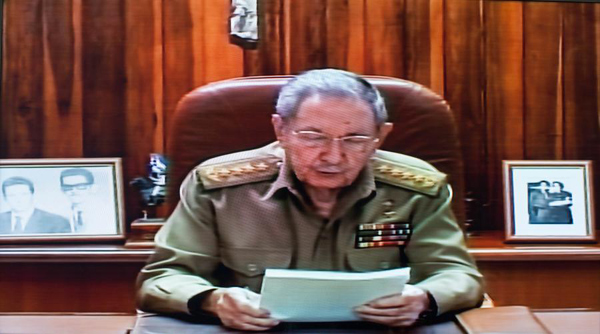 |
| The TV grab taken on Wednesday shows Cuban leader Raul Castro giving a televised speech in Havana, capital of Cuba. Cuban leader Raul Castro confirmed here Wednesday in a special TV appearance that his government and the Obama Administration of the United States had agreed to reestablish the diplomatic relations between the two countries. (Xinhua Photo) |
For China, the restoration of diplomatic relations between the United States and Cuba will bring both opportunities and challenges, experts said.
US President Barack Obama's historic announcement Wednesday to restore diplomatic relations with Cuba — ending more than five decades of estrangement between the two countries — was hailed by Latin American-US experts, saying it is a practical move.
Speaking at the White House, Obama said the US will end "an outdated approach that for decades has failed to advance our interests".
"Instead we will begin to normalize relations between our two countries," said Obama, adding that it will "begin a new chapter among the nations of the Americas".
"Cuba has been used to depending hugely on importing products from China because of the trade embargo by the US," said Wu Guoping, a researcher at the Latin America Institute at the Chinese Academy of Social Sciences. "It may be changed as Cuba will face more options from the US alongside other Latin American countries opening up their markets to the country.
"In many aspects, China will face more competition and won't play the role of solo provider to Cuba," he added. "China can also expect more opportunities in the bilateral trades when the bars are lifted and Cuba show its potential in buying more things."
Zhou Zhiwei, a researcher with the Chinese Academy of Social Sciences institution of Latin America Studies, said the US has paid a lot of attention to the Asia-Pacific area while losing its geopolitical advantages.
"With the rise of China and other BRICs countries, America's presence in Latin America is becoming less prominent," said Zhou. (BRIC stands for Brazil, Russia, India and China.)
China has replaced the US as the largest trading partner and investor in many Latin American countries, which makes the US move toward Cuba a practical one, Zhou noted.
"Not only is it a sign of ending Cold War hostility, but also a signal that the US will keep up its relations with its neighboring countries in Latin America," Zhou said.
Tao Wenzhao, a senior research fellow from the Institute of American Studies at the Chinese Academy of Social Sciences, said the new chapter of US-Cuba relations will be a legacy of the Obama administration.
With the influence of US and China – the world's two largest economies – in the Latin American region, the move will also create new dynamics among the US, China and Cuba on the economic front.
 |
 Joint anti-piracy drill
 Unknown 'monster' fish caught in Shandong
 20 years on: Relocated Three Gorges residents through lens
 Beautiful Chinese woman
 Chestnut girl goes viral online
 PLA HK Garrison veterans leave behind beautiful smiles
 Victoria's Secret Fashion Show
 Representative beauties
 Excellent photos of Zhuhai Air Show
 Blood and terror
 China needs clear strategy to help Russia
 Beijing grapples with overflowing garbage problems
 A roundup of some of the key phrases and events of 2014
Day|Week|Month