
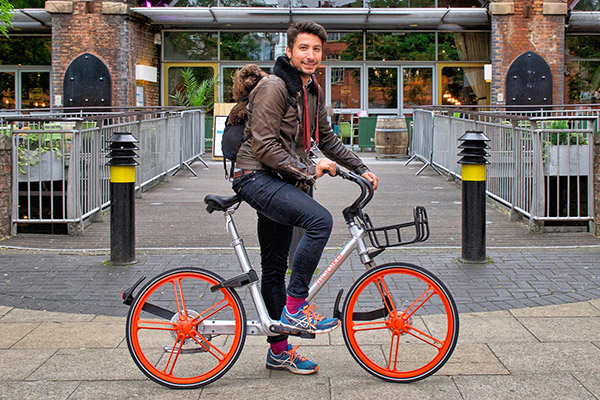
A user rides Mobike's shared bikes in Manchester. [Photo provided to China Daily]
Bike-sharing giant Mobike Technology Ltd, which handles 25 million rides a day in China, looks to be preparing to put riders on its bikes in the US capital, based on its hiring plans in the area.
One of the jobs Mobike posted on professional networking site LinkedIn is for an operations manager, based in Washington, who would need to get to know "the local environment" and "be the main point of contact for the regional government officials and transport authorities", according to The Wall Street Journal.
"We understand there has been market speculation about Mobike's growth plans," Xue Huang, Mobike's head of communication, said in an email reply without confirming the company's plans. "Before we enter any new city, we invest considerable time engaging with local regulators and communities to understand how our smart bike solution can best help address local market needs."
In Washington, Mobike would face competition from Capital Bikeshare, a local company that operates more than 3,700 bikes at 440 stations across five jurisdictions around metropolitan Washington.
Mobike's main Chinese rival, ofo Inc, is also looking at starting operations in the United States. Co-founder Yu Xin said the company is conducting a trial, "but we will also move into official operation soon in several cities." Ofo has said a trial started in California in March.
Ofo operates 6.5 million bikes in more than 150 cities in five countries. It has raised more than $700 million in its latest funding round from investors including Alibaba Group Holding to bring its yellow bikes to 20 million in 200 cities globally by year's end.
In Singapore, the first overseas destination it entered, in February, ofo picked up more than 100,000 customers in just 100 days. It now processes more than 20,000 trips every day involving over 10,000 bicycles.
Mobike, which is backed by Tencent and Apple supplier Foxconn, among others, has raised $600 million recently to expand its business outside of China.
It says it has 5 million bikes in China, processing as many as 25 million trips on peak days, and more than 100 million registered users. It operates in 130 cities across countries that include Japan, Singapore and the United Kingdom, and aims to increase that number to 200 by the end of the year, mainly by expanding internationally.
Both Mobike and ofo offer bike-sharing that allows urban residents to lock and unlock bikes anywhere, without a docking station, via a smartphone app.
But regulations have been a challenge for dockless bike-sharing companies in the US. When Chinese startup Bluegogo International Inc tried to expand into San Francisco in January, it met stiff resistance from local officials. It altered its plans and decided to use private parking spaces instead of public bike racks for its bikes.
Other cities like New York already have agreements with dock-based bike sharing programs such as Citi Bike.
According to a report from research firm Roland Berger last year, bike sharing has become a global business, with about 1,000 operations worldwide. The industry is expected to be worth as much as $5.9 billion by 2020, the report said.
 Magnificent view of Nansha Islands in South China Sea
 Aerial view shows scenery in Hong Kong
 China builds world’s first offshore fish farm
 A Foreigner's Chinese Dream and Love for China
 5,000-year-old Chinese beer recipe goes down a storm in US
 World's first driverless rail transit system unveiled in Hunan
 World's largest cluster of Miao villages in Guizhou
 Daily life in Kashgar, China's Xinjiang
 Top 10 Chinese tech and engineering marvels
 Top 10 most sustainable cities in China
 Top 10 European patent applicants in 2016
 The power of 'She' in China
 Seven most beautiful art museums in China
 China’s law, doctors decide Liu Xiaobo’s treatment
 Village known for exporting replicas of van Gogh, Dali repaints itself as original brand
  Schools making students apply to top colleges to pass local govt tests
 Mini-KTV: A No.1 Hit
 Day|Week


