
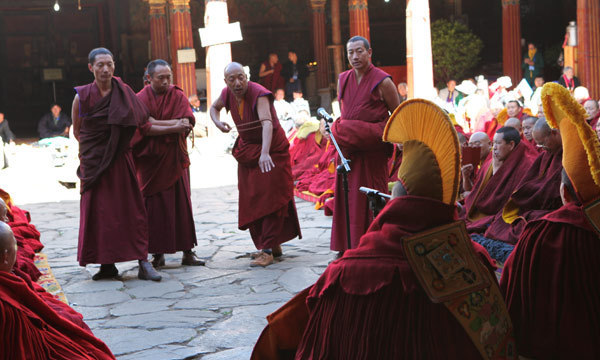
Monks participate in dharma debates in the Jokhang Temple, Lhasa, capital city of Tibet autonomous region. [Photo by Palden Nyima/China Daily]
Religious leaders and scholars in China have voiced support for the government's stance on religions outlined by President Xi Jinping at a top-level conference.
Religious communities were advised to retain their independence and self-management by the president in his speech at the two-day National Work Conference on Religions that ended on Saturday in Beijing.
There are believers from nearly all the world's major religions in China, although nonbelievers comprise the majority of the population. Mu Zhongjian, a professor of religious studies at Renmin University of China, describes China as a "United Nations of all religions".
At the conference, Xi said China is determined to protect its harmonious social relations among believers of various faiths. It also aims to protect believers and nonbelievers from attempted infiltration by external forces and from extremist ideas.
"We should guide and educate the religious circle and followers with socialist core values, and guide religious people with the ideas of unity, progress, peace and tolerance," he said.
At the same time, no religion can interfere with the administrative, judicial and educational functions of the State, the president said, adding that the State must uphold the rule of law when overseeing religious affairs that have a bearing on State or public interests.
Guo Chengzhen, vice-president of the Islamic Association of China, said the national religious conference provided a comprehensive guideline on religions' role in Chinese society.
"Localization for different religions has been discussed in the past, but until the conference, people were not quite clear how this should proceed."
Father Paul Lei Shiyin, the bishop of Leshan diocese in Sichuan province, under the Chinese Patriotic Catholic Association, said the conference had promised to provide the necessary support to various religious groups.
As a result, the Catholic Church in China now stands a better chance of overcoming the difficulties it faces, such as a shortage of clergy and being able to better serve society.
Cao Nanlai, an associate professor of religious studies at Renmin University of China, said the idea of localization is a very inclusive term and may provide enough room for different religions to develop their own innovative practices in China.
"A highlight of the conference was the government's confidence that religious canons and practices-no matter what they are-can be made to serve social harmony and progress, and can work with the core values of the modern China."
Mu, the Renmin University professor, explaining the philosophical root of China's religious policies, said there are different versions of atheism.
The atheism practiced in China not only allows, but respects, religious faiths on the individual level. It is an atheism that is based on equality and inclusiveness, Mu said.
 The evolution of J-10 fighter
 Top 10 Asian beauties in 2016
 What's happening in Xisha Islands?
 When female soldiers meet flowers
 North Sea Fleet conducts drill in West Pacific Ocean
 Old photos record the change of Sichuan over a century
 Breathtaking aerial photos of tulip blossoms in C China
 Horrific: Pit swallows 25 tons of fish overnight
 Vietnamese Su-30 fighters fly over Nanwei Island in South China Sea
 Top 20 hottest women in the world in 2014
 Top 10 hardest languages to learn
 10 Chinese female stars with most beautiful faces
 China’s Top 10 Unique Bridges, Highways and Roads
 Great service or too much
 Reality show sparks anger after endangering relics
 Relocated farmers not provided government services
 ‘Leftover Women’ don’t want to wear stereotyped labels, even proudly
Day|Week


