 |
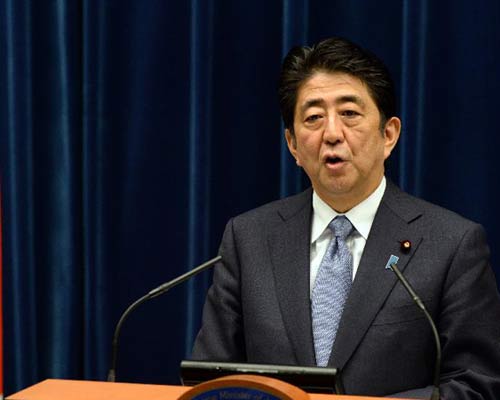
| File photo of Japanese Prime Minister Shinzo Abe |
Many saw Japan's apologies for military aggression during WWII as insufficient, while believing that Germany had apologized profusely, a recent online poll shows.
The survey, released by the Global Times Global Poll Center on Thursday, collected responses from 10,558 residents above 18 years old from 10 countries - the US, the UK, France, Germany, Italy, Russia, South Korea, Japan, Vietnam and China.
The survey on people's knowledge and attitudes of WWII as well as China's role in the war was conducted between May 26 and June 3.
Over 51 percent of respondents said Japan has not made full apologies and some 27 percent held opposite opinion. Among the surveyed, 93.6 percent of the South Koreans, 90 percent of the Chinese and 56.7 percent of the Russians believed Japan failed to express enough regrets.
In the meanwhile, some 79 percent of South Korean respondents and 75 percent of Chinese said Germany fully apologized for its wartime aggression.
The poll results showed that less than a quarter of respondents thought the Japanese government had deeply introspected on its atrocities while over 55 percent were satisfied with the introspection of the German government.
"The results illustrate that the Japanese government has failed to candidly and consistently admit its invasion, and has failed to keep looking into itself. The right-wing historical view has been connived at by the government and mainstream politicians, in stark contrast to the elimination of Nazi influences," said Lu Hao, a research fellow of the Institute of Japanese Studies at the Chinese Academy of Social Sciences.
On the Nanjing Massacre, some textbooks approved by the government in April state that "captives and civilians were involved" in the tragedy and "casualties were exposed," compared to the original words that the Japanese Army "killed many captives and civilians." The phrase "Japan's atrocity was condemned" has been deleted from some books, the Xinhua News Agency reported.
Some 53 percent of the respondents considered the moves to be an evasion of historical responsibilities and distortion of history. About 40 percent said the wrongdoings would lead the next generation astray while 36.6 percent projected that they would incur more regional hostility.
The survey found that Japanese respondents knew much more about the US atomic bombings of Hiroshima and Nagasaki than the Nanjing Massacre and the Lugou Bridge incident (or Marco Polo Bridge) which marked the beginning of the Sino-Japanese War (1937-45).
 'Enemy planes' intercepted by Hongqi-7B air-defense missiles
 Blind date with bikini girls in Nanjing
 Amazing photos of Chinese fighter jets
 Chinese soldiers participate in training for V-Day parade
 Painting: Lonely women in Forbidden City
 China and Russia hold joint drill in Sea of Japan
 'Goddess' in Taiwan McDonald's
 Female soldiers at military parades
 Photos of campus belle doing splits go viral
 Best blade forward
 Infographic: Parsing China's massive V-day parade
 Giant panda cub receives medical care in Guangzhou
 China celebrates 70th Anniversary of Victory of World Anti-Fascist War
Day|Week